Democratic and Republican Lawmakers Introduce Bill
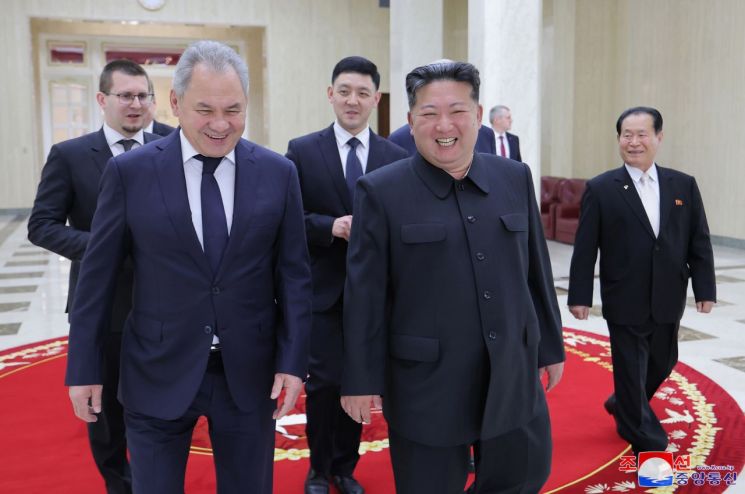 North Korean State Affairs Commission Chairman Kim Jong Un is seen having talks with Sergey Shoigu, Secretary of the Russian Security Council, who visited North Korea on March 21. Photo by Chosun Central News Agency
As signs of strengthened cooperation among North Korea, China, Russia, and Iran emerge, a bill urging the Donald Trump administration to devise measures to counter this trend has been introduced in the U.S. Senate.
According to the U.S. congressional bill information website on May 26 (local time), Senator Christopher Coons (Democrat, Delaware) submitted a bill on May 22 that designates North Korea, China, Russia, and Iran as the United States' "most serious adversaries." The bill calls on the administration to develop a whole-of-government strategy to disrupt the increasing cooperation among these four countries and to mitigate the risks they pose to the United States. Senator David McCormick (Republican, Pennsylvania) joined as a co-sponsor. The full text of the bill has not yet been made public.
In the United States, the mutual cooperation among these four countries is regarded as a threat to the country. In March, Senator Coons and eight other Democratic senators issued a critical statement regarding the Trump administration and Elon Musk, CEO of Tesla, over federal agency staffing cuts and organizational dismantling. They stated, "Within just over a month of taking office, President Trump has alienated nearly all of our international partners and allies, leaving the United States isolated in an increasingly dangerous world where Russia, North Korea, Iran, and China are working together."
Concerns have grown even further since June of last year, when Russia and North Korea signed a strategic partnership agreement that included a mutual defense clause. The two countries had remained silent about North Korea dispatching as many as 10,000 North Korean troops to support Russia in its war with Ukraine, only recently acknowledging this belatedly.
The Foreign Policy Research Institute, a U.S. foreign policy think tank, stated in a report released in March that "questions are being raised as to whether the three countries (Russia, China, and North Korea) are attempting to form a new trilateral axis." While the report ultimately concluded that the likelihood of such an axis forming is "limited," it also noted that some concerns are being raised in certain circles.
A report published in October last year by the Carnegie Endowment for International Peace, another U.S. think tank, stated, "The structure of global politics is evolving in a direction that threatens U.S. global hegemony more than at any time since the end of the Cold War," and pointed out, "What exacerbates the situation is the fact that China, Russia, Iran, and North Korea are strengthening their mutual support." At the time, many lawmakers in the United States also warned of the rise of a new anti-U.S. axis.
The report noted, "The ways in which these countries support Russia's war in Ukraine and the potential for the proliferation of military technology are noteworthy." However, it concluded, "These countries still pose threats in independent ways, and it is difficult to see them as a single cohesive bloc."
Nonetheless, the report urged the United States to closely monitor the patterns of cooperation among the four countries and presented "division" as a strategic goal for the U.S. It referred to China as "the central axis among the four countries and the key nation that provides strategic connectivity," and advised that the United States should improve its relationship with China to prevent the consolidation of the four countries.
© The Asia Business Daily(www.asiae.co.kr). All rights reserved.

















