First Change of Use in the City... Largest Case Since Ministry of Land Standards Eased
Mayor Lee Mingun: "Hope for Widespread Adoption of Proactive Administration"
In Ansan, Gyeonggi Province, there has been a case where an existing residence-type accommodation facility has changed its use to an officetel.
The Ansan City Government announced on the 27th that the change-of-use approval for "Hillstate Siwaho Lagoon Interas Phase 1," located in Seonggok-dong, Danwon-gu, was completed on the 26th.
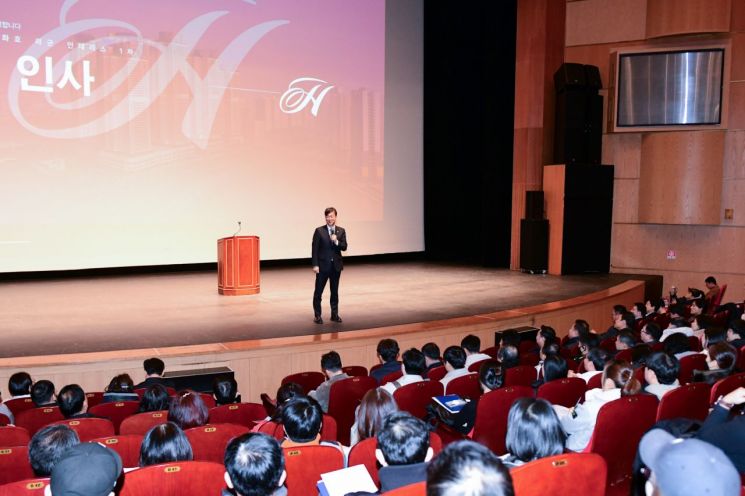 Lee Mingun, mayor of Ansan, attended the first residents' meeting of Hillstate Lagoon Interas held at Ansan Culture and Arts Center last February and explained the city's support policy regarding the change of use. Provided by Ansan City
This change of use is the first case in the Ansan area where a residence-type accommodation facility has been converted to an officetel. It is also the largest change-of-use case since the Ministry of Land, Infrastructure and Transport eased the standards for such conversions. Previously, Lagoon Interas Phase 1 was classified as an "accommodation facility," making it impossible to lease for residential purposes. However, with this change of use, it has now been legally recognized as an officetel, allowing residential occupancy.
Earlier, in January of this year, the Ansan City Government established the "Residence-Type Accommodation Support Task Force Team" under the Architectural Design Division of the Urban Housing Bureau to promote change-of-use following the Ministry of Land, Infrastructure and Transport's announcement last October of the "Support Plan for the Legal Use of Residence-Type Accommodation Facilities." The task force has made administrative efforts by holding several meetings to enable the conversion of residence-type accommodation facilities to officetels and by working closely with relevant departments.
When Lagoon Interas Phase 1 was launched for sale in 2020, it attracted attention as a large-scale complex with 2,554 units in eight buildings, ranging from two basement levels to 49 above-ground floors. However, after the Enforcement Decree of the Building Act was revised in 2021, the use of the complex for residential purposes was restricted, and owners faced difficulties exercising their property rights, such as leasing or selling their units. Unlike ordinary housing, residence-type accommodation facilities face restrictions such as ▲ inability to register as a resident ▲ loan limitations ▲ prohibition of actual residence.
The city expects that, with this change of use, loan restrictions will be eased and leasing for residential purposes or actual residence will become possible, which will not only revitalize transactions but also help attract new residents to the Bandae Island area and boost the local commercial district.
The city plans to continue supporting the change of use for residence-type accommodation facilities through resident consultations and streamlining administrative procedures, using this case as a starting point.
Lee Mingun, mayor of Ansan, said, "Until now, there have been difficulties in changing the use of residence-type accommodation facilities due to legal and institutional limitations," adding, "I hope this case will spread nationwide so that prospective residents can resolve their housing insecurity."
© The Asia Business Daily(www.asiae.co.kr). All rights reserved.

















