Claims of "Consultation" with Agreement Parties Are Unfounded; Mapo-gu Was Never Consulted
Seoul City and Four Districts Unilaterally Signed the Agreement, Excluding Mapo-gu Where the Facility Is Located
Park Kangsoo, Mayor of Mapo-gu: "Relying Only on Formalities Without Procedural Consultation Shows Seoul City's Lack of Communication"
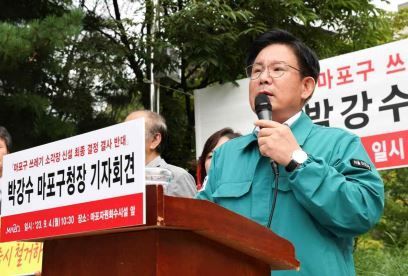
Mapo-gu (District Mayor Park Kangsoo) expressed deep anger on May 25 regarding the Seoul Metropolitan Government's release of an explanatory statement that distorted the facts about the amendment to the joint-use agreement for the Mapo Resource Recovery Facility, and issued a direct rebuttal.
In response to reports that the amendment to the Mapo Resource Recovery Facility joint-use agreement was unilaterally signed on May 16 without Mapo-gu's participation, the Seoul Metropolitan Government claimed that it had "consulted with Mapo-gu and other parties to the agreement."
However, Mapo-gu strongly refutes this claim as being clearly untrue and raises serious concerns about the agreement being pushed forward without due process.
According to the Seoul Metropolitan Government's explanatory statement, consultations began on April 10 between a Seoul city team leader and a Mapo-gu department head, followed by a meeting on May 8 between a Seoul city department head and a Mapo-gu bureau director. On May 20, a Seoul city division head visited the Mapo-gu Office to deliver the city's position.
However, these three meetings were merely formal gatherings, and even during the May 20 visit, Mapo-gu made it clear that this contact was not a "consultation" but simply a "meeting."
"Consultation" should not be limited to a mere formality, but must be judged by comprehensively considering the purpose and intent of the agreement, the circumstances at the time of signing, and the positions of all parties involved.
In particular, because the Mapo Resource Recovery Facility agreement is based on a substantive consensus between equal local governments, the term "consultation" in the agreement does not mean mere "advice" but "substantial consent."
Nevertheless, the Seoul Metropolitan Government continues to emphasize only fairness by pointing out that the Mapo Resource Recovery Facility is "a facility managed by the Seoul Metropolitan Government" and is jointly used by four other districts?Jung-gu, Yongsan-gu, Jongno-gu, and Seodaemun-gu?besides Mapo-gu, falling into a self-contradictory logic.
For over 20 years, Mapo-gu residents have endured health, environmental, and property damages caused by the 750-ton capacity resource recovery facility. Despite this, the Seoul Metropolitan Government has thoroughly ignored the suffering of residents and has persisted with unilateral administration.
This is no different from a situation where a local government in Seoul unilaterally uses a public facility it owns without prior consultation or review by the Seoul Metropolitan Government. To use a housing analogy, it is akin to tenants signing a lease contract while excluding the landlord, which is clearly unjust.
Furthermore, according to the logic of fairness asserted by the Seoul Metropolitan Government, since Mapo-gu has suffered from the incineration facility, the city and other districts should also share the burden and come up with practical measures to reduce waste together.
In fact, Article 6, Paragraph 1 of the Act on the Promotion of Installation of Waste Treatment Facilities and Support for Surrounding Areas stipulates that when developing a residential complex or housing site above a certain scale as prescribed by Presidential Decree, corresponding waste treatment facilities must be installed.
Nevertheless, the Seoul Metropolitan Government insists that there are no available sites for incinerators in other districts and continues to adhere to administrative convenience under the pretext of the joint-use agreement.
The Seoul Metropolitan Government claims to have "consulted" with Mapo-gu, but as clearly stated in Article 10 of the 1997 agreement and Article 10 of the 2009 agreement, an operations committee must be formed and operated to ensure smooth consultation between the parties. Therefore, a simple visit cannot substitute for proper consultation.
Mapo-gu also maintains that fairness and substantial authority must be guaranteed in the composition of the Resource Recovery Facility Operations Committee.
The Seoul Metropolitan Government argues that, since five districts jointly use the facility, all parties should participate in the consultation on equal terms. However, this argument does not reflect reality.
Because the facility is located in Mapo-gu, and Mapo residents bear the environmental and health impacts, it is reasonable for Mapo-gu to have a 50% share, with the remaining four districts sharing the other 50%. Treating all parties equally simply because of joint use ignores the actual victims and constitutes unfair administration.
Moreover, continuing to incinerate waste without consultation regarding the incinerator is a clear illegal act that cannot be justified under any pretext.
Regarding the claim that 20 billion KRW in development funds were provided to Mapo-gu as compensation for the use of the metropolitan resource recovery facility, Mapo-gu stated, "If that 20 billion KRW is so important, we will return the money, so move the incinerator to another area," and made clear that "the quality of life and health rights of residents are fundamental rights that cannot be traded for money."
The Seoul Metropolitan Government also claims that it requested the attendance of Mapo-gu, the Mapo Residents Support Council, and the four other districts that are parties to the agreement at a meeting on May 16 to discuss the amendment of the joint-use agreement, and that only Mapo-gu and the Mapo Residents Support Council did not attend.
However, despite the agreement being set to expire in 2025, the Seoul Metropolitan Government unilaterally presented the amendment just 50 days before expiration without sufficient discussion or prior procedures, and notified parties of the operations committee meeting only three days in advance, completely disregarding procedural legitimacy.
As a result, Mapo-gu and the Mapo Residents Support Council declared the Seoul Metropolitan Government's unilateral and procedurally flawed attempt to amend the agreement null and void, and firmly stated their intention not to participate in the operations committee.
Mapo-gu proposed policies such as reducing the amount of waste incinerated within Seoul by 10% annually for the next five years and raising the price of volume-based waste bags, but the Seoul Metropolitan Government has ignored these suggestions, citing the increase in single-person households and the spread of delivery culture as reasons, and is unilaterally pushing forward with the construction of a new incinerator in Mapo-gu.
Additionally, Mapo-gu proposed joint management of the Mapo Resource Recovery Facility by Mapo-gu and the Seoul Metropolitan Government, a majority composition of Mapo-gu officials and Mapo Residents Support Council members on the facility's operations committee, and annual renewal of the joint-use agreement. However, the Seoul Metropolitan Government has disregarded these proposals and continues with unilateral administration.
Park Kangsoo, Mayor of Mapo-gu, strongly criticized, "The fact that the Seoul Metropolitan Government lost an administrative lawsuit over procedural flaws regarding the unilaterally pushed additional incinerator proves its unilateral administration. Claiming that there was consultation based solely on formalities, without actual procedural consultation, in this joint-use agreement as well, only shows that the Seoul Metropolitan Government has no intention of communicating at all."
He added, "The Seoul Metropolitan Government must immediately nullify this illegitimate agreement and begin official renegotiations. Mapo-gu will respond firmly, not only through legal action but also by standing in strong solidarity with the affected residents against the Seoul Metropolitan Government."
© The Asia Business Daily(www.asiae.co.kr). All rights reserved.

















