A Visit to Taelim Packaging's Siwha Factory
First in the Industry to Operate a Technical Research Institute
Development of High-Strength Specialty Boxes Leads to Cost Reduction
New Technologies Developed Amid Post-COVID-19 Slowdown
"Expanding Products with Eco-Friendliness and High Economic Value"
"Look, the Single Wall (SW) box has greater strength."
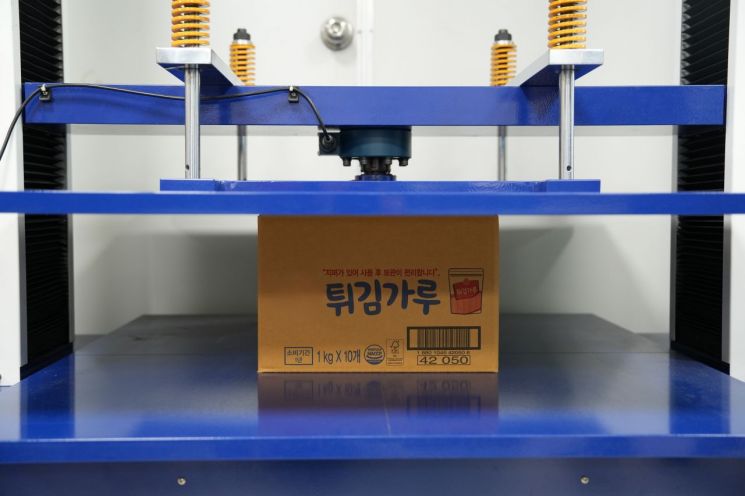 On the 21st, the Technical Research Institute at Taelim Packaging Siwha Factory measured the compression strength of corrugated cardboard boxes. Provided by Taelim Packaging
On May 21, at the Technical Research Institute of Taelim Packaging in Siheung, Gyeonggi Province, Senior Researcher Jang Jungwon made this statement. In front of Researcher Jang, the pressure graph on the 'Box Compression Tester' (BCT) was blinking. Compression strength is a key factor in determining the quality of corrugated cardboard boxes. When a box is placed in the tester, the press descends at a constant speed, and the graph rises until the box can no longer withstand the pressure and ruptures, at which point the graph sharply turns downward.
The experimental results were unexpected. The Double Wall (DW) box, which is generally assumed to be stronger, recorded a maximum strength of 237 kgf (kilogram-force), while the Single Wall (SW) box reached 315 kgf. A Single Wall box consists of two sheets of linerboard and one corrugated medium (the wavy layer between the outer and inner liners). A Double Wall box is made of three sheets of linerboard and two corrugated mediums. Despite reducing the paper layers from five (Double Wall) to three (Single Wall), the compression strength was higher. Researcher Jang explained, "By questioning whether we really need to use five layers of paper, we discovered that using just one corrugated medium can achieve similar strength if its performance is maximized," adding, "As a result, we were able to reduce paper usage by 20% while increasing the strength of the corrugated cardboard by 20%."
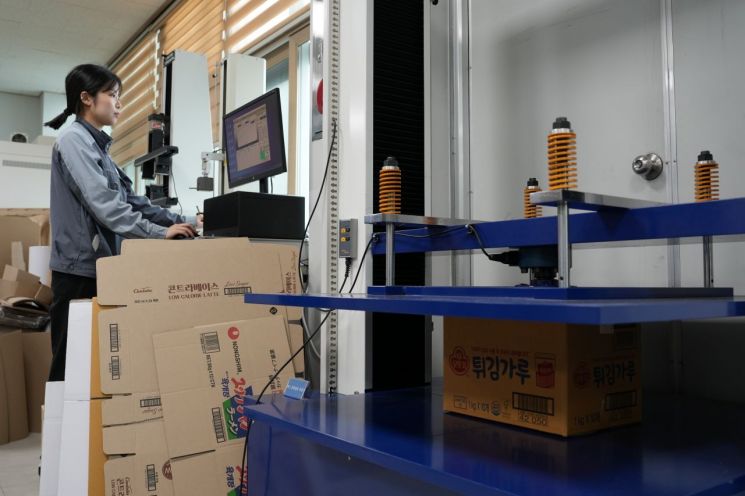 On the 21st, the Technical Research Institute at Taelim Packaging Siwha Factory measured the compression strength of corrugated cardboard boxes. Provided by Taelim Packaging
The greatest advantage of these 'high-strength specialty boxes' is that they allow for a 5% to 10% reduction in product costs by reducing paper usage. Both Taelim Packaging, which manufactures the boxes, and its client companies benefit from this cost-saving effect. For this reason, new orders have been steadily increasing, especially from large food companies and e-commerce businesses that are highly focused on cost reduction. Although these products currently account for about 5% of total sales, Taelim Packaging plans to gradually expand their share.
Researcher Jang stated, "Since high-strength boxes are a unique product manufactured only by Taelim Packaging, client companies seem to have concerns about compatibility," but added, "Nevertheless, due to their excellent cost-effectiveness, some clients are switching their orders from existing products to these boxes."
This high-strength box is the result of Taelim Packaging's research and development (R&D) efforts. Taelim Packaging, established in 1976 and the leading corrugated cardboard manufacturer in Korea, is the only company in the industry to operate a technical research institute for technological differentiation. The company has demonstrated its technological capabilities by independently developing products such as insulated boxes that keep refrigerated meat below 10°C for 21 hours, as well as octagonal and dodecagonal boxes that maximize both space utilization and compression strength.
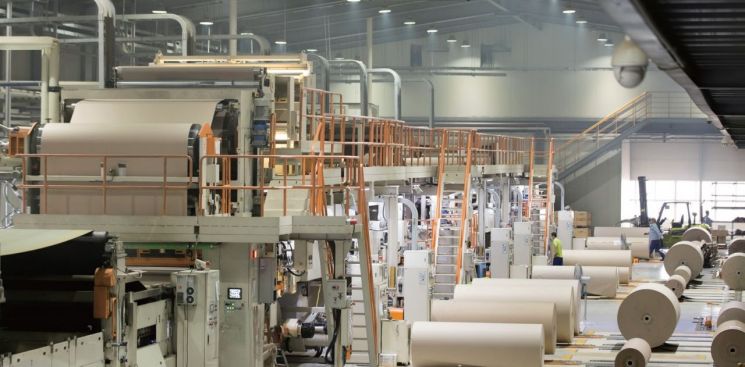
The Siwha factory visited on this day is a showcase of Taelim Packaging's technological prowess. Here, the 'corrugator,' a machine for producing corrugated cardboard sheets, was operating with heavy mechanical sounds and intense heat. Next to the corrugator, large stacks of paper rolls supplied by paper manufacturers were piled up. When the paper rolls are fed into the corrugator, 'corrugated cardboard sheets' are produced. These sheets are then sent to processing machines to be transformed into 'corrugated cardboard boxes.' On another wall, a massive robotic system was automatically stacking and packaging the corrugated cardboard boxes.
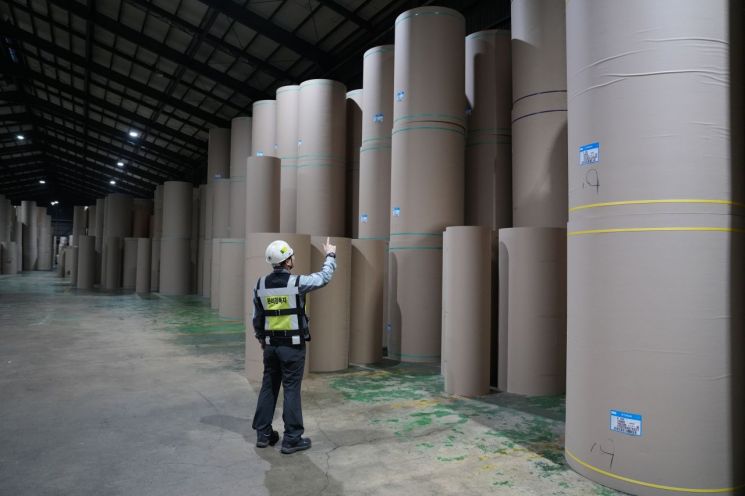 On the 21st, an employee at Taelim Packaging's Siwha factory is checking the inventory of corrugated paper raw materials. Photo by Taelim Packaging
These efforts are part of a strategy to find a breakthrough in the domestic corrugated cardboard market, which has stagnated since COVID-19. According to the Korea Paper Association, domestic production of corrugated cardboard peaked at 5,783,000 tons in 2020, during the height of the pandemic, but shrank to 5,573,000 tons last year. Nevertheless, as social interest in eco-friendliness increases, corrugated cardboard is gaining attention as an environmentally friendly packaging material that can replace plastic and other materials.
Factory Manager Jung Woochul emphasized, "Taelim Packaging will continue to pursue technological innovation and introduce products that satisfy both economic and environmental needs," adding, "With industry-leading technology, we will expand our product lineup to improve logistics efficiency and achieve carbon reduction effects."
© The Asia Business Daily(www.asiae.co.kr). All rights reserved.



















