The Number of Homeowners Has Steadily Increased Since January 2010
13 Out of Every 100,000 People Are "Super Multi-Homeowners" Owning More Than 101 Units

As demand for home ownership continues, it has been found that more than 4 out of 10 people in Korea own collective housing such as apartments, multi-family homes, or officetels. The number of homeowners increases every year, which is analyzed as a result of the growing concentration of assets in real estate, to the extent that Korea is often called a "real estate republic." The number of so-called super multi-homeowners, who own more than 100 housing units, is also gradually increasing.
According to the Court Registry Information Plaza on the 28th, the ownership index for collective housing?such as officetels, apartments, row houses, and multi-family homes?stood at 27.5 as of last month. This figure represents the number of collective housing owners divided by the total population. The index of 27.5 last month means that 27.5 out of every 100 people own collective housing.
The Number of Homeowners Has Gradually Increased
The collective housing ownership index has risen every year since statistics began in January 2010, when it was 17.94. In 2010, about 18 out of 100 people owned collective housing, but this proportion has increased by 9.5 people since then. The index surpassed 20 for the first time in December 2014, and as of January this year, it reached 27.29, rising by 0.21 points over three months.
The index has been on an upward trend as demand for home ownership increases each year. However, the rate of increase has varied depending on whether housing prices were rising or falling. When the real estate market overheated and housing prices were on the rise, the index grew more rapidly due to both basic demand and the sentiment of "buy before prices go up further." In contrast, when prices were falling, people tended to take a wait-and-see approach rather than rush to buy.
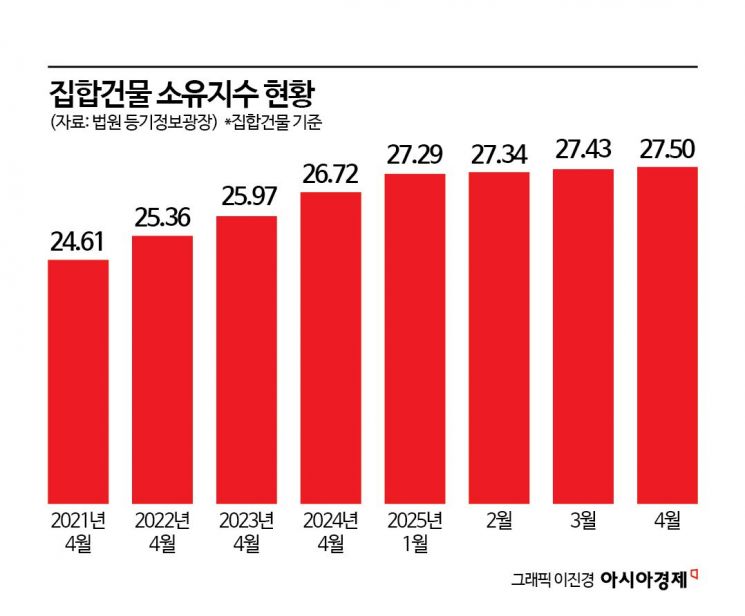
During the COVID-19 pandemic in 2021, the index rose by 0.85 over the year, higher than the average annual increase of 0.57. This was the largest increase on record. At that time, the nationwide annual housing sales price growth rate was 9.9%, the highest in the past decade. In 2020, the index also rose by 0.82, and the housing sales price increased by 5.4%, the second highest after 2021. This is seen as the result of "panic buying" driven by low interest rates and expectations that housing prices would continue to rise.
In 2022, when housing prices fell by 4.7% compared to the previous year, the index rose by 0.58, returning to the average level. Even in 2023, when the real estate market remained sluggish, the index was 0.64. Since last year, as housing prices have gradually recovered, the index increased to 0.71.
Demographic structure also influenced the index. As the population declined but the number of housing units increased, the number of homeowners also grew. According to Statistics Korea, the number of housing units increased by 15.7% over the past decade, from 19,559,100 in 2013 to 22,623,900 in 2023. Kim Hyosun, Chief Real Estate Specialist at NH Nonghyup Bank, analyzed, "The emergence of new towns is also a factor driving up the index. As the population becomes more concentrated and collective housing increases, the ownership index rises accordingly, and as new towns continue to be developed, this phenomenon is being repeated."
The Number of Multi-Homeowners Has Also Increased
As the number of people purchasing homes continues to rise, the number of multi-homeowners?those who own several units?has also increased. This is analyzed as a sign that the concentration of assets in real estate is intensifying.
Last month, the index for people owning two collective housing units was 11.348. This means that 11.3 out of every 100 people own two collective housing units. This figure is up by 0.048 points from 11.3 in April last year. The index for those owning three collective housing units was 2.605, and for those owning 10 units, it was 0.065. The index for those owning 51 to 100 units was 0.022, while the proportion of those owning more than 101 units was 0.013. In other words, 13 out of every 100,000 people are super multi-homeowners, each owning more than 101 collective housing units. This figure dropped to 0.011 in October 2015, but has remained at 0.013 since February 2022.
© The Asia Business Daily(www.asiae.co.kr). All rights reserved.


















