Meeting Ends After Two Hours
Five Additional Agenda Items Proposed On-Site
Includes Items Criticizing Lee Jaemyung Supreme Court Ruling
The National Judges' Representative Meeting was convened to discuss the controversies that arose following the Supreme Court's en banc ruling on the election law violation case of Lee Jaemyung, the presidential candidate of the Democratic Party of Korea. However, the meeting concluded after about two hours without adopting an official position. The representatives decided to continue the meeting after the presidential election, taking into consideration the potential impact on the election during this sensitive period ahead of the early presidential vote.
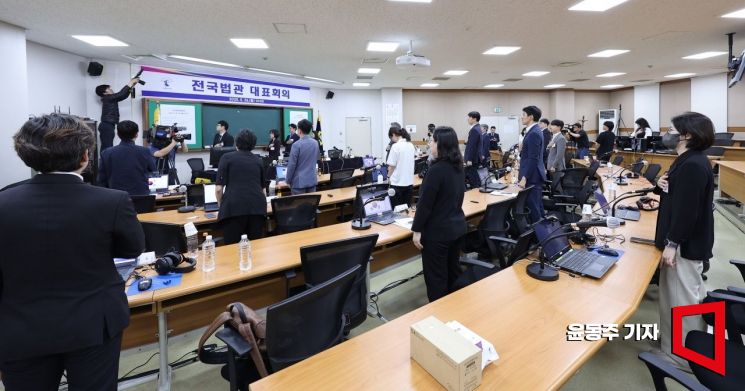 On the 26th, during the National Judges' Representative Meeting held at the Judicial Research and Training Institute in Goyang, Gyeonggi Province, Chairman Kim Yeyeong and attendees are performing the national ceremony. Photo by Yoon Dongju
The National Judges' Representative Meeting held an extraordinary session at 10 a.m. on the 26th at the Judicial Research and Training Institute in Goyang, Gyeonggi Province. After two hours and twenty minutes of discussion, the representatives decided to continue the meeting at a later date. A representative of the meeting stated, "We have concluded today's extraordinary session and decided to reconvene. At the continued meeting, we plan to discuss and vote on the agenda items that have been submitted."
During the extraordinary session, in addition to the two previously submitted agenda items, five new items were proposed and added on-site. Notably, some of the agenda items raised issues with the Supreme Court's en banc ruling on Lee's election law violation case. Specifically, the items included: expressing regret that the Supreme Court's unprecedented procedural handling of a specific case has raised doubts about the judiciary's political neutrality and procedural legitimacy, thereby causing public distrust in the judiciary; declaring that actions such as special investigations, impeachment, or hearings against the judges responsible for the ruling, beyond criticism of the verdict itself, constitute a serious infringement on judicial independence and urging measures to prevent recurrence; recognizing that the so-called "judicialization of politics" poses a significant threat to judicial independence; acknowledging with grave concern that the Supreme Court's en banc ruling has negatively affected public trust in the judiciary; and expressing deep concern that various forms of accountability or institutional changes based on individual trials could undermine judicial independence.
However, the Judges' Representative Meeting did not hold a vote on the seven agenda items raised that day. It was reported that there were differing opinions among the representatives, with some advocating for an immediate vote and others supporting the continuation of the meeting to a later date. In a vote on whether to continue the meeting, 54 out of 90 representatives present voted in favor, while 34 opposed, resulting in the decision to reconvene. A representative explained, "As judicial reform has become an issue in this presidential election, there were growing concerns both inside and outside the judiciary that the adoption of an official position by the representative meeting could influence the election. There were internal discussions among members, and it was decided that it would be better to continue the meeting after the election."
This meeting was convened after some judges called for it, following the Supreme Court's en banc decision to remand Lee's case for a guilty verdict with a 10-to-2 majority, citing concerns about a violation of political neutrality. Initially, only two agenda items were submitted: the first affirmed that judicial independence must be absolutely guaranteed in a democratic nation and declared the commitment to uphold the fairness of trials and the democratic accountability of the judiciary; the second expressed grave concern that the unusual procedural handling of a specific case had shaken public trust, which forms the basis of judicial independence, and voiced deep concern about the possibility that various forms of accountability or institutional changes based on individual trials could undermine judicial independence. The next meeting is scheduled to be held remotely after the June 3 presidential election, with the specific date to be determined through further consultation.
© The Asia Business Daily(www.asiae.co.kr). All rights reserved.

















