BNP Paribas Releases Fiscal Policy Projections for Election Winners
"Lee Jaemyung Expected to Launch Fiscal Projects Through Second Supplementary Budget"
Kim Moonsu Prioritizes Soundness; Any Supplementary Budget Likely Modest
Divergent Approaches to US Trade Talks: Cautious vs. Swift
Both Candidates Emphasize Economic Growth, Show Similarity in Real Estate Policy
Citi: "Foreign Exchange Market More Influenced by Tariffs and Trade Talks Than Election"
With just one week remaining until the presidential election, global investment banks (IBs) are releasing macroeconomic forecasts based on the potential victory of each candidate. If Lee Jaemyung, the Democratic Party’s presidential candidate, is elected, analysts predict the implementation of a second supplementary budget and other expansionary fiscal policies, a stronger Korean won, and the possibility of a value-up in the stock market. In the case of Kim Moonsu, the People Power Party’s candidate, experts expect a stronger emphasis on fiscal soundness and a smoother path toward concluding trade negotiations with the United States.
According to the financial sector on May 27, Yoon Jiho, senior economist at BNP Paribas, outlined these views in a recent report. He noted that the two candidates differ significantly in their fiscal policy approaches. Should Lee Jaemyung win, a larger supplementary budget than the first one passed by the National Assembly this month is expected in the second half of the year. He based this on the Democratic Party’s earlier demand for a 35 trillion won supplementary budget, rather than the 13.8 trillion won that was approved, and on their proposal that at least 20 trillion won is needed for a second supplementary budget to boost livelihoods and consumption. In contrast, Kim Moonsu is seen as likely to prioritize fiscal soundness. While he may consider a second supplementary budget, he is expected to be more cautious about additional spending, meaning any supplementary budget would likely be smaller in scale.
Yoon predicted that if Lee Jaemyung is elected and pursues expansionary fiscal policy, the magnitude of interest rate cuts could be somewhat limited. Although the Bank of Korea has made domestic growth recovery its top priority, last month Governor Rhee Changyong cautioned against the assumption that aggressive supplementary budgets are always necessary for growth stimulation. In other words, if the government increases fiscal spending to drive growth, combining this with further interest rate cuts-another tool for stimulating growth-could negatively impact next year’s growth rate. Therefore, Yoon expects the Bank of Korea to cut rates in May and August this year, bringing the year-end policy rate to 2.25%, but not to implement further cuts next year.
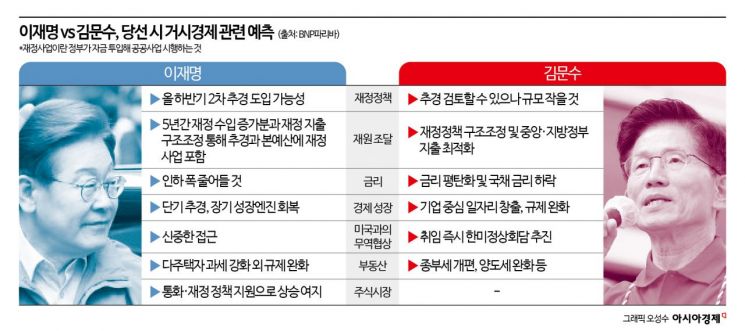
There are also differences in how each candidate would finance fiscal expenditures. Lee Jaemyung is expected not only to save resources by using increased fiscal revenues or adjusting expenditures over his five-year term, but also to include fiscal projects in both supplementary and main budgets. Fiscal projects refer to public initiatives directly funded by the government. Kim Moonsu, on the other hand, is likely to reform fiscal policy itself and attempt to optimize spending at both the central and local government levels. According to Yoon, some of Kim’s pledges are expected to be funded within the existing budget, without additional spending.
Regarding trade negotiations with the United States, Kim Moonsu is expected to move quickly, having pledged to pursue a Korea-US summit immediately upon taking office, which suggests a high likelihood of concluding negotiations. In contrast, Lee Jaemyung is expected to take a more cautious approach, as indicated by comments from diplomatic advisor Kim Hyunjong, who suggested that more time is needed for negotiations. However, the market does see some clear direction emerging. Recently, Kim Jinwook, an economist at Citi, predicted that advisor Kim would lead the negotiations, aiming to reduce US-imposed auto tariffs. As for the stock market, if Lee Jaemyung is elected, the promises of increased fiscal spending and improvements in corporate governance are seen as factors that could lead to a value-up (enhancement of corporate value).
There are also many areas where both candidates are expected to take similar approaches. Neither has yet pledged to introduce fiscal rules, suggesting they will maintain a flexible fiscal stance. Both are prioritizing economic growth as the top policy objective amid low growth rates. However, their strategies differ: Lee Jaemyung plans to use supplementary budgets in the short term and develop growth sectors such as artificial intelligence (AI) in the long term, while Kim Moonsu aims to stimulate growth through job creation centered on businesses and regulatory easing. In real estate policy, both candidates have pledged to ease regulations but have not specified supply targets.
In the foreign exchange market, factors such as tariff reductions and trade negotiations are expected to have a greater impact than the election itself. Yoon forecasts that the won-dollar exchange rate will fall to 1,320 won by the end of next year. However, Kim, the economist, expects that if Korea and the US engage in foreign exchange-related negotiations, Lee Jaemyung would be less inclined to reach a quick agreement with the US, making a currency deal unlikely in the short term.
© The Asia Business Daily(www.asiae.co.kr). All rights reserved.

















