Concerns Grow Over Prolonged Strike
Due to Deepening Labor-Management Conflict
As bus unions affiliated with the National Automobile Labor Union Federation announced a simultaneous nationwide strike on the 28th, the Seoul Metropolitan Government has unveiled transportation measures such as increasing subway service and operating temporary routes.
On the 26th, the Seoul Metropolitan Government stated, "With the strike announced by the Seoul City Bus Union approaching, we have reviewed emergency transportation measures and established a response system to address any illegal work disruption activities by the union." The nationwide bus unions have previously warned that if wage and collective bargaining negotiations are not concluded by the 27th, they will begin a simultaneous strike starting with the first buses on the 28th.
Unlike previous years, when the main point of contention was the wage increase rate, this year, there is a significant difference of opinion between labor and management regarding the wage system, including ordinary wages. This raises concerns that the strike could be prolonged. Accordingly, the city plans to prepare for a strike lasting at least three days.
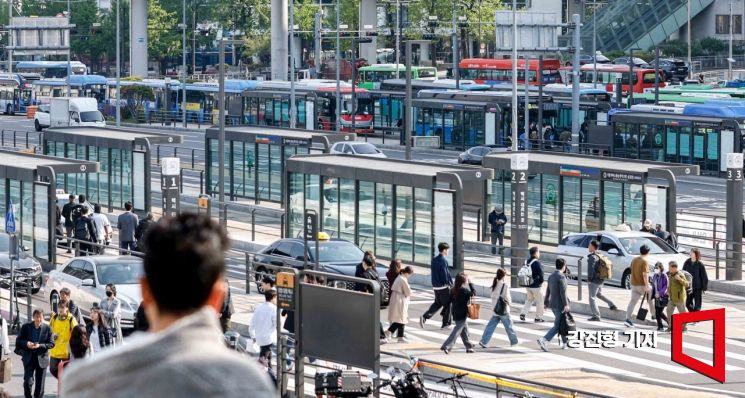 As negotiations between the Seoul city bus labor union and management broke down, the union began a legal strike operation on the 30th. Buses are parked at the Seoul Station Bus Transfer Center in Jung-gu, Seoul. April 30, 2025. Photo by Kang Jinhyung
Previously, the city established emergency transportation measures in April when negotiations between the Seoul city bus labor union and management broke down. Subway service will be increased by a total of 173 additional runs per day, and the main rush hour periods will be extended by one hour to allow for more trains to be deployed. The last subway train will also operate until 2 a.m. to support late-night travel. Each district will operate a total of 117 free shuttle bus routes to help residents access subway stations.
Last year, during the city bus strike, some drivers returned to work before the strike ended and operated temporary routes. This year, the city also plans to operate temporary routes depending on the number of drivers who return to work. Temporary routes will run as shuttles from depots to major subway stations, taking into account the distance and interval of each route. In this case, the temporary routes will be operated free of charge, and whether fares will be collected will depend on when normal operations resume.
The Seoul Metropolitan Government will also work with the police to monitor any illegal work disruption activities by the union. Government officials will be dispatched to each depot, and if illegal activities are identified, swift action will be taken in cooperation with the police. Last year, there were reports of vehicles being illegally parked at depot entrances to obstruct bus operations, as well as drivers leaving their posts after receiving bus keys.
The city has also requested that elementary, middle, and high schools, as well as public institutions, adjust start times by one hour during the strike period. This is because a nationwide strike could result in a widespread suspension of bus operations in the Seoul metropolitan area.
Yeo Jangkwon, Director of Transportation at the Seoul Metropolitan Government, said, "If a full-scale strike occurs, severe disruptions are expected during commuting hours, so we ask citizens to actively utilize remote work and other alternatives." He added, "As there is still time before the announced strike deadline, we urge both labor and management to show understanding and make concessions so that wage negotiations can be concluded amicably at a reasonable level acceptable to citizens."
© The Asia Business Daily(www.asiae.co.kr). All rights reserved.

















