Bacteria Displaced by Red Blood Cells Are Removed as They Adhere to Artificial Thrombus
Published in Advanced Science
A technology has been developed that removes bacteria from the bloodstream by making them adhere to a sticky artificial thrombus.
This technology is expected to contribute to the development of treatments for deadly systemic infections such as sepsis, as it can also eliminate antibiotic-resistant bacteria.
On May 26, Professor Kang Jooheon’s team from the Department of Biomedical Engineering at UNIST announced that they have developed an extracorporeal bacterial purification device using artificial thrombus. Similar to hemodialysis, this technology removes infected blood from the body, adsorbs bacteria onto an artificial thrombus for removal, and then returns the purified blood to the patient.
 Research team (from left) Professor Kang Jooheon, Dr. Jang Bonghwan (first author), Dr. Jung Suhyun, Dr. Kwon Seyong, Dr. Park Sungjin. Provided by UNIST
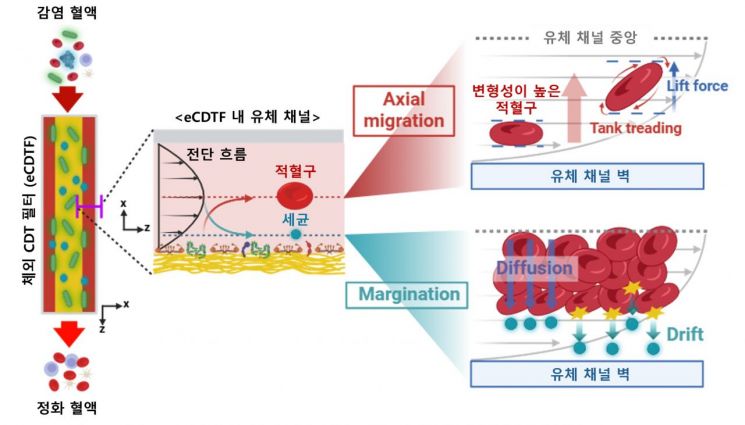
The developed extracorporeal blood purification device (eCDTF) features a spiral structure inserted in the center of a tube. Inside the spiral structure, an artificial thrombus is fitted, allowing bacteria in the blood flowing through the tube to adhere to the sticky artificial thrombus and be removed. The artificial thrombus is composed solely of plasma proteins, without cellular components such as white blood cells, which helps bacteria adhere more effectively to the device surface.
This extracorporeal blood purification device was able to remove more than 90% of both Gram-positive and Gram-negative bacteria, including Staphylococcus aureus and Escherichia coli, as well as antibiotic-resistant bacteria and bacteria derived from human feces.
In preclinical experiments on mice infected with methicillin-resistant Staphylococcus aureus (MRSA), the device also demonstrated excellent efficacy. After just three hours of extracorporeal circulation treatment, both the number of bacteria in the blood and inflammation markers decreased significantly, and the number of bacteria infiltrating major organs such as the liver and spleen was greatly reduced. In contrast to the control group, which all died within seven days without treatment, the group that received a single treatment showed a survival rate of about 33%, and the group that received treatment for two consecutive days achieved a 100% survival rate.
The research team developed this technology by drawing inspiration from fluid dynamics in the bloodstream. Blood contains various cells, including red blood cells, white blood cells, and platelets. Among them, flexible red blood cells tend to gather in the center of the bloodstream, while stiff and small platelets are pushed toward the vessel wall in a process called margination.
The team hypothesized that bacteria, like platelets, are small and rigid and could be displaced by red blood cells. To maximize this effect, they designed the structure of the purification device and adjusted the blood flow rate accordingly.
Professor Kang Jooheon said, "This technology enables the direct removal of various pathogenic bacteria without the use of antibiotics, and it could serve as a turning point in the approach to treating infections such as bacteremia and sepsis." Bacteremia, in which bacteria from a localized infection spread into the bloodstream, can progress to sepsis, a systemic inflammatory response, if not treated in time.
Professor Kang also explained, "We can now scientifically explain some previously unclarified bacterial removal phenomena observed in existing devices, which further increases the clinical applicability of related technologies."
This research was supported by the Pan-Ministry Regenerative Medicine Technology Development Program jointly run by the Ministry of Science and ICT and the Ministry of Health and Welfare, the Mid-Career Researcher Program and Basic Research Laboratory Program of the National Research Foundation of Korea under the Ministry of Science and ICT, and the Materials and Components Technology Development Program of the Ministry of Trade, Industry and Energy.
The research results were published online in the international journal Advanced Science on April 26.
© The Asia Business Daily(www.asiae.co.kr). All rights reserved.


















