The won-dollar exchange rate fell to the 1,360 won level due to global dollar weakness. This marks the lowest point in seven months.
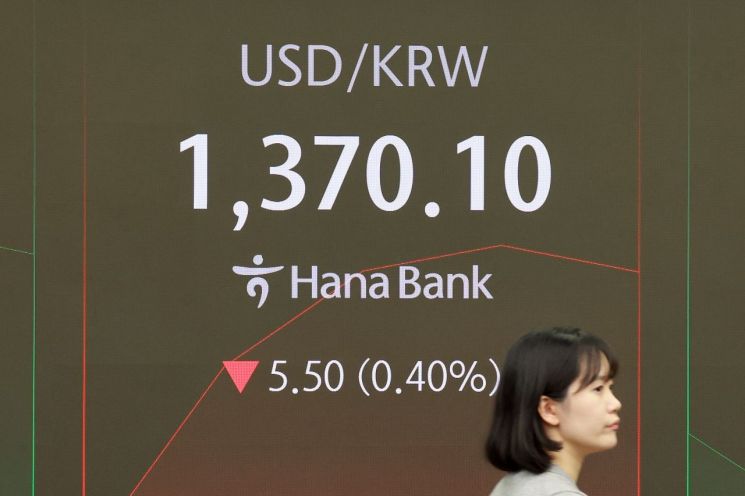
On May 26, in the Seoul foreign exchange market, the won-dollar rate opened at 1,369.0 won, down 6.6 won from the previous trading week's closing price (as of 3:30 p.m.). This is the lowest opening level since October 17 of last year (1,364.50 won). It has returned to the level before the sharp rise triggered by the U.S. presidential election in November and the 12·3 martial law crisis in December of last year.
This decline in the dollar was influenced by several factors: renewed concerns over tariffs; ongoing expectations of won appreciation due to Korea-U.S. currency negotiations; the downgrade of the U.S. sovereign credit rating; and increased fiscal uncertainty. After closing at 1,366.5 won in after-hours trading on May 23, the won-dollar rate continued to move in the upper 1,360 won range in early trading on this day as well.
Although the U.S. has publicly committed to maintaining a strong dollar policy, the market interprets Washington's stance?that the massive trade surpluses of major Asian countries must be managed?as ultimately exerting upward pressure on Asian currencies. Tariff-related concerns also played a role. On May 23 (local time), U.S. President Donald Trump said he could impose a 50% tariff on the European Union (EU) starting June 1, but on May 25 he announced the measure would be postponed until July 9. The dollar index, which measures the value of the dollar against six major currencies, fell to 99.042 on May 23. Although it rebounded slightly on this day, it remains at a low level below 100.
Min Kyungwon, a researcher at Woori Bank, said, "President Trump's negative assessment of trade negotiations with the EU triggered a sharp drop in the dollar index," and diagnosed, "The global trend of dollar weakness is likely to lead to a soft landing for the won in the 1,360 won range today." However, he explained that even if the rate falls further, the lower end is expected to be supported in the mid-1,360 won range. He pointed out, "For importers who saw any dip above 1,400 won as a buying opportunity, the 1,360 won level could trigger aggressive buying," and added, "Actual foreign exchange demand from overseas stock investors (Seohakgaemi) will also act as a factor limiting further declines."
© The Asia Business Daily(www.asiae.co.kr). All rights reserved.

















