First Emergency Arrest for Technology Leakage Suspect
Semiconductor Packaging Market to Reach 40 Trillion Won in Two Years
World-Leading HBM Back-End Technology at Stake
If Leaked, AI Semiconductor Leadership Could Shift to China
46 Cases of Overseas Industrial Technology Leakage Detected in Two Years
'Industrial Technology Protection Act' Only Specifies 'Individuals', Not 'Corporations'
Allow Detention of Suspects in Intangible Asset Leakage
Joint Response System Needed Among NIS, Prosecution, and Police
Companies: "All-Out Effort for Preemptive Monitoring and Prevention"
The fact that authorities have made the first emergency arrest of an individual leaking core high-value semiconductor packaging technology demonstrates the urgent state of industrial security in South Korea. The domestic semiconductor packaging market is expected to grow to 40 trillion won in two years. There is growing concern that attempts to target South Korea's technology are becoming more blatant, especially as high-bandwidth memory (HBM) back-end processing?one of the few advanced technologies in which South Korea leads China?has become a direct target.
An official from a semiconductor company emphasized on the 26th, "Recently, the methods and severity of attempted technology leaks have gone beyond simply leaking internal documents," adding, "Government-level preparedness and support are desperately needed."
Industry insiders believe that the recent emergency arrest of an employee at a semiconductor packaging company is just the tip of the iceberg. There are constant complaints that it is now difficult to prevent technology leaks solely by monitoring people and confidential documents within a company. Methods have become more diverse, such as impersonating partner companies to request internal blueprints via email.
There have also been cases where Chinese capital has established shell companies in South Korea and attempted to leak technology through consulting firms or non-practicing entities (NPEs). In one incident, an employee at a domestic equipment company who had already leaked semiconductor equipment technology set up a separate company linked to China and tried to smuggle out the company's technology, leading to prosecution. In another case, a Chinese company recruited a domestic equipment engineer with a high salary, and the engineer was prosecuted for handing over entire proprietary blueprints to the Chinese subsidiary after changing jobs.
Such technology leaks are particularly threatening because they can directly undermine the growth engine of the South Korean economy. China, in particular, is rapidly closing the technology gap in semiconductors and displays. There are concerns that any leakage could immediately weaken the competitiveness of South Korea's semiconductor industry.
According to analysis by the Korea IR Council, the domestic semiconductor packaging market is growing at an average annual rate of 29.3%. The market size was 8.3891 trillion won in 2020, 14.0257 trillion won in 2022, and is projected to reach 40.7288 trillion won in 2027. In particular, this packaging technology is considered an essential process for realizing artificial intelligence (AI) semiconductors. The technology targeted in the recent leak attempt is directly linked to the performance of HBM. If this technology had been leaked to China, not only would the competitiveness of HBM have been compromised, but the leadership of the entire AI semiconductor supply chain could have shifted as well. The shock to the entire domestic industrial base in such a scenario would be unimaginable.
This is why the first emergency arrest of a technology leak suspect is significant: it cuts off the suspect’s escape route to foreign countries or locations used as rendezvous points for technology transfers, expanding the scope for apprehension. The court recognized the emergency arrest without a warrant and later issued a warrant, with various agencies such as the police acting in concert to achieve this outcome. This is seen as a symbolic measure confirming a tougher stance on technology leaks.
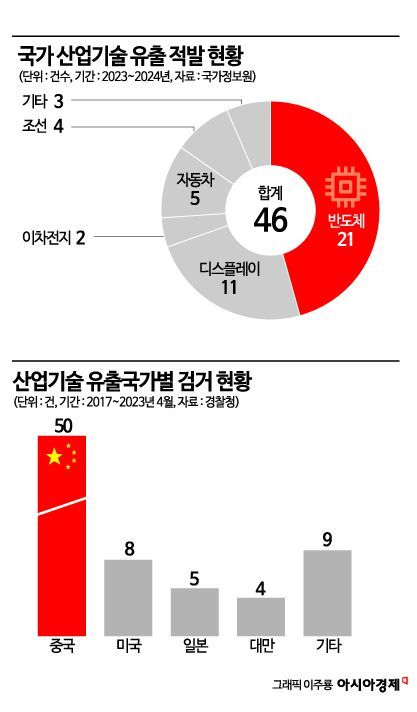
According to statistics from the National Intelligence Service on the 'Number of Detected Overseas Industrial Technology Leaks,' there were a total of 46 cases detected between 2023 and 2024. Of these, semiconductors accounted for 21 cases, nearly half of the total, followed by displays with 11 cases, automobiles with 5 cases, shipbuilding with 4 cases, and secondary batteries with 2 cases. Given that semiconductor technology is the most heavily targeted, the impact of this incident is considered even greater.
Experts advise that government ministries, including the Ministry of Trade, Industry and Energy, should work together to revise laws and systems. The current Industrial Technology Protection Act specifies 'individuals' as subjects prohibited from leaking or infringing on technology, but does not mention 'corporations' or organizations. As a result, there is currently no legal framework to block China, which uses companies and funds to orchestrate technology leaks.
Legal experts argue that emergency arrests for technology leak suspects should be more broadly permitted. Because technology is an intangible asset, it is difficult to investigate or recover damages unless suspects are swiftly detained, and it is also hard to catch them through airport inspections or customs. Therefore, agencies such as the police, prosecution, and National Intelligence Service must operate a sophisticated system to detect suspicious circumstances early and respond accordingly.
Son Seungwoo, intellectual property and technology advisor at Yulchon LLC and former president of the Korea Institute of Intellectual Property, stated, "Although this first emergency arrest involved organic cooperation among multiple agencies, this is not typically the case," adding, "It is necessary to overhaul investigation and arrest systems so that our investigative agencies can respond quickly at the initial stage."
Companies are also strengthening their internal countermeasures. An official from the semiconductor industry said, "Awareness of the risks of technology leaks is very high, and we are doing our utmost to prevent them in advance through various systems," adding, "We are operating a sophisticated monitoring system, but due to security reasons, we cannot disclose details."
© The Asia Business Daily(www.asiae.co.kr). All rights reserved.