Spread of Misinformation Based on Election Fraud Conspiracy Theories
Marking Ballots with a Personal Seal Will Invalidate Your Vote
With the presidential election scheduled for June 3, fake news related to election fraud is rapidly spreading on social networking services (SNS) and online communities.
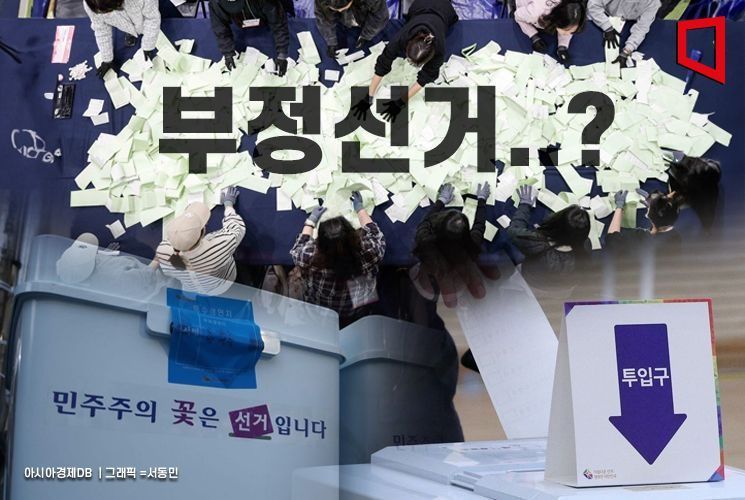
On May 25, claims have been circulating on SNS platforms such as X (formerly Twitter) and KakaoTalk open chat rooms, asserting that "after verifying your ID at the polling station, you should stamp your personal seal instead of signing, and stamping your personal seal on the ballot can prevent election fraud."
However, this is not true. According to the Public Official Election Act and the regulations of the National Election Commission (NEC), voting must be done using the marking tool (permanent stamp) provided by the NEC. The use of personal seals, pens, or any other personal items is strictly prohibited. If a voter leaves a personal seal or any identifiable mark on the ballot, as suggested by these claims, it violates the principle of secret voting and the ballot may be invalidated.
Additionally, there is information circulating that instructs voters to fold the ballot paper five or six times and then unfold it before marking their vote at the polling station. The reason given is that crumpled ballots cannot be processed by the "automatic sorting machine" and must be counted by hand. However, since the last general election, the NEC has already been conducting a manual recount after sorting ballots with the ballot sorting machine, so regardless of how many times a ballot is folded, all such ballots are subject to hand counting.
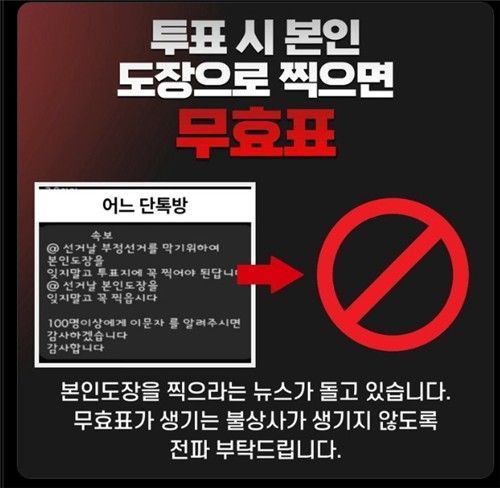 A cautionary post warning against fake news circulating on social networking services (SNS) that instructs voters to stamp their own seal when voting. Screenshot from X (formerly Twitter).
Other claims spreading on SNS include assertions that a large difference in vote percentages between early voting and main voting is evidence of manipulation, that "Baechutnip" ballots (overlapping printed ballots) or stiff ballots without folding marks are evidence of election fraud, and that the NEC is covering polling station CCTV cameras to encourage election fraud. The Supreme Court and the NEC have explained that differences in vote percentages between early voting and main voting are natural phenomena caused by the tendencies of voters and the time of voting.
Furthermore, regarding "Baechutnip" ballots and stiff ballots, the Supreme Court stated after the recount of the 21st general election in 2020 that these were simple incidents caused by printer errors, static electricity, or adhesives.
To prevent ballot forgery, the NEC produces ballots using special ink and barcodes and prints them through authorized issuing machines. The barcode is used for tracking ballots and preventing forgery. Both early voting and main voting ballot boxes are sealed and monitored by closed-circuit (CC) TV for 24 hours, and observers verify this during the counting process. Since the CCTV is open for 24 hours, it cannot be covered. With this multi-layered security system, ballot forgery is virtually impossible. The Supreme Court also ruled in the 2020 recount of the 21st general election that "there was no evidence of ballot forgery."
To avoid creating invalid ballots by falling for false information spreading on SNS or online communities, voters must check voting information through the official NEC website and other official sources.
© The Asia Business Daily(www.asiae.co.kr). All rights reserved.


















