Cases of Early Resignation Surge Before Completing Six-Year Mandatory Service
Appointed as Lieutenants Automatically, Then Leaving Midway
There has been a sharp increase in the number of graduates from the Korean National Police University resigning before completing their mandatory service period of six years, raising concerns that the university's founding purpose is being undermined. It is estimated that a significant number of these graduates are entering law schools, leading to criticism that the police university, which is fully funded by taxpayers to nurture police talent, has effectively become a "training ground for law school candidates."
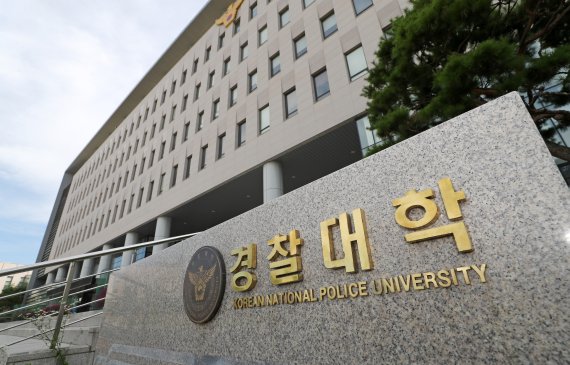 Main building of the Korean National Police University in Hwangsan-ri, Asan-si, Chungnam. Photo by Yonhap News
According to the National Police Agency and the education sector on May 25, an analysis of successful applicants to 22 out of 25 law schools nationwide for the 2025 academic year revealed that 81 were graduates of the police university. Considering that each class at the police university has a capacity of 100 students, this means that the vast majority of graduates from a single class are choosing to enter law school. This demonstrates that the police university is effectively serving as a stepping stone to law school.
The departure of police university students is particularly problematic because the institution is funded by taxpayers. The police university is a national special-purpose university, with several tens of millions of won in taxes invested annually per student for tuition, dormitory fees, and meals. The total amount of tax spent per student until graduation is 86.14 million won. Graduates are required to serve as police officers for six years as a national obligation.
However, over the past three years, 143 graduates have resigned without fulfilling their mandatory service. Most of them resigned after being admitted to law school or after passing the bar exam while still employed as police officers.
Even within the police force, there are voices pointing out loopholes in the system. One officer noted, "There is a widespread perception that even if you have to repay several tens of millions of won in tuition after resigning, you can make it back within a few months as a lawyer," adding, "In reality, it has become a 'pathway to prepare for law school funded by taxes.'"
Some even juggle both work and studies after being admitted to law school. Since taking a leave of absence for law school is not allowed, most opt to work at police substations or precincts, exploiting the system. The four-shift rotation at substations consists of day, night, off, and rest shifts; by utilizing night, off, and rest shifts, they can attend classes at least three days a week. During midterms, finals, or the bar exam period, they use annual leave.
As of May 2024, only 49 police university graduates currently serving as police officers have voluntarily registered their bar qualification with the National Police Agency, but the number is increasing every year, with 12 resigning in 2023 alone. This is a sharp rise compared to 2 in 2021, 5 in 2022, and 6 in 2023.
Faced with this situation, criticism has resurfaced regarding the "excessive privilege" of the system that guarantees police university graduates automatic appointment as lieutenants without a separate exam upon graduation. While it takes at least 15 years and 6 months for a regular police officer to be promoted from constable to lieutenant, police university graduates are granted the rank of lieutenant?equivalent to grade 6 in the civil service?immediately upon graduation. This is an unprecedented system worldwide, where simply graduating from a specific university guarantees an officer rank without a probationary period.
© The Asia Business Daily(www.asiae.co.kr). All rights reserved.

















