Extraordinary Meeting to Be Held at Judicial Research and Training Institute at 10 a.m. on the 26th
Two Agenda Items Submitted for "Independent and Fair Trials"
Attention on Quorum and Majority Needed for Official Statement
A meeting of the National Judges' Representatives Conference will be held to address the controversy both inside and outside the judiciary regarding the Supreme Court's ruling to remand for retrial with a guilty verdict in the public official election law violation case involving Lee Jaemyung, the presidential candidate of the Democratic Party of Korea. The representatives plan to pre-submit and discuss two agenda items aimed at ensuring independent and fair trials. However, the judges have decided that issuing an official statement on the controversial Supreme Court ruling would be inappropriate and have excluded it from the agenda for now.
According to the legal community on May 25, the Judges' Representatives Conference will hold an extraordinary meeting at 10 a.m. on May 26 at the Judicial Research and Training Institute in Goyang, Gyeonggi Province. Kim Yeyoung, the presiding judge of the Seoul Southern District Court and chair of the conference, followed internal procedures to submit two agenda items and sent the details to the 126 representatives. The conference will open with a majority of the 126 members present.
At the meeting, discussions are expected to cover criticisms that the Supreme Court reviewed and ruled on Lee's public official election law violation case at an unprecedented speed, raising doubts about political neutrality. The meeting will also address concerns that the Democratic Party's public demand for Chief Justice Cho Heedai to step down, as well as its push for legislation such as increasing the number of Supreme Court justices and introducing trial appeals, could threaten judicial independence.
The first agenda item centers on the independence and fairness of trials, as well as public trust in the judiciary. Chair Kim outlined, "In a democratic nation, the independence of the judiciary must be absolutely guaranteed, and we also affirm our commitment to upholding the fairness of trials and the democratic accountability of the judiciary, which are the foundation of that independence." He added, "The Judges' Representatives Conference will continue to monitor developments, analyze the causes, and discuss countermeasures through the Judicial Trust and Judicial Ethics Subcommittees."
The second agenda item focuses on concerns about various forms of accountability and institutional changes related to individual rulings. Chair Kim stated, "We are deeply concerned that public trust in the judiciary, which underpins judicial independence, has been shaken, and that holding judges accountable for individual rulings or making institutional changes on that basis could undermine judicial independence."
However, the conference has decided not to issue a statement regarding the Supreme Court ruling involving candidate Lee Jaemyung, which is at the center of the controversy. This decision reflects the view that direct commentary would be inappropriate from the perspective of judicial independence. Chair Kim further explained, "In preparing the agenda, we tried to incorporate as many of the opinions raised during discussions about whether to convene the extraordinary meeting as possible," adding, "We determined that expressing opinions on the appropriateness of individual trials and procedures related to the controversial Supreme Court case would be inappropriate."
He continued, "In light of this situation, I propose that we reflect on values such as judicial independence and the democratic accountability of judges, deeply consider and express concerns about the current situation, and offer opinions on judicial trust and the general principle of judicial independence."
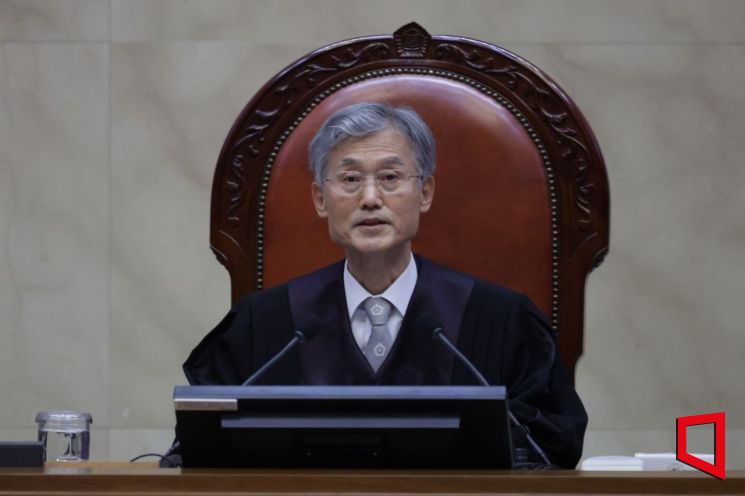 On the afternoon of the 1st, Chief Justice Cho Heedai entered the Supreme Court courtroom in Seocho-gu, Seoul, to preside over the full bench ruling on the public official election law case involving Lee Jaemyung, the presidential candidate of the Democratic Party of Korea, and declared order in the courtroom. 2025.05.01 Photo by Joint Press Corps
Agenda items can also be newly proposed at the meeting itself if the proposer secures the support of at least 10 participants, and amendments may be introduced. After the discussion, any official statement from the Judges' Representatives Conference requires approval by a majority of those present. Whether a resolution will be passed remains uncertain. In an unofficial group chat poll to decide whether to convene the meeting, 70 out of all the representatives?more than half?opposed holding it, leading to expectations that securing a majority for any resolution may be difficult. Posts on the court’s internal network, 'Courtnet,' have even suggested postponing the meeting until after the presidential election. Within the legal community, there is speculation that the conference may delay adopting any resolutions at this meeting due to political sensitivities and reconvene after the election.
The Judges' Representatives Conference is a body where representative judges elected from courts of all levels gather to express opinions or make recommendations on judicial administration and judicial independence. Agenda items are resolved by a majority vote of those present. The conference can be convened either at the chair's discretion or at the request of at least one-fifth (26) of the representatives.
© The Asia Business Daily(www.asiae.co.kr). All rights reserved.
![Clutching a Stolen Dior Bag, Saying "I Hate Being Poor but Real"... The Grotesque Con of a "Human Knockoff" [Slate]](https://cwcontent.asiae.co.kr/asiaresize/183/2026021902243444107_1771435474.jpg)

















