Household Sewer Fees Set to Rise by a Total of 92.5%
The Seoul Metropolitan Government is considering raising sewer fees by 9.5% annually as a measure to secure funds for sinkhole prevention.
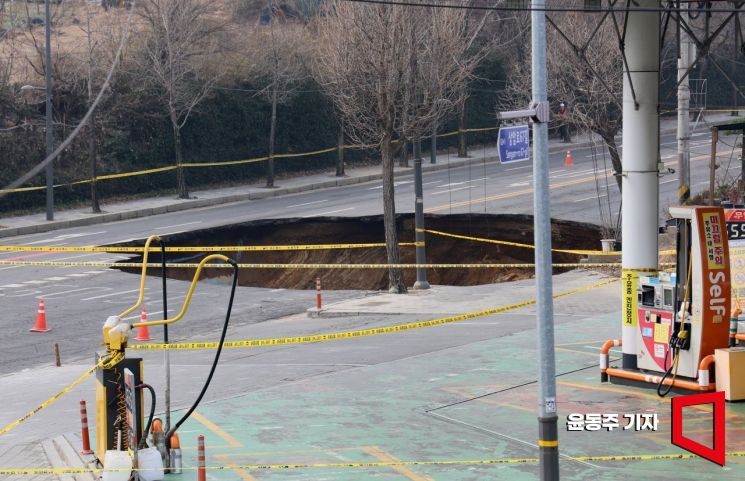 On the 24th, a large sinkhole spanning four lanes occurred at an intersection near Daemyeong Elementary School in Gangdong-gu, Seoul. On the 25th, the area around the accident site is being cordoned off. One passenger car and one motorcycle fell into the sinkhole, and one occupant of the passenger car was transported to a nearby hospital. Currently, one motorcycle rider is buried under the sinkhole. The depth is estimated to be 30 meters. 2025. 03. 25 Photo by Dongju Yoon
According to the city on the 25th, Seoul will convene a Price Countermeasure Committee on June 5 to discuss the adjustment of sewer usage fees. This committee is responsible for reviewing fees determined by the city, including those for transportation, city gas, water supply, and sewer usage. After a resolution is passed by the city council in September, the increased sewer usage fees will take effect on January 1 next year.
According to Seoul's "Annual Sewer Usage Fee Rate Table Revision Plan Based on the Sewer Usage Fee Realization Plan," the city plans to increase sewer usage fees for all sectors by 9.5% each year, resulting in a cumulative increase of 57% by 2030. For households, the existing progressive rate system will be abolished, and fees will be raised by 14% annually from next year through 2030, totaling a 92.5% increase. The progressive rate system is being eliminated because most households do not use more than 30 tons of water.
Specifically, the household sewer fee, currently 400 won per ton (for up to 30 tons), will rise to 480 won per ton in 2026, 560 won in 2027, 630 won in 2028, 700 won in 2029, and 770 won in 2030. A household that currently pays 5,000 won per month is expected to pay 6,000 won per month starting next year.
Sewer fees for general use will also be increased, and the progressive rate system, which previously had six tiers, will be reduced to four. The fee for up to 30 tons, currently 500 won per ton, will be raised to 580 won next year and 900 won by 2030. The progressive rate tiers for 30?50 tons and 50?100 tons will be combined into a single 30?100 ton tier, with the fee set at 1,550 won per ton next year and 2,100 won per ton in 2030. The 100?200 ton and 200?1,000 ton tiers will be merged into a 100?1,000 ton tier, with the fee rising to 2,100 won per ton next year and 2,500 won per ton in 2030. For usage over 1,000 tons, the current fee of 2,030 won per ton will be increased to 2,200 won next year and 2,600 won in 2030.
Sewer usage fees for bathhouses will also rise. For usage up to 500 tons, the fee will increase from the current 440 won per ton to 520 won next year and 800 won in 2030. For the 500?2,000 ton tier, the fee will rise from 550 won per ton to 630 won next year and 950 won in 2030. For usage over 2,000 tons, the current fee of 630 won per ton will increase to 720 won next year and 1,050 won in 2030.
This fee hike is intended to secure a budget for sinkhole prevention. As of the end of 2023, out of Seoul’s 10,866 kilometers of sewer pipelines, 3,300 kilometers have been in place for over 50 years. The city plans to spend about 200 billion won annually to renovate approximately 100 kilometers of aging sewer pipelines each year.
© The Asia Business Daily(www.asiae.co.kr). All rights reserved.

















