"Concerns Over U.S. Crime and Trade War...
Cost Remains Attractive"
The "Gold Card," a U.S. permanent residency program introduced by the Trump administration targeting wealthy foreigners, has received a lukewarm response among affluent Chinese individuals. This is attributed to intensifying U.S.-China tensions, as well as concerns over taxes and crime.
On May 23 (local time), Hong Kong-based media outlet South China Morning Post (SCMP) reported that wealthy Chinese are showing little enthusiasm for the "Gold Card" program, which grants permanent residency immediately in exchange for a $5 million (approximately 7 billion won) investment. While the Gold Card offers a "relatively reasonable price" for obtaining U.S. permanent residency from the perspective of wealthy Chinese, their response has been tepid.
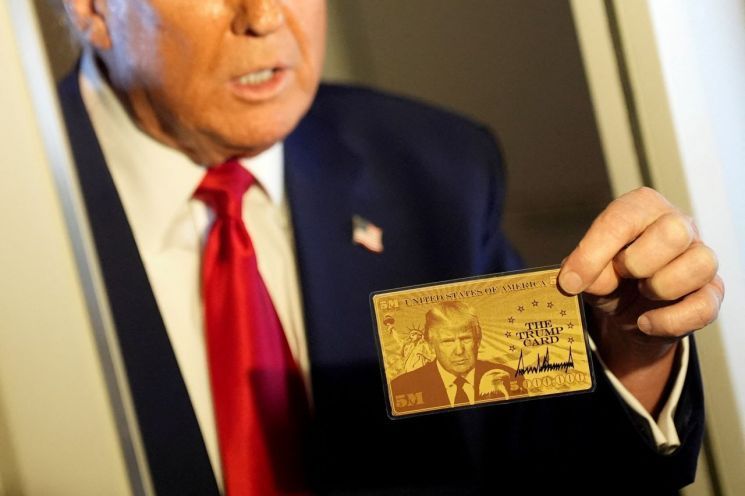 The image of the gold card revealed during a press conference held by U.S. President Donald Trump on his Air Force One on the 3rd of last month (local time). Photo by Reuters Yonhap News
The media outlet analyzed that the main reason is the growing anti-Chinese sentiment in the United States due to escalating U.S.-China tensions. Candice Meng, a real estate developer based in Guangzhou, southern China, told SCMP, "Compared to Singapore or New Zealand, the cost of the Gold Card is attractive." Singapore currently operates an investor immigration program requiring about 19.1 billion won, and New Zealand's program requires 11.5 billion won. However, Meng added, "Given the U.S.-China trade war and the crime rates in American cities, the U.S. does not feel like a desirable place to live," stating that she decided not to apply for the Gold Card.
Affluent individuals are also concerned about tax issues. U.S. President Donald Trump has promised not to tax income earned outside the United States, but there is uncertainty over when this policy might change. For wealthy individuals earning income in multiple countries outside the U.S., this remains a potential headache.
Jack Jing, a manager at the immigration consulting firm Welttrend based in Beijing, China, said, "There are inquiries about the Gold Card, but clients are showing caution." He added, "However, there will likely be definite demand among parents whose children aim to enter Ivy League medical schools," since most U.S. medical schools only accept applications from citizens or permanent residents.
Previously, President Trump announced the Gold Card in February as a more efficient way to attract wealthy individuals from around the world. The Gold Card is expected to replace the existing EB-5 investor immigration program. As of last year, approximately 70% of EB-5 applicants were reportedly Chinese nationals.
© The Asia Business Daily(www.asiae.co.kr). All rights reserved.

















