Windows 10 Support Ends on October 14
Security Updates to Stop... Systems May Be Exposed to Threats
Free Upgrade to Windows 11 Available
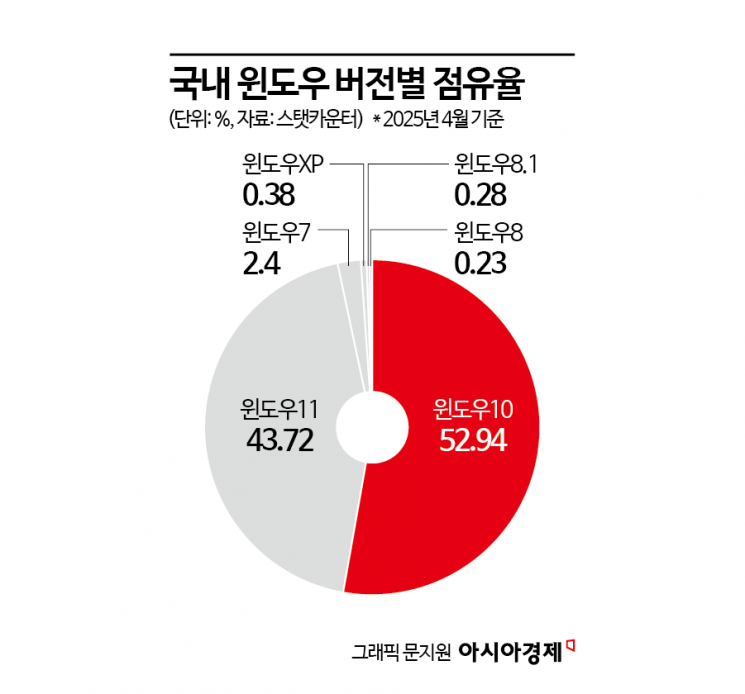
Microsoft (MS) will stop providing security updates for its Windows 10 operating system (OS) starting in October. This means that, in just five months, all Windows 10 users will be exposed to security threats. In South Korea, it is estimated that over 60% of PCs are still running Windows 10.
According to global market research firm StatCounter on May 26, as of last month, 61.6% of PCs in South Korea with a Windows OS installed were still using Windows 10. During the same period, the market share of Windows 11, MS's latest OS, was 37.3%, which is about half that of Windows 10.
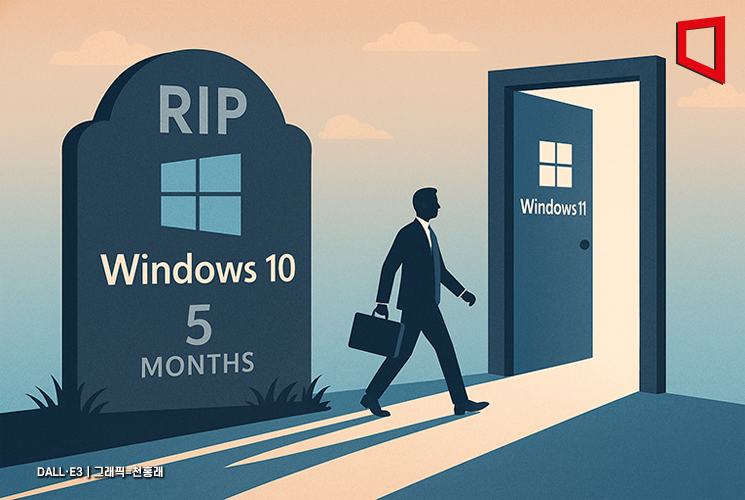
MS plans to end technical support and security updates for Windows 10 starting October 14. Windows 10 was released in 2015 as the successor to Windows 8.1, and nearly ten years have passed since its launch. Until now, MS has provided regular feature and security updates, but after support ends, all security updates will also be discontinued.
Although it will still be possible to use Windows 10 after support ends, users should be aware that their systems will be directly exposed to security threats. This is because security updates will no longer be available, even if vulnerabilities are discovered in the OS. As a result, systems will become more vulnerable to hacking attempts such as zero-day attacks that exploit OS security weaknesses.
To protect PCs running Windows 10, upgrading to Windows 11 is necessary. Since the launch of Windows 11 in 2021, MS has offered free upgrades to all users with genuine Windows 10. Recently, MS has been displaying full-screen notifications to Windows 10 users, prompting them to upgrade to Windows 11.
MS also provides a tool to check whether a current PC can be updated to Windows 11. By clicking the Start button, opening the Settings app, and navigating to Update & Security - Windows Update, users can check if their device is eligible for a free Windows 11 upgrade. The update notification window can also be used to verify whether the PC supports Windows 11.
Companies will also need to undertake OS upgrade efforts. Previously, when support for Windows XP ended in 2014, public institutions and businesses with a high proportion of Windows XP usage rushed to upgrade their OS and replace PCs. Afterward, actual malware attacks exploiting Windows XP vulnerabilities were detected, and the Korea Internet & Security Agency (KISA) released a dedicated antivirus tool to treat the malware.
However, unlike the end of support for Windows XP, most PCs running Windows 10 now meet the requirements for Windows 11 and can be upgraded automatically, so a major disruption is not expected. Some PCs that do not meet the minimum specifications for Windows 11, such as those lacking the TPM 2.0 encryption processor, will need to be replaced.
© The Asia Business Daily(www.asiae.co.kr). All rights reserved.


















