Reflecting the Omission of 'Ten Days' When Switching from the Julian to Gregorian Calendar in 1582
The fact that 'ten days' are completely missing from the Apple calendar application has become a hot topic online.
Recently, a user on X (formerly Twitter) discovered while browsing the 1582 calendar on an iPhone that the day after October 4 was suddenly marked as October 15. The ten days from October 5 to October 14 were entirely omitted.
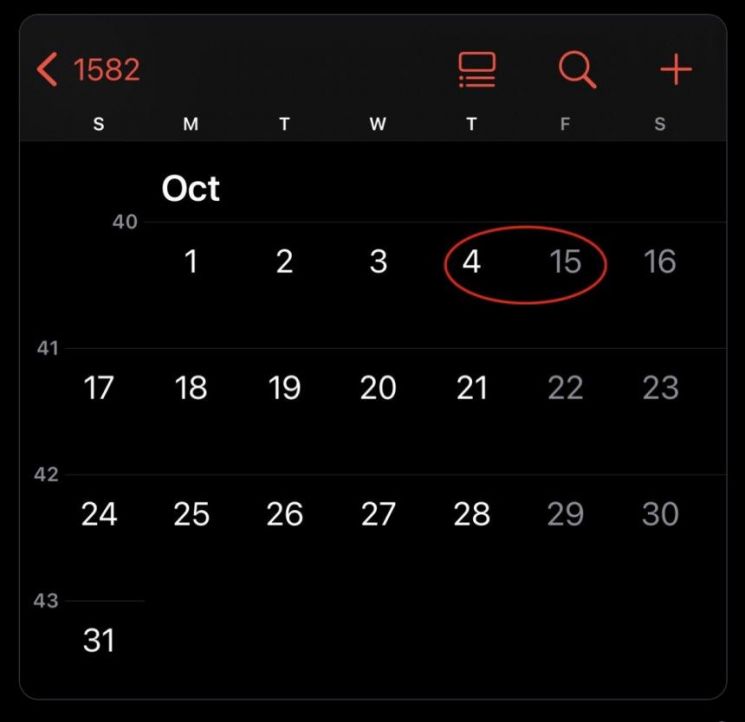 In the calendar app within Apple products, if you go to October 1582, you can see that 10 days are completely missing. X (formerly Twitter)
The user shared a screenshot with the caption, "What on earth happened in October 1582?" In fact, if you check with an iPhone, you can see that ten days are missing when you go to that year.
The post quickly went viral, garnering 45 million views. Online users reacted with comments such as "Ten days deleted overnight," "I'm so curious about the reason," and "I checked, and it's true."
Although it may appear to be a simple technical error, this actually reflects the change in dates that occurred with the adoption of the Gregorian calendar (the modern solar calendar) in 1582. In 45 BC, Julius Caesar, influenced by Egyptian astronomers, introduced the Julian calendar, which replaced the previous lunar calendar with a solar-based system. This calendar calculated a year as 365.25 days, which is about 0.0078 days (11 minutes and 14 seconds) longer than the actual solar year (365.2422 days).
This discrepancy accumulated, causing the date to shift by one day every 128 years, and over centuries, the difference between the calendar and the seasons grew. In particular, as it became increasingly difficult to calculate the date of Easter accurately, Pope Gregory XIII introduced the Gregorian calendar in 1582 to correct this issue.
By that time, the accumulated error under the Julian calendar amounted to ten days. To make up for this, Gregory designated the day after October 4, 1582, as October 15, eliminating the ten-day gap. After the adoption of the Gregorian calendar, the Julian calendar was gradually phased out as the official calendar. However, some Eastern European countries and churches still use it today for religious purposes.
© The Asia Business Daily(www.asiae.co.kr). All rights reserved.

















