New Circulation to Be Halted Starting Next Year
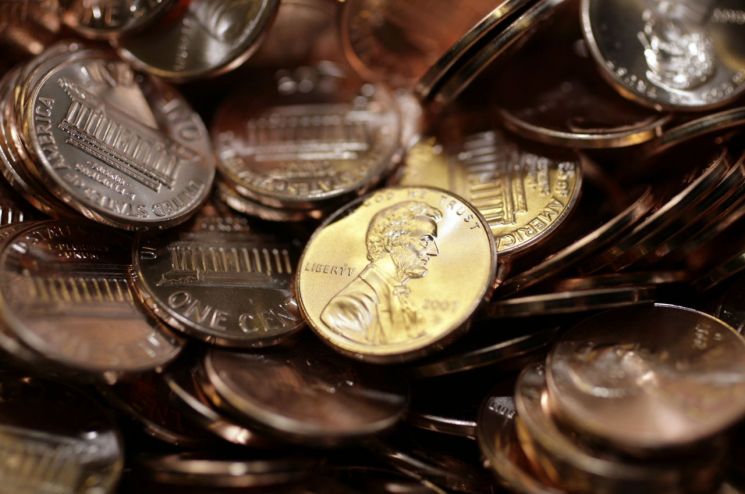
The penny (1-cent coin) is expected to disappear from the United States after more than 200 years. The Wall Street Journal (WSJ) reported on May 22 (local time) that the U.S. Department of the Treasury plans to halt the new circulation of 1-cent coins starting next year and begin a phased withdrawal.
Even after the cessation of penny production, the coin will continue to be used in cash transactions. According to the Treasury Department, if a shortage of 1-cent coins in circulation occurs after production stops, businesses will need to round prices up or down to the nearest 5 cents.
Setting rules for currency production, such as withdrawing coins, is the authority of Congress. However, the Treasury Department told the WSJ that it has the right to halt new minting.
This is the result of longstanding efforts by U.S. political circles to eliminate the penny. Although the penny is worth only 1 cent, its production cost is as high as 3.7 cents. In February, President Donald Trump announced on his social media platform Truth Social that "America has literally been minting pennies that cost more than 2 cents for far too long. This is truly wasteful!" He stated that he had instructed Treasury Secretary Scott Besant to stop penny production. Previously, former President Barack Obama also publicly expressed support for eliminating the penny.
According to political news outlet Politico, earlier this month Republican Senator Mike Lee of Utah and Democratic Senator Jeff Merkley of Oregon introduced a bill to prohibit the Treasury Department from minting 1-cent coins.
According to the Treasury Department, about 114 billion pennies are currently in circulation. However, actual usage is low. The Federal Reserve (Fed) reports that 60% of coins in circulation (up to $14 billion) are stored in coin jars. The WSJ pointed out that Americans throw away coins worth up to $68 million (about 9.36 billion won) each year.
The U.S. Mint plans to stop minting 1-cent coins once it exhausts its current supply of blank coins. The Mint placed its final order for blank coins this month.
Due to rising production costs, the U.S. government produced about 3 billion pennies last year, resulting in a loss of more than $85 million. The Mint expects to save $56 million annually by discontinuing penny production.
There is a global trend toward eliminating low-denomination coins. Canada stopped producing 1-cent coins in 2012 and began rounding cash transactions to the nearest 5 cents. Australia and New Zealand stopped producing 1-cent coins decades ago.
Meanwhile, the discontinuation of 1-cent coin minting is expected to sharply increase the value of rare coins. According to the British media outlet The Mirror in March, the value of the "Lincoln Penny" is estimated to reach up to $121 million. The Lincoln Penny was first issued in 1909 to commemorate the 100th birthday of President Abraham Lincoln and was produced until it was replaced by the "Lincoln Memorial Penny" in 1958.
© The Asia Business Daily(www.asiae.co.kr). All rights reserved.

















