"Weather Volatility Increases Due to Global Warming"
Kim Haedong, a professor in the Department of Environmental Engineering at Keimyung University, predicted, "This summer will be as hot as last year." Last year was recorded as the hottest year in South Korea's observation history.
On May 23, during an appearance on CBS Radio's 'Kim Hyun-jung's News Show,' Professor Kim said, "The Tibetan high-pressure system is expected to have a significant impact on South Korea this year, just as it did last year. In addition, due to global warming, the sea surface temperatures in the western waters are high, which intensifies convection and strengthens the North Pacific high-pressure system. As a result, both air masses that dominate the summer will be strong this year."
He added, "The record-breaking heatwave of 2018 was also caused by the simultaneous influence of the Tibetan and North Pacific high-pressure systems on South Korea."
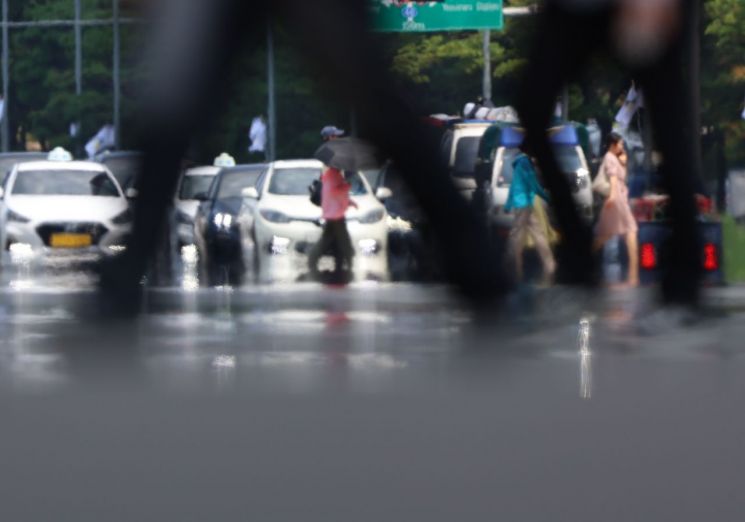 On August 16 last year, heat haze caused by geothermal heat was rising above Yeouidaero in Yeongdeungpo-gu, Seoul. Photo by Yonhap News
When asked about the frequent comments on the high volatility of this year's spring weather, he replied, "Spring weather is inherently variable due to seasonal characteristics." Professor Kim explained, "Even in winter, it is not uncommon for cities closer to the Arctic to have higher temperatures than those in South Korea. This April was quite warm, but in May last year, it was rather cold, and there were even heavy snowfalls."
He went on to say, "In fact, South Korea's weather volatility is nothing compared to other countries." He continued, "In 2023, Italy experienced a prolonged heatwave warning, which was suddenly followed by heavy snowfall. The phenomenon of cold weather when it should be hot is clear evidence that global warming is becoming more severe."
Professor Kim also noted, "Japan is currently experiencing intense heat because the North Pacific high-pressure system is developing rapidly." He added, "Compared to previous years, the rainy season front has also arrived earlier." He explained, "In the Kyushu region, torrential rains caused by the rainy season are very severe, and in Tokyo, there have been many summer days with temperatures exceeding 30 degrees Celsius."
© The Asia Business Daily(www.asiae.co.kr). All rights reserved.

















