Trump Orders Treasury to Halt Penny Production
"It Costs 3 Cents to Make a Penny, It's Wasteful"
Mint Expected to Save 7.74 Billion KRW Annually
President Donald Trump has ordered a halt to the minting of 1-cent (penny) coins, and as a result, the circulation of new 1-cent coins in the United States is expected to be completely halted by early next year. Yonhap News reported on the 22nd (local time), citing the Wall Street Journal (WSJ), that "the U.S. Treasury Department has decided to completely cease the circulation of new 1-cent coins by early next year, as the cost of producing the coin exceeds its face value."
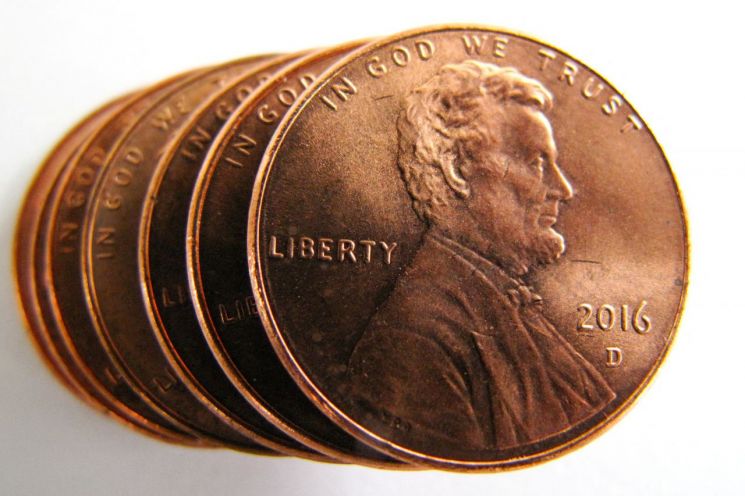 The circulation of new 1-cent coins in the United States is expected to be completely halted by early next year. Reuters Yonhap News
As a result, the 1-cent coin, which has been in use for over 200 years, is expected to be phased out. The Treasury Department reportedly stated, "After a certain period, there will be a shortage of 1-cent coins in the market, which will prompt businesses to adjust their prices up or down to the nearest 5-cent increment."
Although decisions regarding the discontinuation of coins and the establishment of currency production rules fall under the authority of Congress, the Treasury Department is asserting its right to halt new minting.
President Trump instructed the Treasury Secretary to stop minting 1-cent coins in February, citing manufacturing costs. The production cost of a single 1-cent coin is about 3.7 cents, resulting in a loss with every coin made. Additionally, the fact that 1-cent coins are not widely used was also cited as a reason for discontinuation. According to the Federal Reserve (Fed), 60% of coins currently in circulation?up to $14 billion?are stored in coin jars. There is also an analysis that $68 million (about 9.4 billion KRW) worth of coins are discarded annually in the United States.
According to the WSJ, the U.S. Mint will stop minting 1-cent coins once its stock of blank templates is depleted. The Mint reportedly placed its final order for blank coins this month. If the production of 1-cent coins ceases, it is expected that $56 million (about 7.74 billion KRW) could be saved annually through reduced material costs.
President Trump stated on his social networking service (SNS) Truth Social in February, "The United States has been minting pennies that cost more than 2 cents to produce for far too long," adding, "This is wasteful." He continued, "I have instructed the Treasury Secretary to halt the production of new coins," and emphasized, "Let’s reduce waste from the national budget, even if it’s one penny at a time." The Department of Government Efficiency (DOGE), led by Tesla CEO Elon Musk, also argued for the discontinuation of the 1-cent coin in January, stating, "It costs more than 3 cents to make a single 1-cent coin."
Meanwhile, as the likelihood of the 1-cent coin disappearing into history increases, the value of rare coins has surged. According to the British media outlet The Mirror in March, the historically significant "Lincoln Penny" is expected to be valued at $121 million (about 176 billion KRW). The Lincoln Penny refers to the coin first issued in 1909 to commemorate the 100th birthday of President Abraham Lincoln. One side of the coin features Lincoln’s profile, while the other side depicts wheat stalks, and it was produced until it was replaced by the "Lincoln Memorial Penny" in 1958. Coins issued in 1909, 1914, 1943, and 1955 are particularly rare.
If there are small letters under the year on the coin or a printing error, the coin is considered even more valuable. The Mirror noted, "These coins are still in circulation, so anyone could come across one by chance."
© The Asia Business Daily(www.asiae.co.kr). All rights reserved.

















