Enjoying Convenience and Comfort
Without Recognizing AI
Ambient AI is not simply an artificial intelligence service. For this technology to function, it requires a complex technological system capable of detecting a wide range of information from the surrounding environment, analyzing it in real time, and automatically making context-appropriate decisions and executions.
The most fundamental component is the sensor network. These are devices that collect signals across the environment?such as temperature, illumination, movement, and sound?enabling real-time detection of user behavior and changes in space. Edge (distributed) computing technology is then added to rapidly process the data collected. By conducting initial analysis near the device before data is sent to a central server, response speed can be increased and the risk of personal information exposure can be reduced.
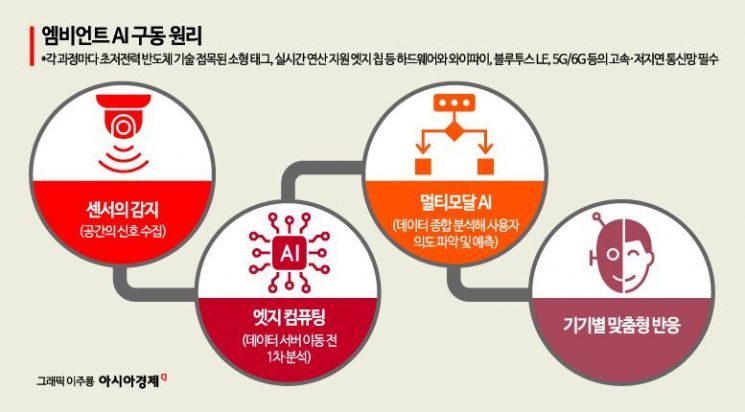
Next, multimodal AI interprets the situation by integrating various sensor inputs. It simultaneously considers complex inputs such as visual, auditory, and behavioral patterns to understand user intent. Providing tailored responses based on this understanding is at the core of ambient AI.
None of these processes would be possible without ultra-low-power semiconductor technology. Energy-efficient hardware, such as small tags that can operate without batteries and edge chips that support real-time computation, is essential. Finally, high-speed, low-latency communication networks such as Wi-Fi, Bluetooth LE, and 5G/6G enable synchronization and data flow among multiple devices.
Ultimately, ambient AI is not a single application technology, but a structure that requires the organic operation of core ICT technologies as a whole. Because it presupposes the maturity of the entire technological ecosystem, it holds industrial significance that goes beyond being a mere convenience technology.
Kim Jaeho, a professor in the Department of Intelligent Information Convergence at Sejong University, explained, "Ambient AI, as artificial intelligence converges with sensors, IoT, networks, edge computing, data, and the cloud industry, will create new industrial opportunities and service markets." He added, "When AI interacts naturally with the environment without user intervention, users can enjoy convenience and comfort without even being aware of the AI's presence, and effects such as automation, increased efficiency, and enhanced safety can be expected across all industries."
© The Asia Business Daily(www.asiae.co.kr). All rights reserved.
![Clutching a Stolen Dior Bag, Saying "I Hate Being Poor but Real"... The Grotesque Con of a "Human Knockoff" [Slate]](https://cwcontent.asiae.co.kr/asiaresize/183/2026021902243444107_1771435474.jpg)
















