Devices Understand and Predict Their Surroundings,
Responding Without User Commands
$406.7 Billion by 2034... Over 20% Annual Growth
Urgent Need for Comprehensive R&D Plans
to Build the Domestic Ambient AI Ecosystem
If there were no smartphones or kiosks, how would we communicate with machines?
Ambient AI is a technology that originated from this very question. It creates an environment where devices understand their surroundings and respond as needed, even without explicit commands from users. As technology replaces interfaces?the connection points that link different devices or systems?technology itself continues to evolve.
Ambient AI is not a single technology, but rather a comprehensive system that operates on the convergence of various ICT technologies, including sensors, edge (distributed) computing, networks, and multimodal recognition that integrates and analyzes sensory information such as vision and hearing.
 Ambient AI collects and analyzes surrounding information in real time, understands the context, and independently decides on appropriate actions. The AI initiates actions without requiring commands to be 'input' and provides services without user intervention. This is why Ambient AI is called the "de facto end point of UX." Provided by Pixabay
It collects and analyzes surrounding information in real time, understands the context, and independently decides on appropriate actions. The AI initiates actions without requiring commands to be input and provides services without user intervention. This is why Ambient AI is called the "de facto end point of UX (user experience)."
Devices understand and predict their surroundings, responding without user commands
The key difference between Ambient AI and traditional automation systems lies in "context awareness." It comprehensively analyzes various signals detected by sensors, such as temperature, humidity, brightness, movement, and voice, and the AI uses this data to predict the next situation. In other words, devices can make judgments and autonomously adjust their responses to suit the situation, all without human commands.
There are already many examples of implementation in the home. Sensors linked to washing machines automatically select the operating mode based on the fabric and degree of soiling, while refrigerators monitor the condition of food and replenish inventory. Sensors attached to pharmaceutical packaging can track whether users have taken their medication and send warnings in the event of missed doses or overdoses.
This trend is expanding to cities and across industries. In manufacturing, sensors detect machine vibrations, temperature, and operating patterns to predict failures and automatically switch process flows. In road and traffic infrastructure, systems coordinate traffic signals in real time by integrating data on vehicle flow, weather, and brightness, while elderly care systems use daily activity patterns to detect fall risks in advance and notify caregivers.
Ambient AI is not only changing "how technology works," but is also redesigning how technology is used. In particular, it offers new possibilities by enabling access to technology without user intervention, even for the elderly and digitally vulnerable groups.
Ambient AI is not just another application technology. Its implementation requires the integration of nearly all ICT fields, including sensors, networks, AI computation, edge hardware, ultra-low-power semiconductors, multimodal algorithms, and security architectures. As such, it stimulates demand across the technology sector and encourages the sequential entry of new players into the ecosystem.
Just as the adult entertainment industry accelerated the development of video compression technology and the gaming industry drove advances in GPUs, Ambient AI serves as a "destination-driven demand source" that provides real incentives for commercialization in various ICT fields.
$406.7 Billion by 2034... Over 20% Annual Growth
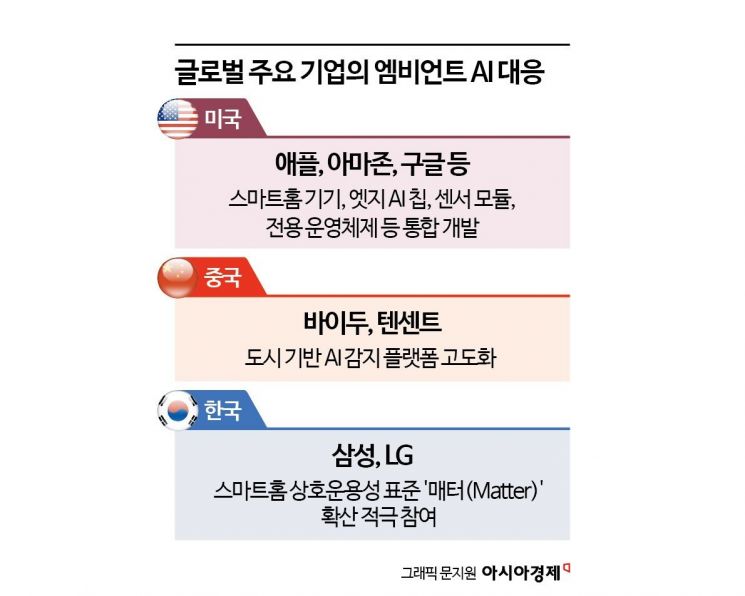
This technological interplay is clearly reflected in the strategies of global companies. Apple, Amazon, and Google are not only developing their own smart home devices, but are also integrating hardware and software such as edge AI chips, sensor modules, and dedicated operating systems. Meanwhile, Baidu and Tencent are advancing city-based AI sensing platforms.
Major European cities are also attempting to transition urban infrastructure to Ambient AI-based systems to improve energy efficiency and public safety. In this way, Ambient AI is not just a technological milestone, but is also being recognized as a catalyst for the transformation of entire industries.
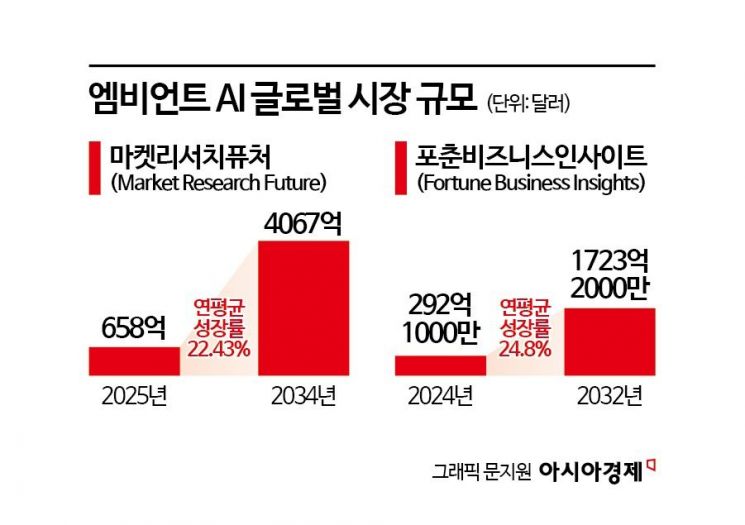
The growth outlook for the Ambient AI market is also very strong. Leading global market research firms predict annual growth rates exceeding 20%. According to Market Research Future, the global Ambient AI market is expected to grow from $65.8 billion in 2025 to $406.7 billion in 2034, with a compound annual growth rate of 22.43%.
Fortune Business Insights estimates that the market will grow from approximately $29.21 billion in 2024 to about $172.32 billion by 2032, with a compound annual growth rate of 24.8%. The main application areas are expected to be smart homes, smart cities, healthcare, retail, and transportation, with gradual expansion into other industrial sectors.
Leading Korean companies such as Samsung and LG are actively participating as key members in the expansion of "Matter," the smart home interoperability standard, keeping pace with the global ecosystem. The government also announced the "Everywhere AI" project in 2023, presenting a strategy to expand Ambient AI centered on smart cities, transportation, and public infrastructure.
However, the reality remains at an early stage. Private sector technology investment is focused mainly on service units, while public sector efforts are limited to pilot projects with only modest results. In particular, government R&D funding is heavily concentrated on AI model development, and investments in foundational technologies such as sensors, edge, and network infrastructure are being made sporadically and without a clear strategy.
Urgent Need for Comprehensive R&D Plans to Build the Domestic Ambient AI Ecosystem
Jaeho Kim, Professor in the Department of Intelligent Information Convergence at Sejong University (Chair of the IoT and Smart City Platform Project Group (PG1001) at the Korea Information and Communication Technology Association (TTA)), emphasized, "Current policy is excessively focused on large-scale AI, and a balanced policy approach between generative AI and physical AI is needed." He added, "It is urgent to establish an Ambient AI ecosystem and comprehensive R&D plans through integration with various industries, including sensors, networks, IoT, home appliances, machinery, and mobility."

Accordingly, there is a need for a shift in awareness among policymakers. Although major presidential candidates have all emphasized fostering the AI industry during the recent election season, most approaches remain shallow, limited to "AI chatbots" and "digital civil service processing."
AI is not just a technology at the level of simple applications. Ambient AI is a representative form of artificial intelligence implemented in real life, and the technological prerequisites that make it possible encompass virtually all ICT infrastructure, including semiconductors, communications, security, sensors, and cloud. In other words, Ambient AI is the most tangible example of "what exactly the AI industry is" in practice.
"AI policies" that are pursued without considering this industrial structure will inevitably have limited industrial impact. What is needed now is a policy shift that approaches Ambient AI not merely as a consumer technology, but as a strategic infrastructure that drives overall technological demand. Without a comprehensive strategy covering regulatory reform, infrastructure investment, and technology standardization, there is a high risk that Ambient AI will become "another technology with opportunities but no structure."
Professor Kim stated, "AI chatbots and digital civil service processing services are certainly areas that should be pursued, but as technologies based on generative AI, their ripple effect across industries is limited." He diagnosed, "We need to establish an industry strategy centered on Ambient AI technology, which organically integrates various technologies, and such a strategy can drive the development of our entire industrial sector."
He further advised, "Structural changes in our society, such as aging and population decline, provide optimal conditions for the early adoption of Ambient AI technology," and added, "Through this, Korea can seize the opportunity to lead related technologies and industries in the global market."
© The Asia Business Daily(www.asiae.co.kr). All rights reserved.
![Clutching a Stolen Dior Bag, Saying "I Hate Being Poor but Real"... The Grotesque Con of a "Human Knockoff" [Slate]](https://cwcontent.asiae.co.kr/asiaresize/183/2026021902243444107_1771435474.jpg)


















