Economic Growth Rate Expected to Remain at 0% This Year
Last year, the number of companies that closed down in Germany approached 200,000, marking the highest figure since the European debt crisis in 2011.
The Centre for European Economic Research (ZEW) reported on May 21 (local time) that the number of business closures in Germany increased by 16% year-on-year to 196,100 in 2024. This is the highest number in 13 years, since 2011, when the entire European economy fell into recession due to the Southern European debt crisis.
By sector, closures of energy-related companies increased by 26% over the past year. IT companies saw a 24% rise, and the construction sector experienced a 20% increase. ZEW researcher Sandra Gottschalk identified Germany’s chronic shortage of skilled workers and excessive bureaucracy as the main causes.
Previously, Germany recorded economic growth rates of -0.3% in 2023 and -0.2% last year, marking two consecutive years of negative growth for the first time in 21 years since 2002?2003. The government also expects the economic growth rate to remain flat at 0% this year.
The German Council of Economic Experts, a federal government advisory body, also stated that "the German economy will be affected for the time being by two factors: US tariffs and fiscal packages," and revised its growth forecast for this year down from 0.4% to 0%.
The German government has decided to establish a 500 billion euro (781 trillion won) infrastructure investment fund over 12 years and is actively seeking ways to stimulate the economy and improve its structure, such as introducing more flexible working hours. The coalition government, which was launched earlier this month, has decided to push for a plan to change the statutory maximum working hours from 8 hours per day to 48 hours per week. The aim is to increase the overall amount of labor by easing restrictions on overtime. Under the current labor law, employees can only work up to 2 hours of overtime per day if their average working hours over six months do not exceed 8 hours per day.
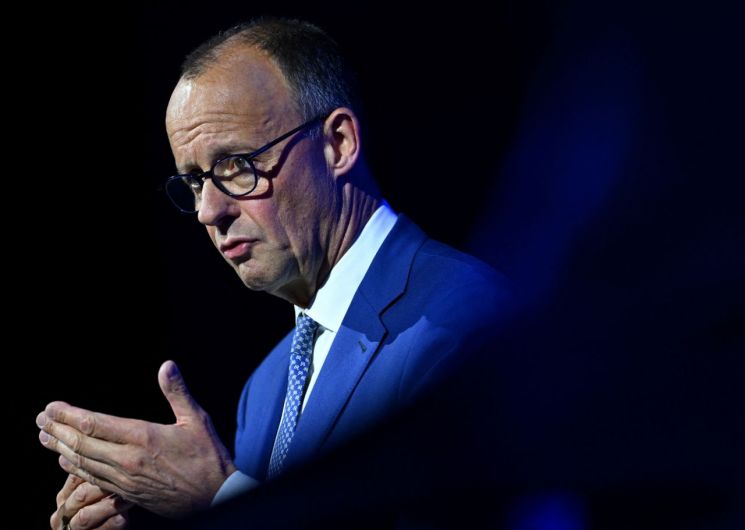
Chancellor Friedrich Merz said on May 15, "A four-day workweek and work-life balance cannot sustain the prosperity of this country," urging people to work more. After his remarks sparked controversy, he added, "It cannot be generalized that Germans work too little."
According to Eurostat, the statistical office of the European Union (EU), the average weekly working hours for Germans last year was 34.8 hours, the third lowest among the 27 member states, following the Netherlands (31.6 hours) and Denmark (33.5 hours).
© The Asia Business Daily(www.asiae.co.kr). All rights reserved.
![Clutching a Stolen Dior Bag, Saying "I Hate Being Poor but Real"... The Grotesque Con of a "Human Knockoff" [Slate]](https://cwcontent.asiae.co.kr/asiaresize/183/2026021902243444107_1771435474.jpg)
















