KFTC Initiates Consent Decision Procedure for Google
"Market Recovery Comes First... Unrelated to Trade Issues"
Google has proposed a voluntary corrective measure in response to the "YouTube Music tying" issue, which includes the creation of a 30 billion KRW mutual growth fund and the launch of a standalone video subscription product. If Google develops and receives final approval for a concrete and effective corrective plan from the Korea Fair Trade Commission (KFTC) plenary session within the next three months, it will be able to avoid administrative sanctions such as fines.
KFTC Accepts Consent Decision Instead of Imposing Fines
On May 22, the KFTC announced its decision to initiate the consent decision procedure in response to Google’s application regarding alleged violations of the Monopoly Regulation and Fair Trade Act. A consent decision is a system in which a business operator accused of violating the law proposes measures for restoration and victim relief, and if these measures are deemed reasonable, the case is closed without determining the legality of the conduct.
Within the next 30 days, Google must submit a draft consent decision that includes a detailed corrective plan for the alleged violations and relief measures for affected companies and consumers. The submitted draft will undergo a two-month public comment period and plenary review before being finalized.
Google’s proposed consent decision centers on the launch of a "YouTube video-only product" and the establishment of a 30 billion KRW mutual growth fund. The YouTube video-only product is identical to the "YouTube Premium Lite" plan already available in nine other countries. This new product will be offered separately from the existing "YouTube Premium" plan, excluding YouTube Music. Even after the new subscription product is launched, consumers will still be able to use the existing YouTube Premium and YouTube Music Premium plans.
Additionally, Google has pledged 30 billion KRW to mutual growth initiatives, including consumer welfare enhancement linked to the new subscription product, support for the domestic music industry, and assistance for artists and creators. Regarding the size of the 30 billion KRW fund, Kim Moonsik, Director General of the KFTC’s Market Surveillance Bureau, explained, "We determined the amount by considering the balance with the level of sanctions (fines) expected if the violation were confirmed." The amount of the mutual growth fund through voluntary corrective measures is the third largest, following Apple and Naver (100 billion KRW each).
The KFTC stated, "We decided to initiate the consent decision procedure after comprehensively considering the nature of the case, the public interest of the corrective measures proposed by the applicant?such as improvements to transaction order and expansion of consumer choice?and the balance with the expected level of sanctions."
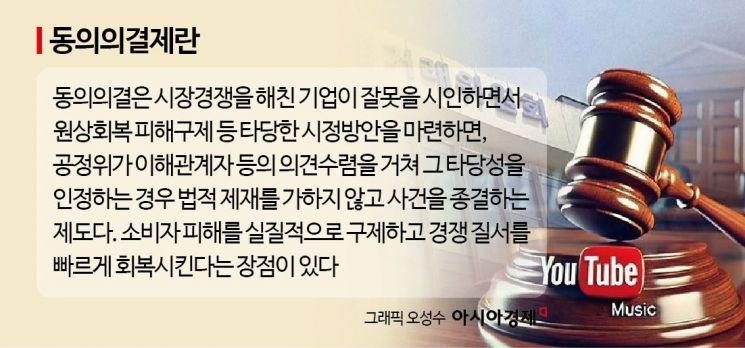
"Market Recovery Comes First... Unrelated to Trade Issues"
Google required users to subscribe to the YouTube Premium plan (14,900 KRW per month) to watch YouTube without ads, which also included YouTube Music Premium (11,990 KRW per month). By bundling the less popular music service with its main video subscription product, Google effectively forced users who did not need the music service to purchase YouTube Music if they wanted to avoid ads. The KFTC has been pursuing sanctions against this practice, as it constitutes tying and impedes fair market competition with other music streaming providers such as Melon, Genie Music, and Flo.
Initially, Google submitted a statement in February denying all allegations raised by the KFTC and announced its intention to contest the matter legally. However, Google abruptly shifted course and opted for voluntary corrective measures. This led to speculation that Google’s sudden move to seek a consent decision was an attempt to use trade issues between South Korea and the United States as leverage to avoid administrative penalties.
In response, the KFTC stated, "This case is unrelated to trade issues," and explained, "We decided to initiate the procedure after determining whether the application met the requirements for a consent decision under the Fair Trade Act."
While consent decisions are regarded as an effective means to provide substantial relief to consumers and quickly restore competitive order, they are sometimes criticized as a loophole because they do not involve a determination of illegality. Business operators accused of violations can avoid fines, years of legal battles, and the legal repercussions that come with an adverse ruling.
Regarding the controversy over granting immunity, the KFTC dismissed the criticism, stating, "The notion that consent decisions amount to leniency for companies is a misunderstanding," and added, "In this case, we determined that the consent decision process was suitable because the online music service market is dynamic and the process can promptly correct the violation."
The KFTC further explained, "We considered the need to promptly restore transaction order to ensure consumer choice and fair competition, the fact that most of the population watches YouTube videos and that this is closely related to daily life, and the potential for the launch of the new subscription product to directly benefit domestic consumers."
© The Asia Business Daily(www.asiae.co.kr). All rights reserved.
![Clutching a Stolen Dior Bag, Saying "I Hate Being Poor but Real"... The Grotesque Con of a "Human Knockoff" [Slate]](https://cwcontent.asiae.co.kr/asiaresize/183/2026021902243444107_1771435474.jpg)

















