Organoid Science, a company specializing in organoid technology, and Cellames, a bioelectronics company, announced on May 22 that they have signed a strategic memorandum of understanding (MOU) for the commercialization of organoid technology.
The two companies plan to integrate a non-destructive real-time monitoring system into the organoid mass production process to ensure uniformity and standardization in production.
Organoid Science has been developing therapeutic organoids that mimic the functions of various tissues and organs. The company plans to focus on establishing a mass production process that ensures consistent quality by utilizing Cellames’s monitoring system.
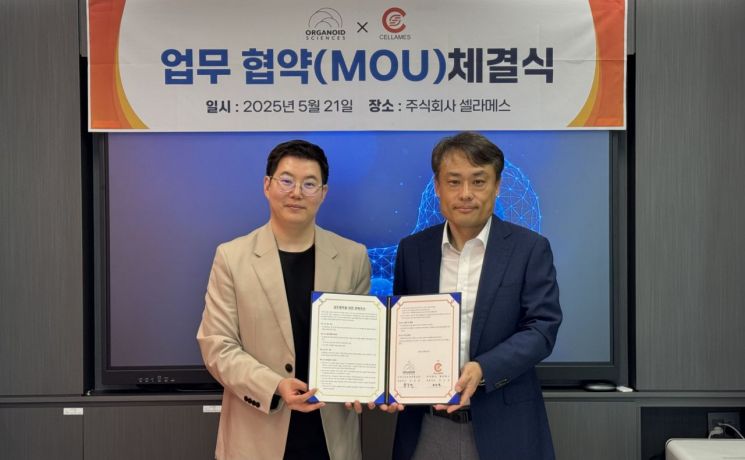
Cellames is currently developing a range of sensors, including non-destructive real-time impedance and MEA systems applicable to non-animal alternative testing methods (NAMS), cell chips for 2·3-dimensional cell analysis including organoids, DO sensors, and pH sensors. Through this agreement, the company plans to provide precise cell analysis and real-time monitoring technologies necessary for organoid mass production.
Organoids are a next-generation biotechnology that can be used in various fields such as regenerative therapy, toxicity testing, and new drug development. However, the lack of standardized production processes has made it difficult to ensure quality, reproducibility, and mass production.
With this agreement, the integration of Cellames’s sensor and real-time monitoring system technology is expected to further accelerate the improvement of organoid quality and mass production.
© The Asia Business Daily(www.asiae.co.kr). All rights reserved.

















