Published in the SCI(E)-Level International Journal 'PLOS ONE (IF=2.9)'
A recent study has found that Chuna therapy, a traditional Korean manual therapy, is effective in improving the function of temporomandibular joint (TMJ) disorders, enhancing quality of life, and offering economic benefits in treatment.
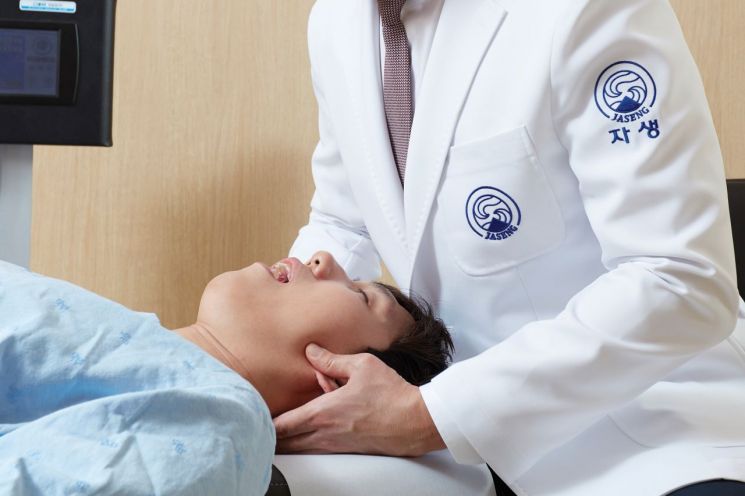 Medical staff at Jaseng Hospital of Korean Medicine are performing temporomandibular joint Chuna therapy. Jaseng Hospital of Korean Medicine
The Spine and Joint Research Institute at Jaseng Hospital of Korean Medicine announced on the 22nd that its research paper, "Clinical Effectiveness and Cost-Effectiveness of Chuna Therapy for Temporomandibular Joint Disorders," has been published in the SCI(E)-level international journal PLOS ONE (IF=2.9).
Temporomandibular joint disorders are conditions characterized by pain in the TMJ and masticatory muscles, restricted jaw movement, and joint noises. Because these disorders are closely related to daily life, they can lead to secondary symptoms such as chronic fatigue and depression. The prevalence of TMJ disorders has been increasing, particularly due to modern lifestyle habits and poor posture. According to statistics from the Health Insurance Review and Assessment Service, approximately 460,000 patients sought medical care for TMJ disorders in 2020, but by 2023, this number had increased by over 100,000 to around 566,000.
Treatments for this condition include physical therapies such as thermotherapy and transcutaneous electrical nerve stimulation (TENS). In Korean medicine, integrated therapies such as acupuncture, pharmacopuncture, and Chuna therapy are used. In particular, Chuna therapy involves using the fingers and palms to push, pull, or rub the affected area to correct body misalignments, and has demonstrated excellent efficacy in improving TMJ disorders.
The research team divided 80 patients with TMJ disorders who visited Jaseng Hospital of Korean Medicine (Gangnam, Daejeon, Bucheon, Haeundae) into two groups: a Chuna therapy group and a general treatment group that received commonly used physical therapies for TMJ disorders, such as thermotherapy and TENS. The patients underwent four weeks of treatment, and the effectiveness and cost-efficiency of each treatment method were compared and analyzed.
The results showed that Chuna therapy was superior in terms of functional and quality of life indicators. The Jaw Functional Limitation Scale (JFLS-Global), which assesses overall TMJ function, improved by about 35% in the Chuna therapy group, from 3.3 points before treatment to 2.13 points after treatment. In contrast, the general treatment group improved by about 9%, from 3.0 points to 2.72 points.
The post-treatment differences between the Chuna therapy group and the general treatment group were also statistically significant. In the evaluation of emotional and verbal expression functions, the Chuna therapy group showed an improvement of approximately 47%, while the general treatment group saw only a 1.4% improvement. Quality of life indicators were also higher in the Chuna therapy group, and follow-up assessments at weeks 13 and 26 showed greater improvement in most areas for the Chuna therapy group.
Both the Visual Analogue Scale (VAS) and the Numeric Rating Scale (NRS), which assess pain, showed that the Chuna therapy group experienced greater improvement than the general treatment group, although the difference was not dramatic.
The cost-effectiveness analysis, which calculated costs related to healthcare utilization, also demonstrated that Chuna therapy was a more efficient treatment than general therapy. From a societal perspective, including productivity loss, the Chuna therapy group achieved a cost savings of about $338 (approximately 470,000 KRW) compared to the general treatment group, and the quality-adjusted life year (QALY) was also higher in the Chuna therapy group. QALY is an index that considers both quality of life and life expectancy, with perfect health equating to 1 and death to 0. In this study, when the willingness-to-pay for 1 QALY was set at 30,050,000 KRW, the probability that Chuna therapy would be cost-effective was up to 98.3%.
Lee Yoonjae, Deputy Director of the Spine and Joint Research Institute at Jaseng Hospital of Korean Medicine, stated, "Through this study, we were able to scientifically prove the clinical effectiveness and cost-effectiveness of Chuna therapy for TMJ disorders. We hope that, with more systematic follow-up research and data, health insurance coverage for TMJ Chuna therapy will be expanded in the future."
© The Asia Business Daily(www.asiae.co.kr). All rights reserved.
![Clutching a Stolen Dior Bag, Saying "I Hate Being Poor but Real"... The Grotesque Con of a "Human Knockoff" [Slate]](https://cwcontent.asiae.co.kr/asiaresize/183/2026021902243444107_1771435474.jpg)
















