The Ministry of Culture, Sports and Tourism announced on May 22 that, together with the Korea Sports Promotion Foundation, it has partially revised the "Regulations on the Criteria and Procedures for Physical Fitness Certification Grades" to subdivide the physical fitness certification grades from three to six levels, with the new system taking effect from June 2.
The Ministry and the Korea Sports Promotion Foundation are operating the "National Fitness 100" project, a public sports welfare service that scientifically measures and evaluates physical fitness, and provides counseling and prescriptions for exercise methods to promote the fitness and health of the public. As of 2025, there are 75 physical fitness certification centers nationwide that measure the fitness of the general public and issue physical fitness certificates or participation certificates for grades 1 to 3.
However, there has been controversy that the criteria for the three-grade system were excessively strict. As of last year, about 60% of participants were classified as "outside the grades." In response, field opinions were raised that the physical fitness certification grades should be newly expanded and set in order to establish a foundation for motivating the public to improve their physical fitness.
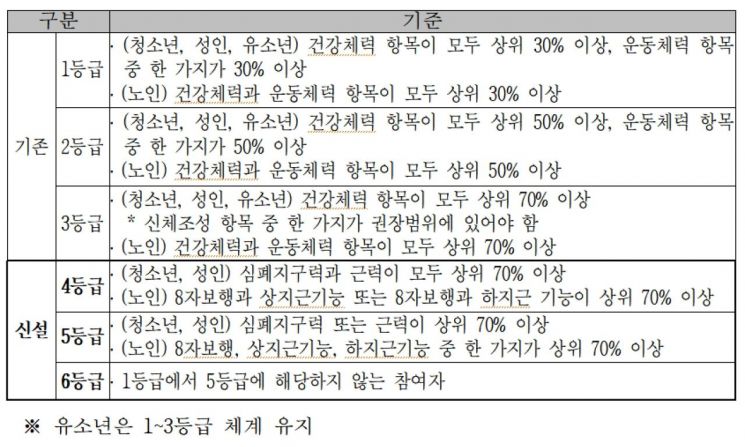 Revised Physical Fitness Certification Grade System [Data provided by the Ministry of Culture, Sports and Tourism]
The Ministry has accepted this feedback and revised the regulations to expand the physical fitness certification system from the existing three-grade structure to a six-grade structure. For example, under the previous system, both adolescents and adults had to be in the top 70% for all categories?muscular strength, muscular endurance, cardiorespiratory endurance, and flexibility?to receive a grade. Under the revised system, even if muscular endurance or flexibility does not reach the top 70%, a grade can be awarded if at least one of cardiorespiratory endurance or muscular strength is in the top 70%.
In addition, the revised regulations now require mandatory verification of participants' identification during the confirmation process, align the Body Mass Index (BMI) and body fat percentage criteria with those of the Korean Society for the Study of Obesity, and have changed the method for displaying percentiles to a format that is easier for the general public to understand.
With this revision, participants who previously could only be classified as "outside the grades" can now receive a grade that accurately reflects their fitness level and receive exercise prescriptions tailored to their needs. This also establishes a foundation for more people to participate in physical fitness improvement activities. Furthermore, if participation in fitness assessments by people with lower fitness levels increases in the future, the "National Fitness 100" physical fitness certification centers' data?used to compile the annual "National Physical Fitness Measurement Statistics"?will become more accurate, increasing its utility in fields such as medicine and public health.
A policy official from the Ministry stated, "With the subdivision and expansion of the physical fitness certification grades, more precise exercise prescriptions can be provided, which is expected to improve public health. We will continue to make efforts to further expand the number of fitness certification centers and to enhance physical fitness measurement and exercise prescription so that all citizens can enjoy a healthy and happy life through the 'National Fitness 100' physical fitness certification centers."
© The Asia Business Daily(www.asiae.co.kr). All rights reserved.

















