Amendment Approved with Modifications by Urban Planning Committee
Three Key Regulations Eased... Introduction of Preliminary Review System
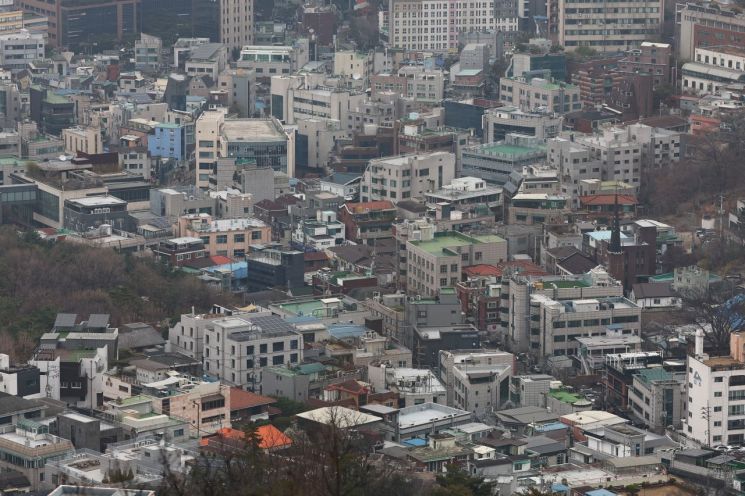
In the future, when the zoning of areas in Seoul that are subject to height restrictions is upgraded, the required ratio of public contributions will be eased. Additionally, the Seoul Metropolitan Government plans to accelerate housing supply by eliminating regulations, such as relaxing floor area ratio requirements when three-dimensional parks are created on sites or atop buildings during redevelopment projects.
The city announced on the 22nd that the amendment to the "2030 Seoul Urban and Residential Environment Improvement Master Plan (Residential Environment Improvement Project Section)" was approved with modifications at the Urban Planning Committee meeting held the previous day.
Through this amendment to the 2030 Master Plan, a legal basis has been established for the following measures announced by the city in January and February: easing the public contribution ratio for areas with height restrictions (Regulation Elimination No. 3), relaxing floor area ratio requirements when three-dimensional parks are created during redevelopment projects (Regulation Elimination No. 6), and setting standards for upgrading quasi-residential zoning in station influence areas with low project profitability (Regulation Elimination No. 35).
First, due to Regulation Elimination No. 3, areas subject to height restrictions?such as those overlapping with altitude or landscape districts, areas near cultural assets or schools, and hilly terrain?will no longer be uniformly required to provide a 10% public contribution when their zoning is upgraded.
Additionally, redevelopment and reconstruction projects will be allowed to introduce three-dimensional parks on private project sites or atop buildings in exchange for relaxed floor area ratio requirements. The area of the three-dimensional park is not excluded from the total site area, resulting in additional land available for housing. This increases the number of housing units that can be built, and the floor area ratio can be further relaxed in proportion to the cost and area of the park installation.
The standards for upgrading quasi-residential zoning in station influence areas with low project profitability have also been clarified. These standards will be applied first to redevelopment projects where the average officially assessed land price in the area is at or below the city’s average for redevelopment and reconstruction projects. Only the portion of the area within 250 meters of the subway station boundary will be eligible for the zoning upgrade.
The city expects these measures to help promote redevelopment projects in station influence areas with low profitability.
In addition, once a redevelopment plan is finalized, it will be possible to undergo Urban Planning Committee review immediately, regardless of whether more than 50% of residents have agreed. The introduction of this "preliminary review system for redevelopment" is expected to further accelerate the designation of redevelopment zones.
The city plans to shorten the period required to designate redevelopment zones by up to an additional six months through the implementation of the preliminary review system, in addition to the significant reduction already achieved through the expedited integrated planning process.
The amended 2030 Master Plan will be officially announced next month after a 14-day period for public review of the modifications approved by the Urban Planning Committee.
Choi Jinseok, Director of Housing for the Seoul Metropolitan Government, stated, "In order to promote redevelopment projects, we have expedited the completion of legal procedures so that the regulation elimination measures can be implemented as quickly as possible." He added, "We will continue to push for regulatory elimination to improve project conditions and focus our efforts on expanding housing supply."
© The Asia Business Daily(www.asiae.co.kr). All rights reserved.

















