"Fine Dust Temporarily Elevated During Residual Fire Extinguishing on May 19"
Health and Environment Research Institute Conducts 24-Hour Monitoring of Surrounding Area Pollution
Yeongsan River Basin Environmental Office: 59 Types of Volatile Organic Compounds Not Detected or Negligible
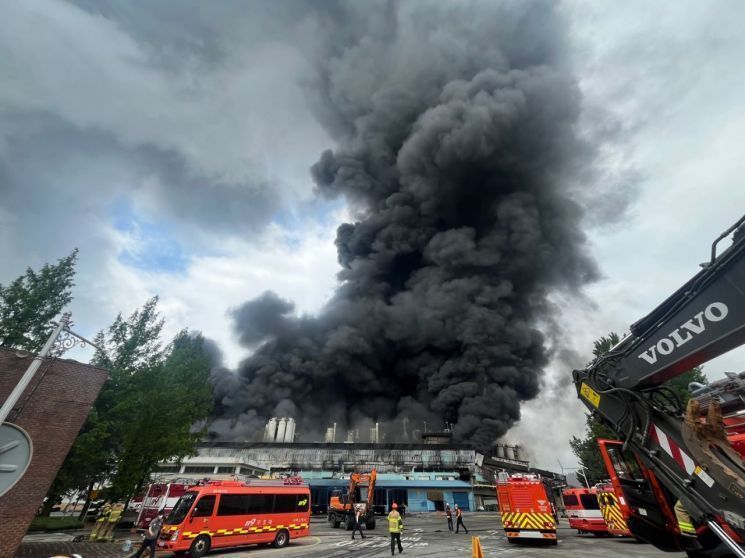 On the morning of the 17th, black smoke soared into the sky due to a fire at the Kumho Tire factory in Gwangsan District, Gwangju. Photo by Song Bohyun
The Gwangju city government announced on May 21 that, according to its monitoring of air pollution in areas near the Kumho Tire Gwangju factory following the fire, fine dust levels were temporarily elevated on May 19 during the extinguishing of residual fires, while air quality remained within standard levels on the other four days.
After the fire broke out at the Kumho Tire Gwangju factory, the city deployed 11 air quality monitoring stations across Gwangju and stationed a mobile monitoring vehicle near the factory to measure and publicly disclose six air pollutants regulated by air quality standards: fine particulate matter (PM-2.5, PM-10), ozone (O₃), sulfur dioxide (SO₂), nitrogen dioxide (NO₂), and carbon monoxide (CO), up to 3 p.m. on May 21.
According to the monitoring results, all six pollutants were measured below air quality standards in the areas surrounding the factory on May 17, the day of the fire, and on May 18. However, after the incident, pollutants that had dispersed into the air due to the heat of the fire descended under low atmospheric pressure, and scattered dust from the extinguishing of residual fires led to (ultra)fine dust levels exceeding the standard on May 19. On May 20 and up to 3 p.m. on May 21, measurements returned to within air quality standards.
Measurements from the air quality monitoring network installed throughout Gwangju indicated that, for all five days from the day of the fire through May 21, air pollution levels remained within air quality standards and showed little difference compared to the 2023 annual average.
The Yeongsan River Basin Environmental Office (Air Quality Management Division) also used a mobile monitoring vehicle to measure 59 types of volatile organic compounds (VOCs) generated by the tire factory fire, and found that they were either undetected or present at negligible levels.
The Health and Environment Research Institute is expected to release this week the results of an odor survey (23 items) conducted on May 19 at three apartment complexes near the factory, as well as indoor air quality measurements taken on May 20 at four nearby apartment complexes.
The Health and Environment Research Institute is also conducting a quantitative analysis, from May 20 for seven days, by collecting samples of about 20 types of volatile organic compounds (VOCs) at the boundary of the Kumho Tire Gwangju factory site. Results are expected around May 30.
Na Byeongchun, Director of Climate and Air Policy, stated, "Although the Kumho Tire fire was completely extinguished on May 20, due to the characteristics of tire factory fires and subsequent demolition work, dust may continue to be generated." He urged, "Residents in surrounding areas should keep their windows closed and be sure to wear masks when going outside."
Meanwhile, in addition to monitoring air pollution, the Gwangju city government is also distributing masks, sending emergency text alerts, and intensifying cleaning of roads near the fire site and other major roads.
© The Asia Business Daily(www.asiae.co.kr). All rights reserved.

















