Four Seasons Hotel Seoul Sets Price at 149,000 Won
Up 18.3% from Last Year
Most Offerings Now in Low 100,000 Won Range
Rising Ingredient and Overhead Costs Drive Increases
As the intense summer heat begins, luxury hotels in South Korea are introducing mango bingsu, a signature summer dessert. The price of mango bingsu has risen every year, and this year, some offerings are approaching 150,000 won. Considering poor harvests due to abnormal weather and rising costs across the board, some even say that "this year may be the last chance to enjoy mango bingsu at its lowest price."
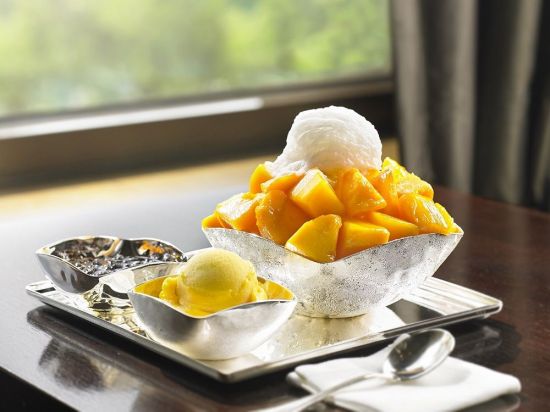
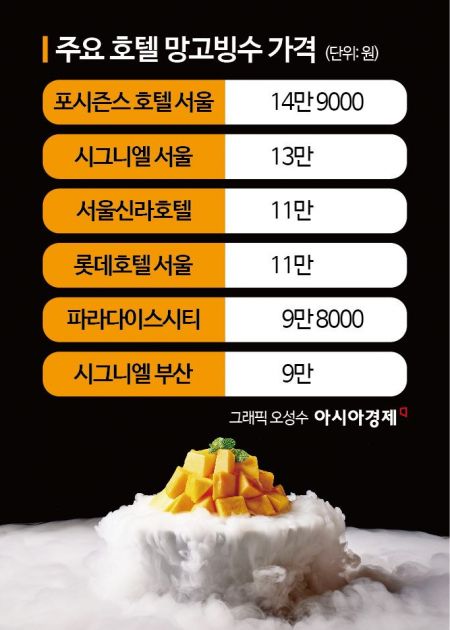
According to the industry on May 21, Four Seasons Hotel Seoul in Gwanghwamun is selling its Jeju Apple Mango Bingsu for 149,000 won this year. This is an 18.3% increase from last year's price of 126,000 won. The bingsu contains two whole premium Jeju apple mangoes. Both Seoul Shilla Hotel and Lotte Hotel Seoul have also raised their mango bingsu prices to 110,000 won this year, marking increases of 7.8% and 19.6% respectively compared to last year.
Until last year, most mango bingsu offerings were priced below 100,000 won, but this year, most have entered the low 100,000 won range. Signiel Seoul is selling its "Signature Jeju Apple Mango Bingsu" for 130,000 won, the same price as last year. Meanwhile, mango bingsu at Paradise City, Paradise Busan, and Signiel Busan is relatively more affordable, priced at 98,000 won, 95,000 won, and 90,000 won respectively.
Mango bingsu was first introduced at Jeju Shilla Hotel in 2008 for 27,000 won, but as it spread to major hotels nationwide, its price quickly increased. At Seoul Shilla Hotel, for example, the price rose from 42,000 won in 2017 by about 10,000 to 20,000 won each year, surpassing 100,000 won for the first time last year.
The hotel industry explains that price hikes are inevitable because the cost of Jeju apple mangoes, the main ingredient, rises every year. Additionally, the prices of secondary ingredients, labor, facility operation, and service fees have all increased. According to the Seoul Agro-Fisheries & Food Corporation, on this day, premium domestic mangoes (3 kg) were traded at Garak Market for 173,750 won, up 23.6% from the same period last year (140,625 won). On top of this, hotels are expected to continue raising prices each year as they add extra decorations and seasonal ingredients to gain a competitive edge.
Despite being more than ten times pricier than bingsu sold at regular dessert shops, hotel mango bingsu continues to attract customers. An industry insider stated, "As the 'small luxury' trend spreads, people are more willing to spend on affordable indulgences like hotel bingsu, rather than pricier rooms or buffets. This makes hotel bingsu less off-putting despite its high price." The insider also noted, "Mango bingsu is gaining popularity among younger generations who want to share their experiences through social media photos."
Major hotels are responding to this trend by expanding their range of unique desserts and diversifying price points to offer more choices. For example, Seoul Shilla Hotel recently launched truffle ice cream, made with premium truffles, as a summer menu item, priced at 60,000 won. Four Seasons Hotel also introduced Maru Bingsu, a modern reinterpretation of the traditional red bean bingsu, for 89,000 won.
© The Asia Business Daily(www.asiae.co.kr). All rights reserved.


















