"They said I can't have surgery if I don't understand Korean."
Begum Ruksana (66), a Pakistani national whom this reporter recently met at Korea University Anam Hospital in Seongbuk-gu, Seoul, visited the Department of Neurology twice just to make a decision about arterial surgery. Although she has been to the hospital a total of four times for diagnosis and tests after being diagnosed with carotid artery stenosis, medical terms such as "MRI" and "cerebral blood flow ultrasound" are still unfamiliar to her. Ruksana said, "They told me that if I couldn't communicate, I couldn't even get an MRI or CT scan, so I had to call foreign friends who speak Korean to barely manage it. Even then, I was guided through hand gestures during the scan," and added, "For surgery, communication is crucial for safety, so they said I can't have the procedure if I don't understand Korean."
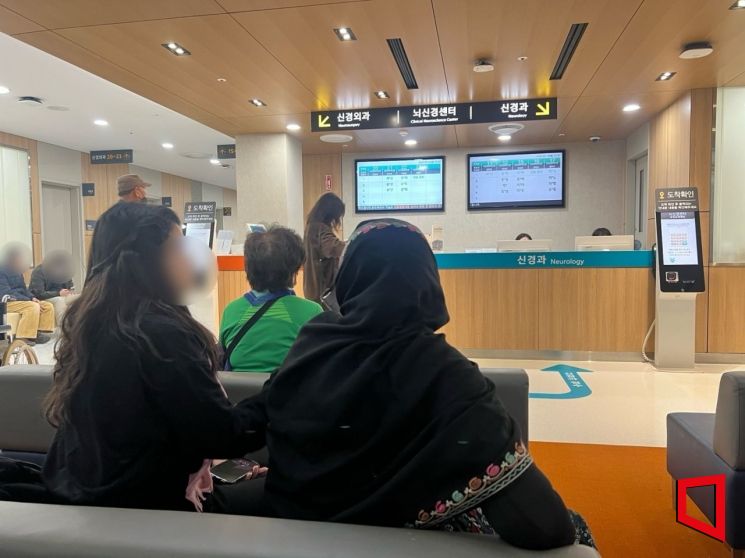 Begum Ruksana (66), in her second year living in Korea, waiting for a consultation at the Department of Neurology, Korea University Anam Hospital. Photo by Eun Seo Lee
Ruksana is not the only one struggling with the "language barrier" at the threshold of making a surgical decision.
According to the "2024 Survey on the Living Conditions and Employment of Immigrants" jointly conducted by Statistics Korea and the Ministry of Justice, among 1.56 million foreigners, 93,000 experienced being unable to visit a hospital in the past year, and among them, 36,000 cited communication difficulties as the reason.
In particular, for foreigners, tests and surgeries for serious illnesses are a significant hurdle. This is because communication between medical staff and patients is most important in cases of major surgery. Medical staff must discuss the patient's medical history, surgical methods, and expected outcomes with the patient and obtain consent in order to ensure a safe surgery. Many foreigners say that without interpretation, it is difficult to receive treatment, from detailed consultations at major hospitals to payment procedures.
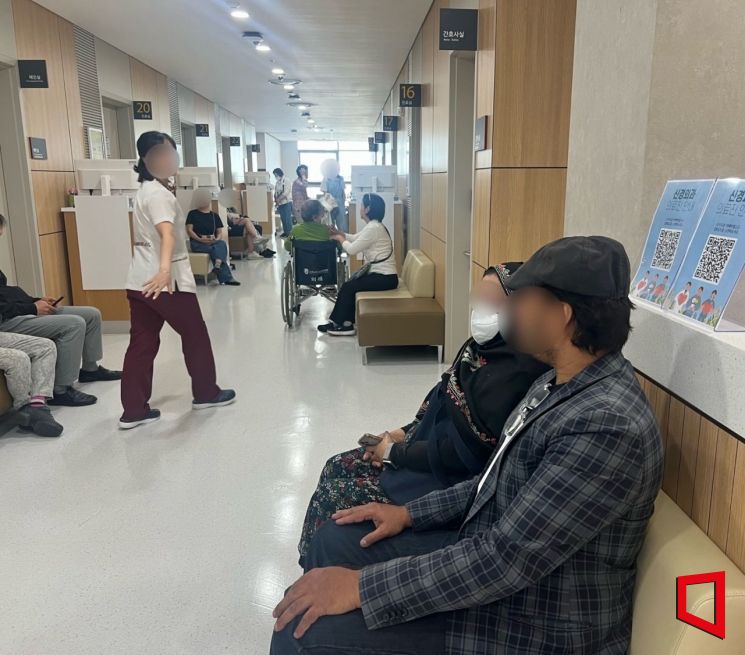 Begum Luksana is seen undergoing hospital treatment procedures with the help of Urdu interpreter Emad Mubasil (47). Photo by Eunseo Lee
To improve medical accessibility for migrants, the Seoul Eastern Foreign Resident Center began providing interpretation support services through the Seoul Medical Interpreter Support Group starting in May. Ruksana was also able to listen to explanations about the surgical procedure and make a decision about surgery with the help of Urdu interpreter Emad Mubasil (47) and interpreter mentor Lim Kyungjin. After the doctor and interpreter mentor discussed the surgical procedure, Emad Mubasil explained it to Ruksana in Urdu.
However, there are still many blind spots on the ground. In particular, interpretation services for minority languages involve complicated procedures. This is because it is difficult to find interpreters who possess both medical expertise and interpretation skills. Emad Mubasil, who interprets in Urdu, said, "Medical terms are different from everyday language, so it's difficult," and added, "Even after living in Korea for 20 years, terms like 'neurophysiology lab' and 'thoracic surgery' are still unfamiliar." Not only is it challenging to interpret medical terminology, but there are also limitations in guiding patients through hospital procedures from registration to payment, so a Korean interpreter mentor with medical knowledge is needed.
Another issue is that interpretation is prioritized for serious cases, surgeries, and hospitalizations, which means foreigners with mild illnesses are given lower priority. Even if symptoms appear mild, patients may actually have a serious illness they are unaware of.
There are calls for additional measures to improve medical convenience for migrants. Kim Sagang, a research fellow at the Migration and Human Rights Research Institute, said, "Even if interpretation services are provided, there are limits to accommodating numerous languages at every medical institution," and added, "It is necessary to provide booklets or systems that translate hospital terminology into various languages and have been reviewed to prevent mistranslation."
© The Asia Business Daily(www.asiae.co.kr). All rights reserved.
![Clutching a Stolen Dior Bag, Saying "I Hate Being Poor but Real"... The Grotesque Con of a "Human Knockoff" [Slate]](https://cwcontent.asiae.co.kr/asiaresize/183/2026021902243444107_1771435474.jpg)

















