Allegations have surfaced that Korea Land and Housing Corporation (LH), the project owner, arbitrarily changed evaluation criteria during the process of selecting a contractor for the construction of the country's largest semiconductor cluster site, potentially steering the project toward a specific company.
Unlike in previous cases, LH tightened the bidding requirements, allowing only a particular company to participate. Controversy has arisen from the very first stage of the industrial complex development.
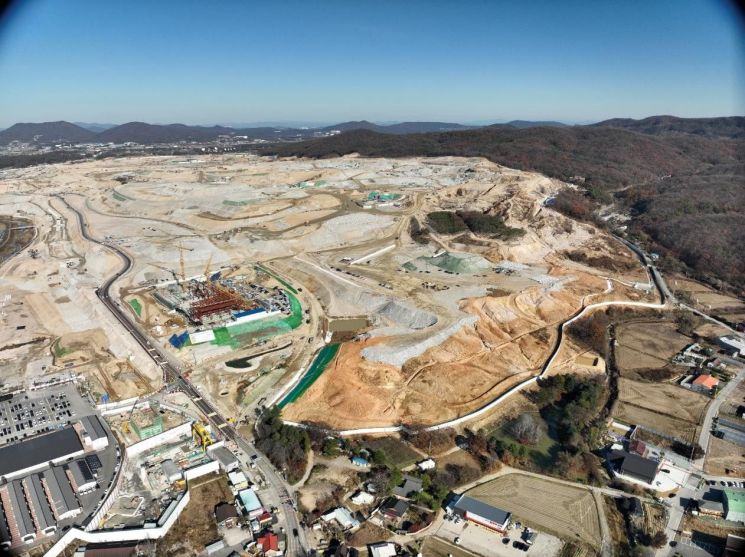 Panoramic View of Wonsam Yongin Semiconductor Cluster General Industrial Complex Construction Site...
LH's Existing Standard: 279.9 Billion Won Possible... Actual Cutoff at 1.3 Trillion Won
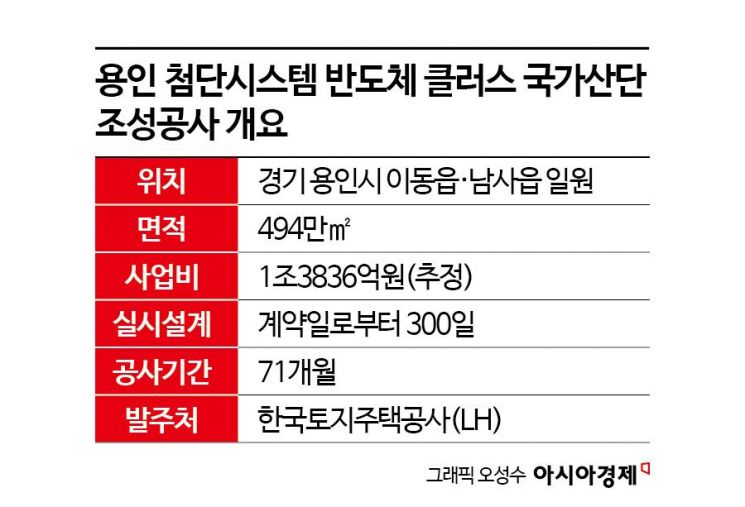
On May 20, LH reissued the notice for selecting a contractor for Section 1 of the Yongin Advanced System Semiconductor Cluster National Industrial Complex development project. After issuing the initial bidding notice in mid-April and conducting a pre-qualification (PQ) screening until recently, only the Hyundai Engineering & Construction consortium (Hyundai E&C) passed the PQ. As competitive bidding was not established, LH decided to reissue the notice.
PQ is a stage prior to the main bidding process to verify whether a company meets 'eligibility' requirements, such as financial health and construction capabilities. If a company is deemed ineligible at this stage, it is 'cut off' and cannot participate in the main bid. For this PQ screening, LH set the evaluation standard amount at 1.3814 trillion won, equivalent to the total construction cost. Only companies with prior experience in developing industrial complex sites of this scale were allowed to participate in the bid.
The construction cost standard applied in the PQ screening contradicts LH's own internal evaluation criteria. According to these criteria, for site development projects exceeding 1 million square meters, the evaluation standard amount should be calculated as 'estimated construction cost × 1 million square meters / actual project size (area in square meters)'. This provision is specified as a special clause and is generally applied before other regulations. Applying this formula, the threshold for a perfect score is about 279.9 billion won?only one-fifth of the standard initially presented by LH.
LH explained, "The PQ criteria are necessary conditions considering the characteristics and the massive scale of the Yongin Semiconductor National Industrial Complex project," adding, "We set the standards according to the National Contract Act and construction PQ criteria, and reflected them in the bidding notice." Article 14 of LH's PQ criteria states, "For matters where it is difficult to apply these criteria, they may be implemented by reflecting them in the bidding notice or site briefing documents." There are differing opinions as to whether this project qualifies as a case where it is difficult to apply the standard criteria.
"Criteria Actually Relaxed"
LH has stated that the PQ criteria applied in this bidding process were actually more relaxed than the original standards. For projects not subject to the comprehensive evaluation lowest bid system, as in this case, companies would normally need to have experience amounting to at least 350% of the evaluation standard (either in scale or value) to receive a perfect score. If this standard were applied as is, companies would need construction experience totaling nearly 5 trillion won or over 17 million square meters. Since no construction company meets this requirement, LH claims that lowering the threshold to 100% of the construction cost made it easier to participate in the bid.
However, only Hyundai E&C qualified in the PQ screening. Since the same conditions are maintained for this re-bid, it is highly likely that Hyundai E&C will secure the project through a private contract.
LH Overlooks Competitive Bidding
The industry is rife with speculation regarding this project. Some criticize LH's decision to set the PQ standard based on monetary value. For relatively straightforward projects like industrial complex site development, area has typically been used as the standard. For example, LH used area as the basis for PQ screening for projects such as Guri Galmae Station Area, Seongnam Geumto Public Housing District, and Gyeongsan Daeim Public Housing District.
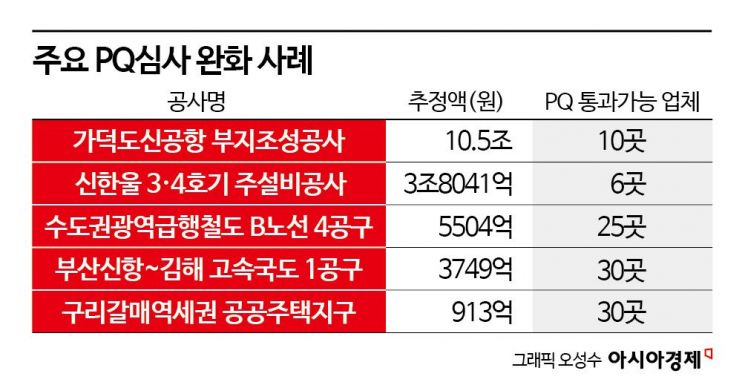
For large-scale projects, it would have been possible to divide the project into smaller packages for separate bidding. For instance, the Ministry of Land, Infrastructure and Transport, through the Public Procurement Service, divided the site development for the Gadeokdo New Airport into separate PQ standards for the airport (80 billion won), port (90 billion won), and bridge (240 billion won). Despite the high complexity of the project, which included reclaiming part of the coastline to build a runway, the PQ standards were much lower than those for the Yongin Semiconductor Complex. In the Gadeokdo New Airport site development project, 10 companies passed the PQ. For Section 4 of the Metropolitan Express Railway Line B, the PQ perfect score threshold was eased from 300% to 100%, allowing 25 companies to pass the PQ and qualify for bidding. In bids for various social infrastructure projects such as railways and roads, it is common practice to broaden eligibility to encourage competition.
There are also arguments that, since the project uses a Construction Manager at Risk (CMR) method, it would be more reasonable to select a contractor through competition among various companies. Under the CMR method, LH, as the project owner, collaborates with the selected construction company to review designs and determine the optimal design or construction method.
There are also suggestions that the bidding process may have violated relevant laws such as the National Contract Act. The National Contract Act stipulates that, in government contract bidding, eligibility restrictions must be appropriate, and it is prohibited to require completion records beyond what is necessary. Restricting participation so that only a specific company can bid may constitute unfair trade practices or abuse of market dominance, potentially violating the Fair Trade Act.
© The Asia Business Daily(www.asiae.co.kr). All rights reserved.



















