Korea's Exports Fall 2.4% in Early May
U.S. Exports Show Steepest Decline Among Major Trading Partners
Exports to the United States have continued to decline in May, following a drop in April, due to the impact of tariff measures imposed by U.S. President Donald Trump. As exports to the U.S. fell by nearly 15% in the first 20 days of this month, total exports also decreased by 2.4%.
According to export and import statistics for May 1-20 released by the Korea Customs Service on the 21st, exports amounted to $32 billion, a decrease of 2.4% ($780 million) compared to the same period last year.
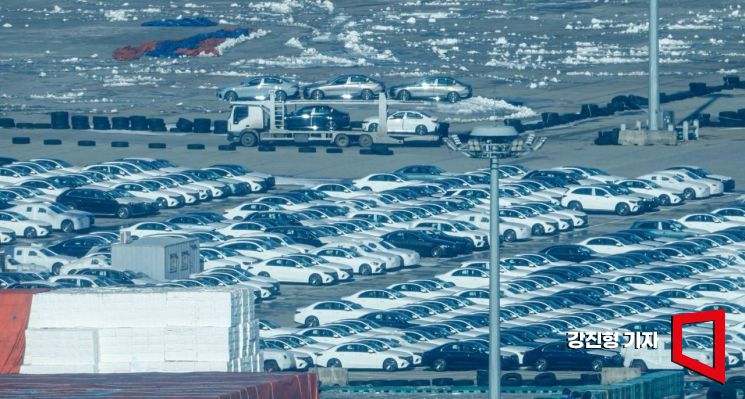 Export vehicles are waiting to be loaded at Pyeongtaek Port, Gyeonggi. 2025.2.13. Photo by Kang Jinhyung
The number of business days remained the same at 12.5 days. Taking this into account, average daily exports were $2.56 billion, down 2.4% from a year earlier.
Among the top 10 export items, eight categories saw declines, with the exception of semiconductors (up 17.3%) and ships (up 0.1%). Exports of passenger cars and petroleum products fell by 6.3% and 24.1%, respectively. Steel products (-12.1%), auto parts (-10.7%), and home appliances (-19.7%) also experienced declines. By country, exports increased to Vietnam (up 3.0%), Taiwan (up 28.2%), and Hong Kong (up 4.5%). In contrast, exports to China (-7.2%), the United States (-14.6%), and the European Union (EU, -2.7%) decreased.
Among the top 10 export destinations, the decrease in exports to the United States (-14.6%) was the steepest. Exports to the U.S. had already fallen by 6.8% last month, reflecting the impact of Trump's policies. In particular, automobile exports dropped by 19.6% due to the 25% tariff imposed by the U.S. on imported cars starting April 3, 2025. The government analyzed that the decline in automobile exports to the U.S. was due to both the imposition of tariffs and the full-scale operation of a new plant in Georgia.
Imports for May 1-20 totaled $32.2 billion, down 2.5% ($820 million) from the same period last year. Imports of semiconductors (up 1.7%) and semiconductor manufacturing equipment (up 2.4%) increased, while imports of crude oil (-9.5%) and gas (-8.4%) decreased. Total energy imports, including crude oil, gas, and coal, fell by 10.7%.
By country, imports from Japan (up 2.4%), Australia (up 12.8%), and Vietnam (up 25.3%) increased, while imports from China (-1.4%), the United States (-2.3%), and the EU (-9.2%) declined.
The trade balance for May 1-20 recorded a deficit of $300 million. As a result, the cumulative surplus from January 1 to May 20 this year decreased to $11.768 billion.
© The Asia Business Daily(www.asiae.co.kr). All rights reserved.
![Clutching a Stolen Dior Bag, Saying "I Hate Being Poor but Real"... The Grotesque Con of a "Human Knockoff" [Slate]](https://cwcontent.asiae.co.kr/asiaresize/183/2026021902243444107_1771435474.jpg)
















