A team of Korean researchers has, for the first time in the world, proposed a methodology to quantitatively diagnose catalyst degradation (performance deterioration) during the production of green hydrogen.
On May 21, KAIST announced that a research team led by Professor Dongyoung Jung from the Department of Bio and Chemical Engineering has developed a new evaluation metric, the Operational Stability Factor (OSF), which can predict the lifespan of catalysts in water electrolysis systems.
 (From left) Jinyeop Kim, PhD candidate, Department of Bio and Chemical Engineering; Dongyoung Jung, Professor, Department of Bio and Chemical Engineering; Jongsu Noh, PhD candidate, Department of Bio and Chemical Engineering. Provided by KAIST
First, the research team identified the phenomenon of catalyst and support degradation, including catalyst damage and performance deterioration, that can occur when water electrolysis systems are shut down or operated at low loads. They also developed the Operational Stability Factor as a metric to quantitatively assess this degradation.
The Operational Stability Factor is designed to numerically reflect the degree of catalyst degradation that occurs as water electrolysis equipment repeatedly starts and stops, thereby enabling accurate prediction of durability under real operating conditions.
For example, an Operational Stability Factor of 100% means that the catalyst is not damaged at all during load fluctuations, while a value of 99% indicates that the catalyst is damaged by 1% each time the system is shut down.
In hydrogen production systems utilizing renewable energy sources such as solar and wind power, the supply of electricity is inherently variable, causing the load on water electrolysis devices to fluctuate continuously.
However, by applying the Operational Stability Factor, it becomes possible to optimize operating conditions with durability in mind, which the research team expects will serve as an important benchmark for developing strategies to operate water electrolysis systems over extended periods.
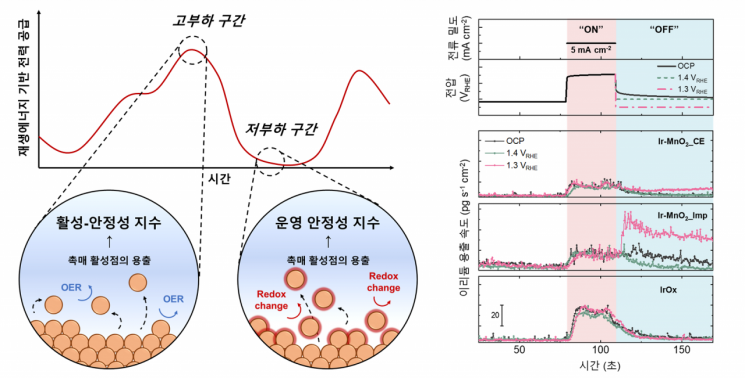 Operation and Degradation Mechanisms of Water Electrolysis Systems in Response to Renewable Energy Fluctuations. Provided by KAIST
Professor Dongyoung Jung stated, "The Operational Stability Factor is a powerful evaluation criterion that can numerically predict the long-term lifespan of water electrolysis catalysts," adding, "It has great potential to become an international standard for durability diagnostics in the future."
Meanwhile, the research paper was completed with Jinyeop Kim, a PhD candidate in the Department of Bio and Chemical Engineering, as the first author. The paper was published on May 2 in ACS Energy Letters, one of the most prestigious journals in the field of energy.
© The Asia Business Daily(www.asiae.co.kr). All rights reserved.


















