Who Will Lead the Next Administration's Diplomatic Stage?
Organizational Leadership Shifts with Each Administration
Federation of Korean Industries Faces Awkward Ties with the Democratic Party
Economic Organizations Deliberate Post-Election Response Strategies
With the presidential election scheduled for the 3rd of next month and the launch of a new administration approaching, economic organizations are engaged in a subtle competition for leadership in private-sector diplomacy.
According to the business community on the 22nd, major economic organizations such as the Federation of Korean Industries (FKI), the Korea Chamber of Commerce and Industry (KCCI), and the Korea International Trade Association (KITA) are now engaged in behind-the-scenes competition to secure leadership, as the representative body in the new administration's diplomatic arena could change. An official from one economic organization said, "The organizations are keeping a low profile and watching carefully ahead of the presidential election." In particular, major organizations are paying close attention to the possibility of changes in their relationship with Lee Jae Myung, the Democratic Party's leading presidential candidate.
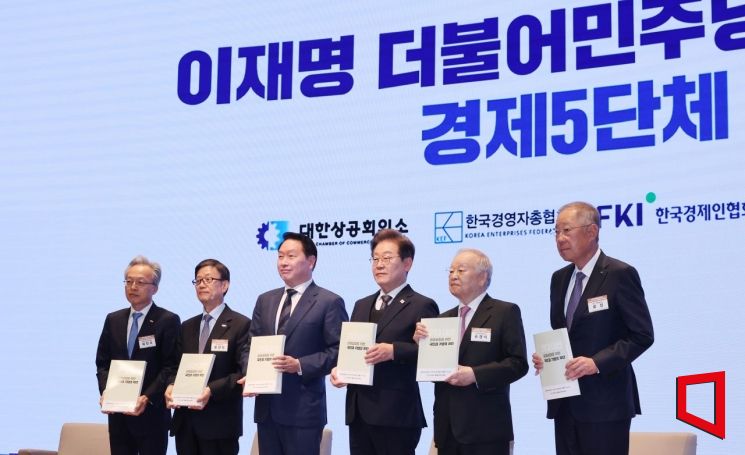 Lee Jae Myung, the Democratic Party presidential candidate, attended a meeting with the heads of five economic organizations at the Korea Chamber of Commerce and Industry in Jung-gu, Seoul, on the morning of the 8th, holding a policy proposal booklet and taking a commemorative photo together. (From left) Choi Jin Sik, chairman of the Korea Federation of Medium-Sized Enterprises; Yoon Jin Sik, chairman of the Korea International Trade Association; Choi Tae Won, chairman of the Korea Chamber of Commerce and Industry; candidate Lee; Sohn Kyung Shik, chairman of the Korea Employers Federation; Ryu Jin, chairman of the Federation of Korean Industries. Photo by the National Assembly Press Photographers Group
There is also the precedent that the role of economic organizations leading private-sector diplomacy has changed depending on the political orientation of the administration. During conservative administrations, the FKI (formerly the Federation of Korean Industries) was at the center, while during progressive administrations, the KCCI tended to take the lead. As a result, there is a growing perception that the organization holding the initiative in the first summit diplomacy of the next administration will, in effect, represent the business community.
The FKI is known to have become more distant from the Democratic Party after being implicated in the "state affairs manipulation" scandal during the Park Geun Hye administration when it was still known as the Federation of Korean Industries. Last year, the organization appointed Ryu Jin, chairman of Poongsan, as its new chairman and changed its name in an effort to refresh its image, but it is still considered to be distant from the Democratic Party. Internally, there is an atmosphere of refraining from political statements until the presidential election.
As a result, there is speculation that the KCCI may benefit relatively. Choi Tae Won, chairman of the KCCI, has recently been actively engaging with politicians from both ruling and opposition parties and is considered to be maintaining a relatively smooth relationship with the Democratic Party.
Some organizations are already developing response strategies on the assumption of a progressive administration. This is seen as a preemptive measure to address risks related to management rights and corporate regulation. Candidate Lee has proposed amendments to the Commercial Act, including the mandatory cumulative voting system and the separate election of audit committee members. Economic organizations have previously expressed concerns that such measures could worsen the corporate management environment.
© The Asia Business Daily(www.asiae.co.kr). All rights reserved.

















