Fire Authorities Estimate Over 60 Percent Damage to Second Plant
Relocation of Factory Considered Over Facility Restoration
Difficulties in Securing 1.2 Trillion Won for Relocation
Numerous Challenges Including Land Purchase and Zoning Changes
1 Billion Won Down Payment Remains for Bitgreen Industrial Complex Site
No Exit Strategy Other Than Investment from Doublestar
Kumho Tire: "Compensation for Residents Is the Top Priority"
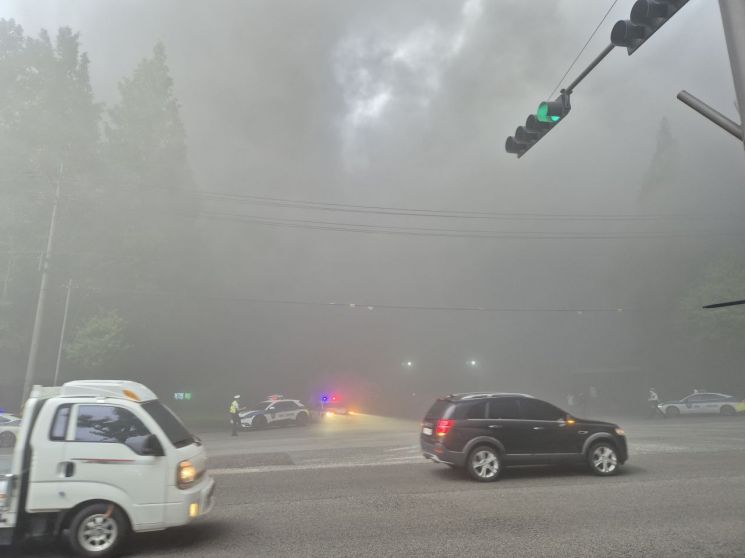 On the morning of the 17th, a fire broke out at Kumho Tire's Gwangju factory, filling nearby roads with thick black smoke, causing vehicles to slow down. Photo by Reader
The fire that broke out at Kumho Tire's Gwangju factory was extinguished after more than three days, but the company's concerns continue to deepen. Although there are calls to expedite the relocation of the factory due to extensive damage across the production lines in the region, it is not physically easy to make an immediate decision. Furthermore, the company is now faced with a host of issues, including employee treatment and compensation for local residents, that have arisen in the aftermath of the fire.
The fire authorities announced that the fire was completely extinguished at 11:50 a.m. on May 20, 2025. The fire incident had started at 7:11 a.m. on May 17, and the suppression took a total of 76 hours and 39 minutes.
Although the fire has been put out, the atmosphere inside Kumho Tire remains unsettled. The company must promptly investigate the cause of the accident, assess the extent of damage to production facilities, and devise countermeasures. According to fire department estimates, Kumho Tire's Gwangju factory lost about 50 to 60 percent of its second plant (compounding process) out of its two main sections.
However, a Kumho Tire official explained that losing 60 percent does not necessarily mean that the remaining 40 percent of production facilities are fully intact. Depending on the situation, the company may have to remove all production facilities.
The second plant, which suffered the most damage in this fire, primarily handles the compounding process, in which various chemicals are mixed with natural rubber, the main raw material for tires. The tire production process generally involves compounding, followed by extrusion and rolling to create semi-finished products, and then molding, vulcanization, and inspection before final shipment. As the facility responsible for the initial compounding stage, it is considered a core production line.
Kumho Tire operates eight tire production factories in Korea, China, the United States, and Vietnam. The Gwangju factory alone has produced 33,000 tires per day, totaling 12 million tires annually. This accounts for 44 percent of domestic production, which is 27 million units per year. In terms of sales, this translates to an average of 2.7 billion won per day, or approximately 950.4 billion won per year. If the second plant is deemed completely unusable and production is halted for several months to nearly a year, this sales figure would directly translate into losses.
Some argue that now is the right time to push for the long-delayed relocation of Kumho Tire's factory. If the factory is going to be relocated anyway, they question the need to restore production facilities at the current site.
Last October, Kumho Tire signed a contract with Korea Land and Housing Corporation (LH) to purchase 500,000 square meters (151,250 pyeong) of land within the second phase of the Hampyeong Bitgreen National Industrial Complex for 116.08 billion won. With this land secured, relocation is considered feasible if the company is willing.
On the other hand, there is considerable hesitation within Kumho Tire regarding the relocation. There are many hurdles to overcome in order to proceed with moving the factory.
The estimated cost of relocating the Gwangju factory is about 1.2 trillion won. This estimate is based on development planning data, but due to the nature of the factory, the actual cost could be even higher. Kumho Tire originally planned to fund the relocation with the proceeds from selling the current factory site, which was valued at 1.4 trillion won according to a 2022 appraisal.
However, due to the domestic and global economic downturn, the construction and development markets have slumped, making it difficult to find major investors willing to negotiate. Furthermore, administrative procedures such as changing the land use designation of the current factory site must be completed for the sale, but achieving this within a few months is virtually impossible.
Although one option is to pay the remaining 100 billion won of the down payment (10 percent of the total amount already paid) for the Hampyeong Bitgreen National Industrial Complex land and immediately begin facility construction, the company currently lacks sufficient cash to do so.
Kumho Tire estimates that the maximum period required for factory relocation is about three years.
Given that the company generates up to 1 trillion won in annual sales, the opportunity cost of suspending the production line for three years makes it unlikely that an immediate decision to relocate will be made.
In addition, there are other difficult issues to resolve, such as compensation for residents affected by the fire and employment concerns for the approximately 2,200 workers.
Of course, if Doublestar, the majority owner of Kumho Tire, were to provide aggressive financial support as part of an exit strategy, the situation could change. However, given Kumho Tire's track record of maintaining independent management, this seems unlikely.
There is also speculation that insurance payouts from this fire could help cover some of the relocation costs.
Kumho Tire has insurance contracts with six companies: DB Insurance, Hyundai Marine & Fire Insurance, Samsung Fire & Marine Insurance, Hanwha General Insurance, Meritz Fire & Marine Insurance, and KB Insurance, with a maximum compensation limit of about 500 billion won.
While compensation will ultimately be determined based on the results of the investigation into the cause of the accident and the company's own liability, the insurance industry cautiously predicts that Kumho Tire will find it difficult to secure more than 60 to 70 percent of the maximum payout.
From Kumho Tire's perspective, relocating the factory is ultimately inevitable, but at this point, the company finds itself in a dilemma where neither option is feasible.
A Kumho Tire official stated, "This fire has caused a complex set of problems. At this point, our priority is to determine the cause of the accident and to focus on the health and compensation of residents around the factory. Relocating the factory is not something we can do just because we want to. We need to monitor the situation further."
© The Asia Business Daily(www.asiae.co.kr). All rights reserved.

















