Overseas Koreans: "Sometimes it takes a two-day trip just to vote"
Lee: "People Power Party likely to oppose... Needs discussion in the National Assembly"
On the proposal for a K-Internet University to promote Hallyu: "That's a great idea"
Lee Jaemyung, the presidential candidate of the Democratic Party of Korea, emphasized the need to consider measures such as postal voting and expanding polling stations to guarantee voting rights for overseas Koreans. When an overseas Korean proposed the establishment of a 'K-Internet University' to teach Hallyu as a policy idea, Lee responded by saying, "That's a great idea," and was seen jotting it down in his notebook.
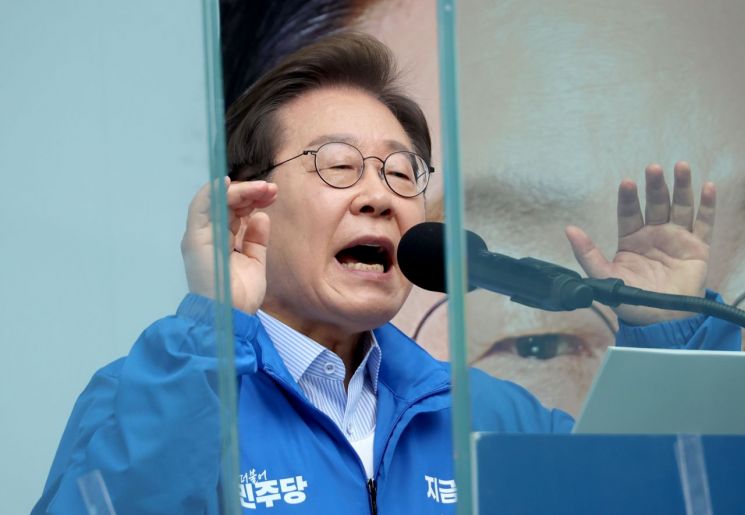
On the morning of May 20, Lee held a Zoom meeting with overseas Koreans titled "K-Initiative TV: Korean Citizens Around the World Online Talk, Talk!" Responding to a suggestion from an overseas Korean about the necessity of postal voting, Lee said, "We may not be able to cover all the costs required for overseas Koreans to vote, but we should at least provide a minimum level of convenience," adding, "We will look for ways to secure stability, such as increasing the number of polling stations or allowing people to register and vote at the same time, so that voting can be made easier."
Overseas Koreans who participated in the meeting shared that, due to the long distances to polling stations, they sometimes have to spend as much as two days and one night to vote. Kang Hwihyun, a student at Ohio State University in the United States, said, "I plan to vote at the Chicago polling station, but it's 250 kilometers away, so I have to take a round-trip flight costing about $300 to vote." Jung Sunjae, who lives in Botswana, Africa, said, "Botswana does not have an embassy or consulate, so I have to cross the border and vote in South Africa," adding, "Once I go, it turns into a two-day, one-night trip."
Lee pointed out, "Whenever we try to improve voting accessibility like this, the People Power Party always opposes it," and added, "They even suggest abolishing early voting and reducing voting hours, and they are still doing so now." He went on to encourage voting by saying, "The goal of vested interests is to prevent people from voting, so not voting is not a neutral act?it ultimately helps them."
After the meeting, Lee spoke with reporters at a location in Uijeongbu, Gyeonggi Province. When asked about the possibility of introducing postal voting, he said, "I question whether it is reasonable to deprive overseas Koreans of the opportunity to vote by mail," and added, "Although there is a high possibility that the People Power Party will oppose it, I believe the National Assembly should introduce an appropriate and rational system." He also said, "In places with a large number of overseas Koreans, we could hire temporary staff to set up temporary polling stations. Rather than individuals spending hundreds of thousands to millions of won, I think the state should at least provide this level of support."
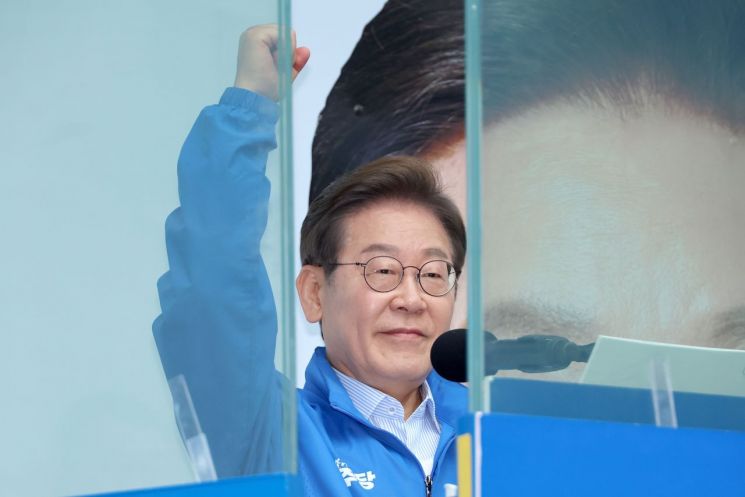
In response to a policy proposal from Lee Mihyun, who lives in Japan, about the need for a K-Internet University to promote Korean culture, Lee said, "That's really a great idea," and made a note of it in his notebook. Lee Mihyun said, "I teach Korean at Hitotsubashi University, and I believe that teaching a language is also about teaching the culture and spirit of that country. However, since there are no Korean studies departments at universities throughout Japan, I thought it would be good to have an educational institution in the form of a K-Cyber University."
Lee responded, "That's really a great idea," and added, "I saw something similar called Sejong Institute in a documentary, and apparently there is significant demand." He continued, "I heard that among the students at Sejong Institute, outstanding students are selected and sent to Sungkyunkwan University as international students. If the government could support this at the national level, it would be great. I hadn't thought of the idea of a K-Internet University, but I think it would be good to select foreigners who have learned Korean well and want to study in Korea, and recognize them as additional admissions at each university." Lee also asked Lee Mihyun to "send the relevant policy proposal separately via Telegram message."
During the meeting, Lee also directly addressed the perception that he would be hostile in relations with Japan. He said, "On issues such as Dokdo and historical disputes, I cannot help but take a firm stance. However, people only see that aspect, but when it comes to cultural exchange and Korea-Japan cooperation, I have an active and open attitude." He added, "When former President Kim Daejung opened Korean culture to Japan, the culture of Korea developed tremendously. Even if we respond firmly to issues like Dokdo and territorial disputes, we should separate those from private exchanges and diplomatic issues between Korea and Japan."
Meanwhile, regarding the proposal by Kim Yongtae, co-chair of the People Power Party's election committee and emergency committee, for a debate among presidential candidates' spouses, Lee responded with a laugh, "What about candidate Lee Junseok?" and added, "People should make sensible suggestions." He criticized, "The problem with that party is that they are impulsive, irresponsible, and lack any real plans," and emphasized, "We should not turn the sacred process of exercising sovereignty into a mere event or a joke."
© The Asia Business Daily(www.asiae.co.kr). All rights reserved.
![User Who Sold Erroneously Deposited Bitcoins to Repay Debt and Fund Entertainment... What Did the Supreme Court Decide in 2021? [Legal Issue Check]](https://cwcontent.asiae.co.kr/asiaresize/183/2026020910431234020_1770601391.png)
















