First Large-Scale Disease Disaster Archive Launched in Korea
The National Institute of Health under the Korea Disease Control and Prevention Agency unveiled the 'Disease Disaster Archive (SAVE)' website on May 20, marking the first systematic online collection and preservation of disease disaster-related information in South Korea.
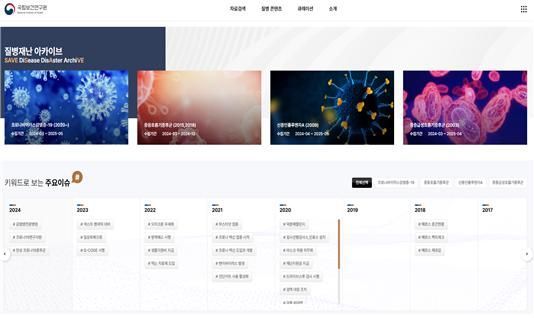
When a disease disaster occurs, a vast amount of information is generated in real time by central government agencies, local governments, and overseas organizations. However, if this information is not preserved in a timely manner, there is a significant risk that it will disappear.
In response, the National Institute of Health has decided to systematically collect, organize, and provide over 20,000 related materials?including press releases and guidelines?on four major infectious diseases for which the Central Disease Control Headquarters was established and operated in Korea: COVID-19, Middle East Respiratory Syndrome, Novel Influenza A, and Severe Acute Respiratory Syndrome.
In particular, the archive allows users to refine their searches by disease, producing agency, and type of material, enabling them to quickly and accurately find the information they need. It also offers a timeline service that visualizes the disease disaster response process in chronological order, as well as issue archiving by major topics, providing differentiated and tailored services focused on the needs of information users.
Park Hyunyoung, Director of the National Institute of Health, stated, "Going forward, we will link this service with the National Medical Science Knowledge Center (the national medical library that collects, processes, preserves, and shares domestic and international medical science information resources and health care research outputs) operated by the National Institute of Health. By gradually expanding the collection of materials such as reports, papers, and patents related to disease disaster response and research?especially those that required collaboration among various stakeholders as seen during the COVID-19 pandemic?we aim to contribute to the development of related policies and the establishment of effective research strategies."
© The Asia Business Daily(www.asiae.co.kr). All rights reserved.

















