Moody's, one of the world's top three credit rating agencies, will announce the results of its sovereign credit rating review for South Korea in the second half of this year. Following the pandemic, South Korea has run annual fiscal deficits of around 100 trillion won, pushing the national debt to a record high of over 1,175 trillion won last year. As the pace of national debt growth outstrips the increase in gross domestic product (GDP) amid the risk of negative growth, there are concerns that the country's credit rating headroom could shrink. In response, the government is expected to focus on defending its credit rating by explaining measures for expenditure rationalization and structural reform.
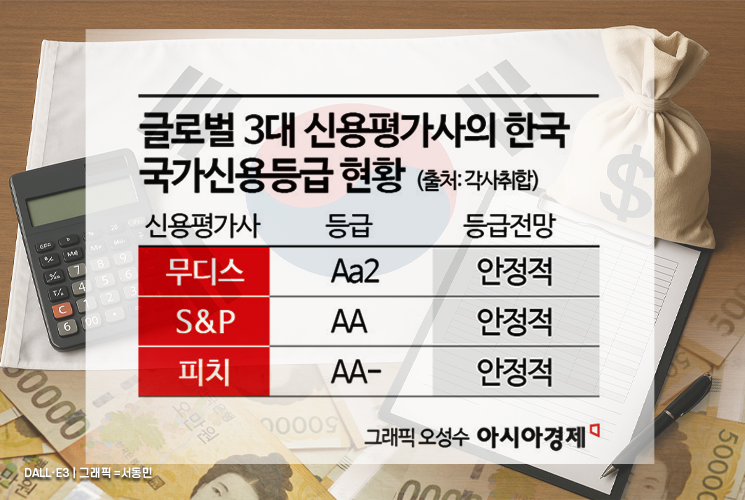
According to relevant ministries on May 20, a Moody's assessment team will visit the South Korean government, including the Ministry of Economy and Finance, in the second half of this year to conduct its annual consultation for the rating review. Previously, in May last year, Moody's maintained South Korea's sovereign credit rating and outlook at their previous levels (Aa2, stable). Moody's typically provides an official rating opinion for South Korea every two years, and this year was supposed to be an off year. However, the agency has decided to conduct an extraordinary review. An official from the Ministry of Economy and Finance stated, "Moody's annual consultation team is expected to visit South Korea in the second half of the year for the credit rating review," adding, "The specific timing has not yet been determined."
The consultation team is expected to visit government ministries, the Bank of Korea, state-run research institutes, and private companies to hear explanations about South Korea's economic situation and policy direction. Based on these annual consultations, Moody's is likely to announce a new rating decision within the year. The consultation is expected to focus on key issues such as changes in economic policy following the early presidential election, the execution of the supplementary budget and the formulation of a second supplementary budget, the increase in household debt, and the impact of the U.S.-initiated tariff war.
Moody's is paying particular attention to the rapidly increasing national debt and rising fiscal spending pressures. As of the end of December last year, South Korea's national debt-to-GDP ratio stood at 46.1%, which is around the median for countries with the same rating. However, this figure has nearly doubled since the 2008 financial crisis (25.7%), making the pace of debt growth the fastest among major economies. According to the Ministry of Economy and Finance, this ratio is projected to rise by 2.3 percentage points to 48.4% by the end of this year.
There are concerns that if populist policies, which were major campaign pledges during the presidential election, are implemented and additional supplementary budgets are executed to boost the sluggish economy, the national debt will increase further, worsening fiscal capacity. The government has so far kept the national debt-to-GDP ratio below 50%, but due to structural changes such as low birth rates and an aging population, the ratio is projected to surge to 55.3% by 2030 (according to the long-term fiscal outlook), and to 107.7% by 2050, surpassing 100% in the medium to long term.
In an environment where uncertainties such as the ongoing tariff war have become constants, the reduction in the current account surplus due to declining exports is also a source of concern. The Bank of Korea expects this year's current account surplus to fall short of the previously forecasted $75 billion, representing a decrease of about 25% compared to last year's $99.04 billion. South Korea's economic growth rate plunged to -0.2% in the first quarter, and there are even projections that the potential growth rate will fall into the 0% range in 15 years.
Kang Sungjin, professor of economics at Korea University, stated, "The essence of the sovereign credit rating downgrade issue is whether the ability to repay foreign currency debt will become more difficult than in the past." He added, "Compared to past crises, higher foreign exchange reserves, net external financial assets, and a low short-term external debt ratio serve as safety buffers against economic crises. However, rapidly increasing national debt amid sluggish growth is being pointed out as a medium- to long-term risk factor."
Moody's upgraded South Korea's sovereign credit rating from Aa3 to Aa2 in December 2015 and has maintained this rating for ten consecutive years. After the 12·3 Martial Law Incident last December, Moody's issued a report warning that prolonged political uncertainty could negatively affect the credit rating, although it did not actually downgrade the rating. Fitch and S&P each released their annual consultation results in February and April, respectively, maintaining their existing ratings and outlooks.
© The Asia Business Daily(www.asiae.co.kr). All rights reserved.
![Clutching a Stolen Dior Bag, Saying "I Hate Being Poor but Real"... The Grotesque Con of a "Human Knockoff" [Slate]](https://cwcontent.asiae.co.kr/asiaresize/183/2026021902243444107_1771435474.jpg)
















