Path Open for UK to Join EU Rearmament Plan
Fisheries Agreement Extended Until 2038
The United Kingdom and the European Union (EU) agreed on May 19 (local time) to reset their relationship, five years after the UK’s withdrawal from the EU, known as Brexit.
UK Prime Minister Keir Starmer, European Commission President Ursula von der Leyen, and President of the European Council Antonio Costa held a summit in London on the same day and reached this agreement. Prime Minister Starmer stated, "It is time to look ahead. We must move past long-standing disputes and political strife to find common sense and practical solutions," emphasizing that this agreement will boost the UK’s economic growth. President von der Leyen said, "This is a tremendous day as we turn a page and open a new chapter. It is important at a time of heightened geopolitical tensions. We are like-minded and share values."
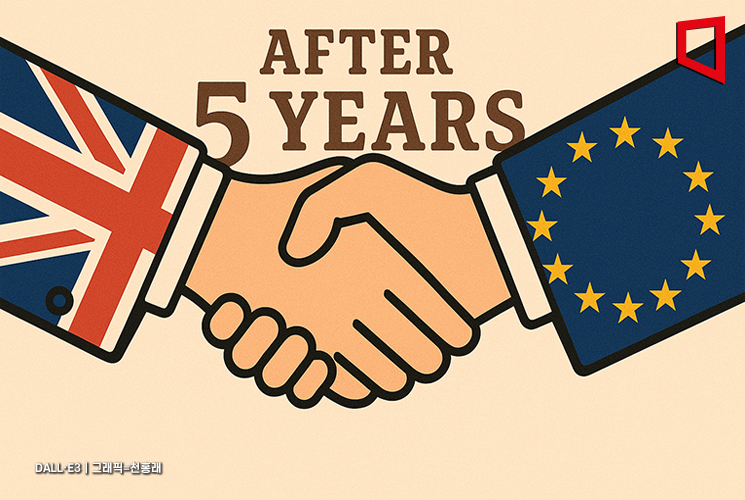
With this, the relationship between the two sides has reached a critical turning point: nine years after the UK decided to leave the EU in the 2017 Brexit referendum, and five years after Brexit took effect in 2020 following four years of difficult negotiations. The two sides agreed to establish a defense and security partnership to address geopolitical challenges such as the threat from Russia. They will cooperate in various fields, including intelligence sharing and maritime and space security. In addition, the EU will swiftly seek ways for the UK to participate in its 'rearmament plan' worth 150 billion euros (approximately 240 trillion won).
In terms of economy and trade, both sides agreed to extend the fisheries agreement, which is set to expire next year, until 2038, maintaining mutual fishing rights for an additional 12 years. They also decided to ease regulations, including exempting certain agricultural, livestock, and fisheries exports from quarantine requirements. The UK was reluctant to extend EU fishermen’s fishing rights in UK waters for a long period and wanted a four-year extension, but reportedly made concessions in order to secure eased agricultural quarantine rules and energy cooperation.
The two sides also plan to cooperate on climate action by linking their carbon markets. The EU remains the UK’s largest trading partner, but the UK’s exports to the EU have decreased by 21% since Brexit. The UK government explained that this agreement is expected to generate nearly 900 million pounds (16.7 trillion won) in economic benefits for the UK by 2040.
Additionally, both sides will work together on a balanced youth mobility program under mutually agreed conditions to facilitate migration and employment for people under 30. UK citizens will also be able to use electronic automated border gates (e-gates) at EU borders. Regarding immigration, the agreement noted the need for both sides to prevent irregular Channel crossings and to cooperate with countries of origin and transit.
However, opposition parties, including the centrist Conservative Party, the main opposition, and the right-wing populist Reform UK party, which has recently expanded its influence, criticized the extension of fishing rights. Conservative Party leader Kemi Badenoch said, "This is extremely concerning," while Reform UK leader Nigel Farage claimed it was "the end of UK fisheries." The opposition has continued to argue that the Labour government’s attempt to reset relations amounts to 'surrendering' to the EU and a 'betrayal' of the Brexit referendum.
© The Asia Business Daily(www.asiae.co.kr). All rights reserved.

















