Western Jin Dynasty's "Jingoguryeogwiehu" Gold Seal
Xinhua: "Evidence That Goguryeo Was Governed by the Central Plains Dynasty"
As a Goguryeo gold seal from over 1,700 years ago was recently donated to a museum in China, controversy is expected after Chinese state-run media claimed that the artifact is "evidence that the Central Plains dynasty governed Goguryeo."
According to Xinhua News Agency on May 19, at the 2025 International Museum Day event held the previous day in Jilin Province, Northeast China, a horse-shaped gold seal from the Western Jin period, inscribed with "Jingoguryeogwiehu," was donated to the Jian City Museum.
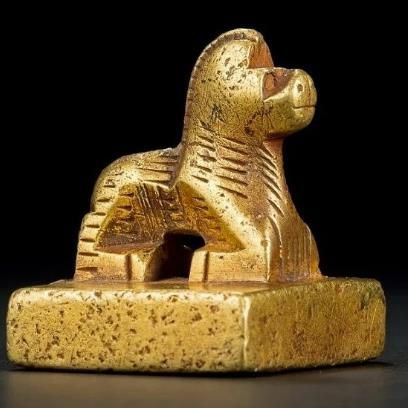
The Jingoguryeogwiehu seal was put up for auction last month at a China Guardian auction in Hong Kong and was sold for 10,797,000 Hong Kong dollars (approximately 1.93 billion Korean won). The seal, previously owned by a Japanese collector, was purchased by Chairman Jin Mingnan of Jindou Group, who is originally from Jian City, and his wife, who then donated it to the museum. The seal measures 2.4 x 2.3 cm on the stamping face, with a total height of 2.8 cm (stamp height 0.6 cm), and weighs about 88 grams. The inscription "Jingoguryeogwiehu" is clearly engraved on the seal's surface.
Xinhua News Agency described the seal as an official seal granted by the Western Jin dynasty to the Goguryeo, which they referred to as a minority ethnic group. The agency further claimed, "Compared to the six previously discovered seals related to Goguryeo's tribute and investiture, this seal is of a higher grade, and together with those seals forms a complete chain of evidence, proving that during the Western Jin period, Goguryeo was under the effective jurisdiction of the Central Plains dynasty." Such unilateral assertions are expected to spark academic controversy. The report added, "The gold seal is a rare tangible piece of evidence of exchanges between minority groups and the Central Plains dynasty, and is an important resource for further research on the history of the northeastern frontier."
Korean Academia: "Comprehensive Consideration of the International Situation at the Time Is Needed"
In contrast to the Chinese claims, the prevailing view among Korean historians is that the tribute and investiture system, which was a formal aspect of international relations in ancient East Asia, as well as the broader political context of the time, must be considered comprehensively.
According to Yonhap News Agency, Professor Park Daejae of the Department of Korean History at Korea University introduced the seal at the Korean Ancient History Society in March, explaining that since the Han and Wei dynasties, the Chinese Central Plains authorities had a diplomatic tradition of granting official seals along with investiture to the leaders of neighboring ethnic groups. He noted that during the Wei and Jin periods, the grades of official seals were established as king, guiyiwanghuin, and solseonin, in three ranks. He continued, "Until now, the only existing 'Jingoguryeo' seals that have survived were of the third rank, 'solseon.' With the discovery of the Jingoguryeogwiehu, this is the first time a second-rank 'guiyihou' seal has been confirmed." However, Professor Park also stated, "It is currently impossible to verify the provenance or authenticity of the gold seal," adding, "I hope related research will be conducted in China in the future."
Professor Park further commented, "Some in China interpret the existence of the seal as tangible evidence of Jin's rule over Goguryeo, but it is important to note that the investiture system and the distribution of seals were longstanding diplomatic practices in East Asia and were often quite removed from the actual international situation." He added, "After the fourth century, the Jin dynasty's territory was greatly diminished by the Five Barbarians in the north, and in order to overcome external crises, the dynasty distributed gold seals to the leaders of the Xianbei, Wuhuan, and Goguryeo."
© The Asia Business Daily(www.asiae.co.kr). All rights reserved.

















