More Than Half of the Public Cite "High Prices" as Biggest Burden
Price Stabilization Ranked Top Priority for Economic Recovery Across All Age Groups
"Policies Needed to Stabilize Agricultural and Livestock Prices"
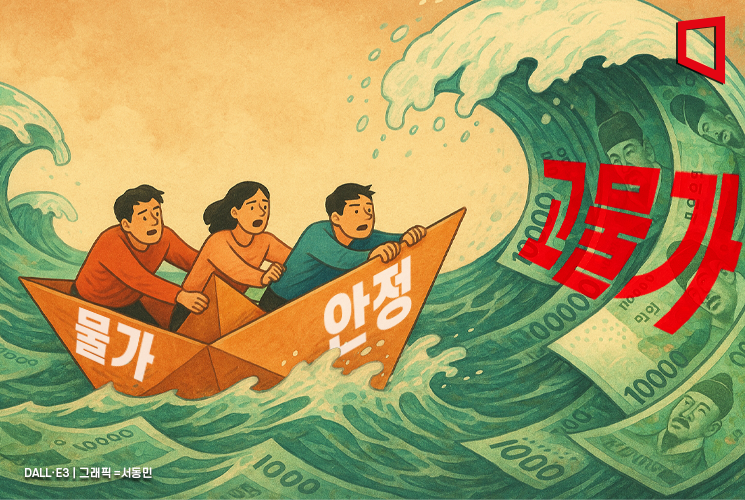
Amid the ongoing economic downturn, the public identified "prices" as the most significant economic challenge they are currently facing. "Price stabilization" also emerged as the top priority for economic recovery.
According to a survey titled "Measures for Stabilizing the Livelihood Economy," conducted by Mono Research on behalf of the Korea Businessmen Association and released on May 19, more than half of respondents (53.5%) cited "rising prices and increased cost of living" as the most pressing difficulty in their daily economic lives. Other major concerns included: ▲job-related issues and employment instability (11.3%), ▲rising housing costs and increased burden of rent or lease payments (10.0%), ▲economic slowdown and contraction of domestic demand (7.2%), and ▲stagnant income and decline in real wages (6.8%).
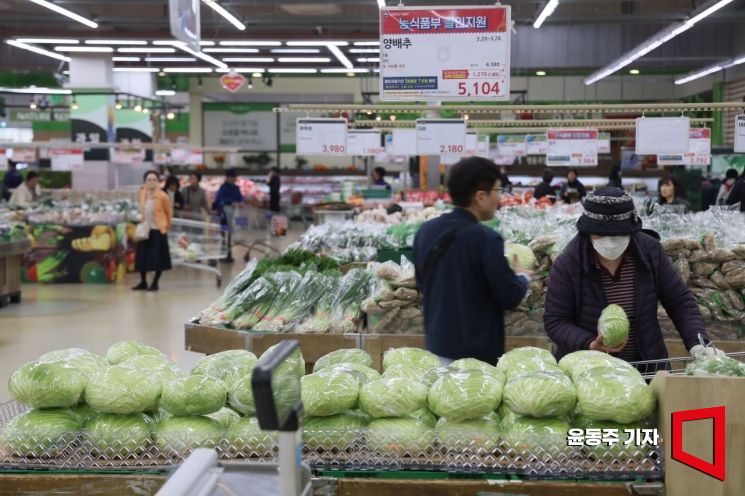
The Korea Businessmen Association explained that although consumer prices have recently stabilized at just above 2%, high prices have persisted over a prolonged period, so the public still perceives inflation as severe. In fact, comparing the period from 2016 to 2020 (using 2020 as the base year for the revised consumer price index), the inflation rate was 4.4%. However, from 2020 to April 2025, prices rose by 16.4%.
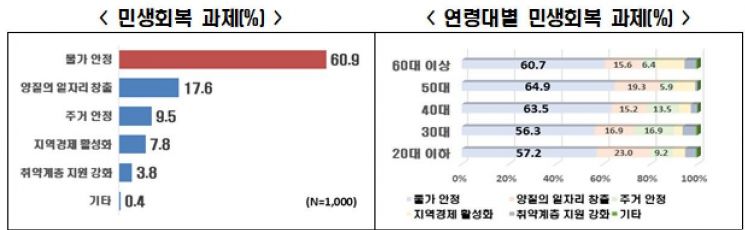
When asked about the most desired measure for restoring the livelihood economy, 60.9% of respondents chose price stabilization. This was followed by ▲creation of quality jobs (17.6%), ▲housing stability (9.5%), ▲revitalization of the local economy (7.8%), and ▲enhanced support for vulnerable groups (3.8%).
Across all age groups, price stabilization was cited as the number one priority for restoring the livelihood economy. The proportion was highest among those in their 50s, at 64.9%. Excluding price stabilization, "creation of quality jobs" was the most common response among those in their 20s and younger (23.0%) and those in their 50s (19.3%). Among those in their 30s, both "housing stability" (16.9%) and "creation of quality jobs" (16.9%) were cited at relatively higher rates compared to other age groups. The Korea Businessmen Association interpreted these results as reflecting the characteristics of those in their 20s and 50s, who have high demand for new or re-employment, and those in their 30s, who are typically at the stage of purchasing homes after marriage.
Regarding the policies the government should prioritize to achieve price stabilization?the number one task for restoring the livelihood economy?the most common response was "stabilizing prices of agricultural, livestock, and daily necessities" (35.9%). Other priorities included: ▲reducing the burden of public utility charges (electricity, gas, water) (21.8%), ▲mitigating exchange rate volatility and stabilizing import prices (17.2%), ▲alleviating tax burdens and strengthening support for living expenses (17.1%), and ▲stabilizing energy and raw material prices (7.8%).
For the creation of quality jobs, the most frequently cited priority policy was "strengthening tailored employment support for young people, women, and the elderly" (31.9%). This was followed by ▲job creation in high-tech industries and new growth sectors (21.0%), ▲labor market reform and improvement of working conditions (20.6%), and ▲expanding employment through fostering small and medium-sized enterprises and startups (20.0%).
For housing stability?the third most important task for restoring the livelihood economy?the highest response rate was for "expanding housing supply and stabilizing the real estate market" (36.3%). Other priorities included: ▲stabilizing rent and lease prices and strengthening tenant protection (27.4%), ▲expanding support for vulnerable housing groups (16.1%), ▲expanding housing finance and tax support (13.2%), and ▲urban regeneration and improvement of residential environments (6.7%).
To revitalize the local economy, the most frequently cited need was improving infrastructure such as transportation and logistics networks (31.4%). For vulnerable groups such as small business owners and small and medium-sized enterprises, the top priority was support for boosting domestic demand and expanding sales channels (27.1%).
Lee Sangho, head of the Economic and Industrial Division at the Korea Businessmen Association, stated, "The prolonged period of high prices and economic stagnation is intensifying the economic difficulties faced by the public." He added, "To stabilize the prices of food and daily necessities, which are directly linked to perceived inflation, efforts should be made to diversify import sources for agricultural products and improve distribution structures. At the same time, it is essential to enhance the private sector's capacity to create jobs, thereby boosting households' income-generating abilities."
© The Asia Business Daily(www.asiae.co.kr). All rights reserved.



















