Building a Supercomputer with the Taiwanese Government and Corporations
Will AI Leadership Shift from the US to Taiwan?
Jensen Huang, CEO of Nvidia, has unveiled an ambitious plan to bring artificial intelligence (AI) leadership to Taiwan. He announced a partnership with the Taiwanese government, the world’s largest foundry TSMC, and the world’s largest electronics manufacturing services company Foxconn to build a supercomputer.
During his keynote speech at the Taipei Music Center in Taipei, Taiwan, on the morning of the 19th, CEO Huang stated, “Together with Foxconn, the Taiwanese government, and TSMC, we will build Taiwan’s first large-scale AI supercomputer,” adding, “This is for Taiwan’s AI infrastructure and ecosystem.” While Taiwan has so far been a factory producing supercomputers and their components for the world, the new vision is to create an AI supercomputer for Taiwan itself.
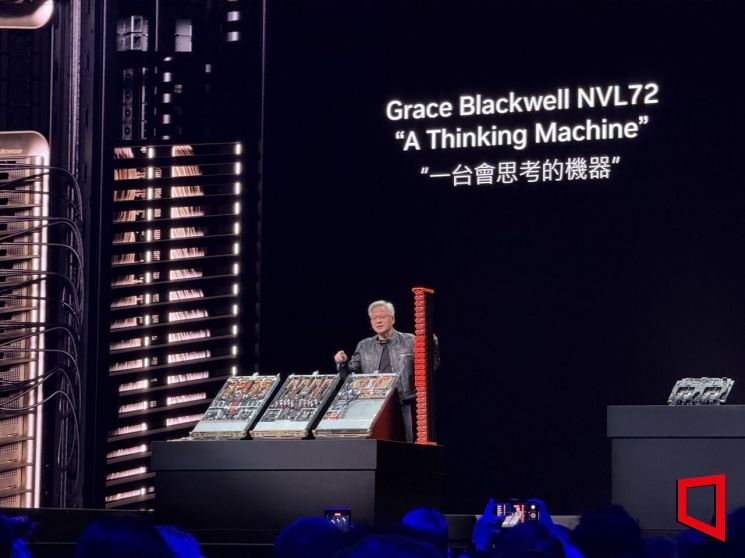 Jensen Huang, CEO of Nvidia, is delivering the keynote speech at Computex 2025 at the Taipei Music Center in Taipei, Taiwan, on the morning of the 19th. Photo by Jang Heejun
The construction of a supercomputer is not simply about installing a single ‘computer’ but is a national-scale project aimed at structurally enhancing scientific, technological, and industrial security capabilities. In other words, CEO Huang’s announcement is interpreted as a declaration that Taiwan will shift from being merely a supplier of AI, semiconductors, and systems to becoming a ‘user’ as well.
The AI supercomputer infrastructure project led by Nvidia will involve major Taiwanese players such as Foxconn and TSMC, as well as both public and private sectors including the National Science and Technology Council (NSTC) of Taiwan. The strategy appears to be to ‘localize’ the entire process, from chip production and packaging to servers and integration.
Nvidia is expected to provide the supercomputing system composed of graphics processing units (GPUs) such as the Grace Blackwell, as well as system architectures like NVLink and MVLink, and software. In this project, TSMC will be responsible for contract manufacturing Nvidia’s latest semiconductors, while Foxconn will handle AI hardware assembly. The NSTC is expected to open supercomputing resources to universities, research institutions, and startups.
CEO Huang emphasized, “TSMC is already conducting a massive amount of scientific and AI research, and Foxconn is carrying out large-scale research in robotics. Having world-class AI infrastructure locally in Taiwan is extremely important, and it will drive progress in education, science, and technology.”
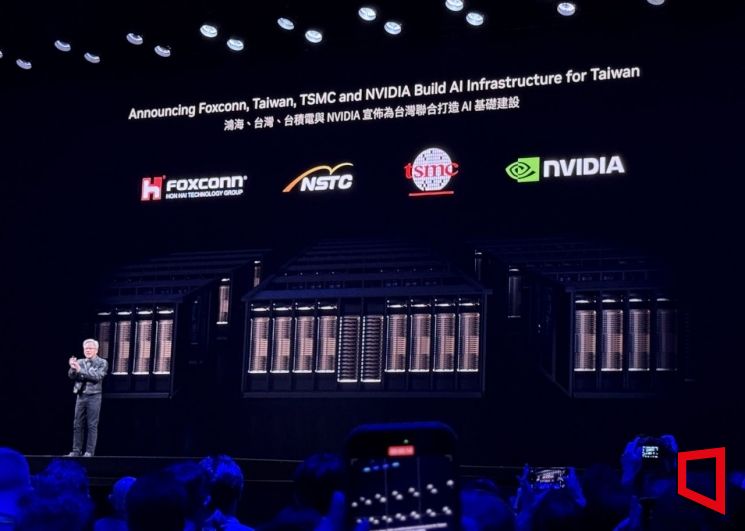 Jensen Huang, CEO of Nvidia, is delivering the keynote speech at Computex 2025 at the Taipei Music Center in Taipei, Taiwan, on the morning of the 19th. Photo by Heejun Jang
Meanwhile, during his keynote speech, CEO Huang also unveiled NVLink and the Blackwell architecture, which will be installed in the supercomputer. NVLink is Nvidia’s high-speed interconnect technology that enables communication between GPUs without a central processing unit (CPU). The architecture system was developed by Nvidia’s Taiwanese partners, including Pegatron, QCT, Foxconn, Gigabyte, and Asus. CEO Huang stated that the ultimate goal of these partner companies is to build Taiwan’s AI ecosystem, and that Nvidia’s Blackwell chip will make this possible.
© The Asia Business Daily(www.asiae.co.kr). All rights reserved.


















