"Changes Observed in the Dynamics of Negotiations"
Bloomberg News reported on May 18 (local time) that China's stance in the U.S.-China tariff negotiations is giving other countries engaged in trade talks the confidence to take a tougher position against the United States.
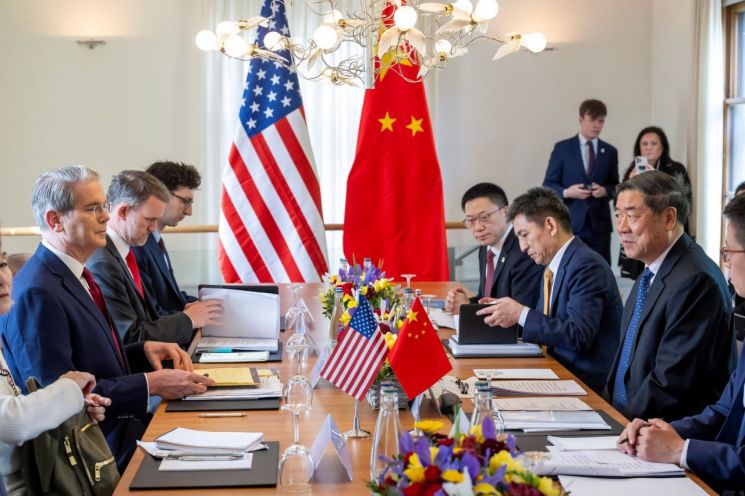 Scott Besent, U.S. Secretary of the Treasury (far left), and He Lifeng, Vice Premier of the State Council of China (far right), are preparing for the high-level economic and trade talks between the two countries in Geneva, Switzerland, on the 10th (local time). Photo by Reuters Yonhap News
According to Bloomberg, "Other countries, having witnessed China secure a favorable agreement through a hardline negotiation strategy, are now questioning whether a diplomatic and swift response toward the United States is the right approach."
Steven Olson, Senior Research Fellow at the Yusof Ishak Institute in Singapore, stated, "The dynamics of negotiations are changing," adding, "Many countries, after observing the outcome of the U.S.-China talks, will likely conclude that President Trump has begun to realize he may have overreached."
In particular, analysts point out that countries with large economies recognize they have a variety of negotiation tools at their disposal and can afford to slow down the pace of talks. For example, in the case of India, while President Trump claimed that India is aiming to eliminate all tariffs on U.S. products, S. Jaishankar, India's Minister of External Affairs, told reporters that "it is premature to make such a judgment."
Marko Papic, Chief Strategist at BCA Research Geomacro, noted, "What many countries can learn from China's example is that, when negotiating with President Trump, they should firmly stick to their positions and remain calm in order to pressure the United States into making concessions."
Alicia Garcia, Chief Economist for Asia-Pacific at Natixis investment bank, said, "China's trade deal demonstrated that it is possible to jump the queue in negotiations with the United States, and it appears that the U.S. did not secure any clear benefits," adding, "Countries that have been waiting in line are now wondering, 'Why were we even waiting in the first place?'"
Some also question the credibility and substance of President Trump's negotiation tactics. According to one source cited by Bloomberg, considering that the U.S. achieved little during the 90-day grace period and failed to present clear final objectives, President Trump may not be strongly committed to further escalating pressure on China.
Valdis Dombrovskis, European Union Commissioner for the Economy, also commented in an interview on May 15 that "the agreements reached so far have not fully resolved the situation," referring to both the U.S.-China and U.S.-UK deals.
However, experts point out that only countries with large economies are able to confront "Trump-style negotiations," and that countries highly dependent on trade with the United States, such as Vietnam, have limited leverage and few options. Katrina Ell, Head of Asia-Pacific at Moody's Analytics, stated, "Countries with large economies have room to negotiate in services trade if they wish to oppose the United States. China, in particular, has a variety of negotiation levers against the U.S., making it difficult for the U.S. to maintain a hardline stance," adding, "Many other countries do not find themselves in the same position as China."
© The Asia Business Daily(www.asiae.co.kr). All rights reserved.

















