Hyundai and Kia Expand U.S. Production Capacity by 70 Percent
One in Three Global Sales Now in North America
Growing Consensus on the Importance of the U.S. Market and Securing Competitiveness
Recruitment of American Market Experts to Form a "Dream Team"
"Our competitors manufacture in the United States and sell at lower prices. If we insist on producing only in Korea, we could lose our competitive edge and see our market share drop significantly. The union is also aware that export routes could be completely blocked."
I found myself nodding in agreement as an insider familiar with Hyundai Motor's internal affairs explained the situation. When the second Trump administration in the United States declared its intention to impose high tariffs on imported finished vehicles, Hyundai Motor Group announced plans to expand production in the U.S. The company decided to increase the production capacity of Hyundai Motor Group Meta Plant America (HMGMA), which began operations in Georgia in October 2024, by an additional 200,000 units to reach a total of 500,000 units.
With this move, Hyundai and Kia aim to increase their total production capacity in the United States from the current 700,000 units to 1.2 million units. Despite the bold announcement of a 70% increase in production capacity, the Hyundai Motor labor union has remained unusually quiet. Just two or three years ago, the atmosphere was quite different. Even the mere suggestion of expanding overseas production or relocating production of export models would prompt the union to declare fierce opposition.
In 2021, Hyundai Motor attempted to increase U.S. production of the Palisade, a large SUV popular in America. The union strongly opposed the plan to ramp up production at the U.S. plant, citing a clause in the collective bargaining agreement that stipulated any adjustment of production volumes, including new overseas vehicle allocations, must be discussed by a joint labor-management committee. Ultimately, the plan for U.S. production was scrapped, and it was decided instead to add a Palisade production line at a domestic plant.
However, despite Hyundai Motor Group's recent announcement to invest 31 trillion KRW over four years to boost local production in the U.S., the union has remained unexpectedly quiet. This is explained by the fact that the union also recognizes Hyundai Motor Group's commitment to the U.S. market and understands that success in America is directly tied to the company's survival. There is a growing consensus that, unlike in the past, fighting over overseas plants could lead to mutual destruction.
The Hyundai Motor labor union is currently analyzing the impact of tariffs by vehicle model. Of Hyundai's 16 models, the union believes that 13 will inevitably see a decrease in domestic production due to the impact of tariffs. This figure only includes existing models produced domestically and does not count new models to be released in the future. As Hyundai Motor Group has announced plans to increase HMGMA's production capacity from 300,000 to 500,000 units, the likelihood of future electric vehicles, hybrids, and other new models targeting the U.S. market being produced locally has grown. The flagship electric SUV Ioniq 9, launched in February 2024, is already being produced at HMGMA in Georgia.
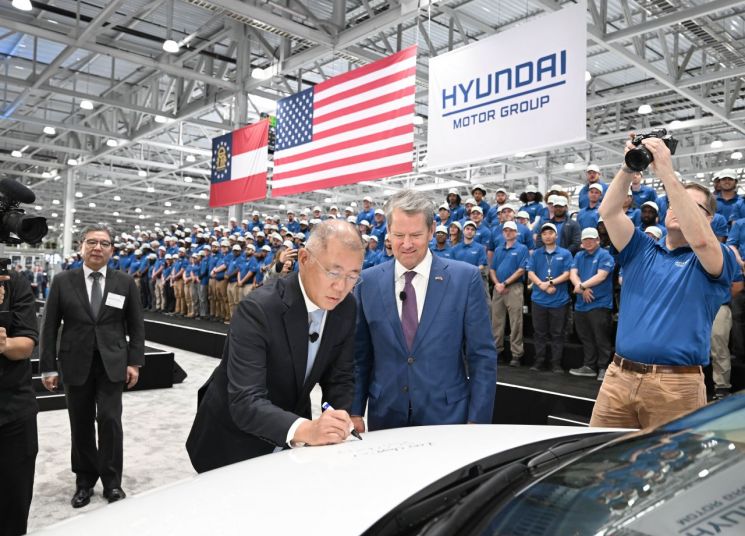 Hyundai Motor Group Chairman Chung Euisun signing a commemorative autograph on an Ioniq 5 vehicle produced at HMGMA. Provided by Hyundai Motor Group
One in Three Hyundai and Kia Vehicles Sold in North America
Why is the U.S. market so critical for Hyundai and Kia? The answer lies in the growing importance of the North American market. In 2024, one out of every three Hyundai and Kia vehicles sold globally was purchased in North America. In terms of units, North American sales reached 2.18 million, surpassing sales in Korea (1.25 million). By region, North America accounts for the largest share at 31%.
In the past, Hyundai and Kia expanded their global market share by focusing on emerging markets like China and pursuing a high-volume, low-margin strategy. Since the 2020s, however, they have shifted their focus to advanced markets like the U.S., boosting sales by emphasizing SUVs and eco-friendly vehicles. American consumers, in particular, prefer high-value-added large vehicles and SUVs. As a result, the more Hyundai and Kia sell in the U.S., the more their profitability improves. In 2023, the average overseas SUV selling price for Hyundai surpassed 70 million KRW, and for Kia, it exceeded 60 million KRW, thanks largely to expanded sales in the U.S.
Although the combined global sales of Hyundai and Kia?over 8 million units at their 2015 peak?have declined (to 7.2 million units in 2024), the companies have set new records for revenue and operating profit for three consecutive years since 2022. This shift reflects a strategy that now prioritizes quality over quantity. Recognition for product quality and technological prowess in the advanced U.S. market has also boosted brand value worldwide.
This is further evidenced by the numerous awards they have received overseas. The Kia EV3 won the 2025 World Car of the Year award, marking the fifth time in six years that a Kia vehicle has claimed the title, and it has also been named Car of the Year in the UK, Finland, and Denmark. Additionally, Hyundai Motor Group ranked first for two consecutive years (2022?2023) in J.D. Power's Vehicle Dependability Study, and Genesis was ranked the top premium brand in J.D. Power's Initial Quality Study in 2021.
These accolades have further fueled Hyundai and Kia's sales growth in the U.S. market. Practical-minded American consumers prioritize product quality when purchasing vehicles. Objective evaluations from credible organizations serve as highly effective marketing tools for reaching U.S. consumers. Ji Sungwon, head of Hyundai's Brand Marketing Division, said, "In the marketing industry, there is a saying: 'Americans buy products, Europeans buy brands, and Chinese buy innovation.' In the U.S. market, it is important to emphasize product quality, tangible consumer benefits, and practical features such as short charging times."
Genesis, Which Saved Tiger Woods, Stands Beside Ivanka
"Chairman, we have a serious problem. Tiger Woods has been in an accident."
In February 2021, Vice Chairman Jang Jaehoon, then CEO of Hyundai Motor, urgently called Chairman Chung Euisun. Jang reported that global sports star Tiger Woods had been involved in a rollover accident while driving a Genesis GV80 SUV. The incident sent shockwaves through Genesis and the entire Hyundai Motor Group.
Tiger Woods, who was in Los Angeles as the host of the Genesis Invitational golf tournament sponsored by Genesis, was driving a GV80 provided by Genesis for personal reasons when the accident occurred. Woods entered a curve at excessive speed, struck the median, and rolled several times before landing in a roadside forest. Although the vehicle was severely damaged, Woods managed to walk away with a limp. Genesis officials were naturally alarmed by the news. Had the accident been attributed to a mechanical defect, not only Genesis but also the safety of Hyundai and Kia vehicles would have come under intense global scrutiny. Furthermore, the fact that the person involved was Tiger Woods, a figure of worldwide attention, heightened the stakes.
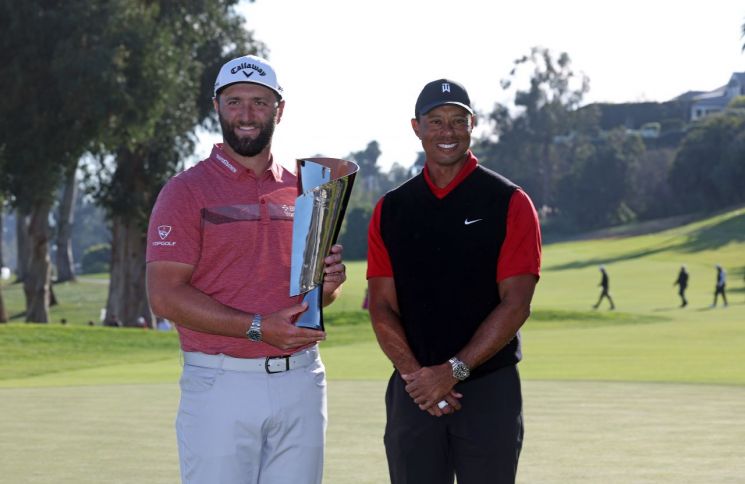 Tiger Woods (right in the photo) is taking a commemorative photo with John Rahm, the winner of the 2023 Genesis Invitational. Photo by Genesis
The situation took a dramatic turn when the investigation results were released. It was revealed that the primary cause of the accident was speeding, and there was no vehicle defect. As a result, Genesis received positive evaluations for safety. Local media and the public unanimously praised Genesis, saying the vehicle "saved Woods's life." Woods himself commented, "I'm grateful to be alive. Just being able to walk is a miracle." Hyundai Motor Group did not issue any official statements or technical explanations regarding the accident. In fact, it is said that internal directives at Hyundai at the time explicitly forbade using the incident for marketing purposes.
In retrospect, Tiger Woods's accident became an opportunity to enhance the Genesis brand image. The year 2021, when the accident occurred, saw the most rapid growth for Genesis since its launch as an independent brand in the U.S. in 2016. In the previous year, 2020, the COVID-19 pandemic had depressed new car sales in the U.S., causing Genesis sales to drop by about 20%. In 2021, however, sales surged by over 200%, rising from 16,000 to around 50,000 units. Industry observers attribute this remarkable growth in part to the "Tiger Woods effect."
More recently, Genesis has sought to elevate its brand image through various forms of indirect advertising, including associations with the highest echelons of American society. In January 2025, the Genesis GV80 appeared in a video featuring Ivanka Trump, the eldest daughter of President Donald Trump. In footage of Ivanka Trump's family boarding a military transport plane to attend the presidential inauguration, the Genesis GV80 was prominently displayed on the airport runway. Hyundai Motor Group has not commented on whether Genesis provided the vehicle for protocol purposes or if it was merely a coincidence.
However, industry insiders believe that, given the strict security surrounding the Trump family's official vehicles, such a coincidence is highly unlikely. This project is believed to have been spearheaded by Kim Sung, who officially joined Hyundai Motor Group as head of external strategy in 2025 after serving as U.S. Ambassador to South Korea.

Hyundai's Strategy Amid Trade Turbulence
The Trump administration's second-term auto tariff policy is shifting rapidly. The goal is to use automobiles as leverage in negotiations to secure advantages for the U.S. However, the side effects of unilateral high tariffs are significant. While the stated aim of the tariff policy is to protect domestic industry, ironically, the greatest harm may fall on American automakers and the U.S. economy. As a result, the Trump administration will inevitably have to adjust its pace, and policy uncertainty is higher than ever.
In this context, I believe Hyundai Motor Group's relative competitiveness will become even more pronounced. The group's greatest strength is its "flexibility" in responding to the ever-changing policies of the U.S. government.
The second Trump administration has hinted at the possibility of repealing the Inflation Reduction Act (IRA), which was designed to address the climate crisis. This would mean scaling back electric vehicle subsidies and tax credits for clean energy investments that had been supported by the Biden administration. In response, Hyundai Motor Group shifted its strategy to produce hybrids alongside electric vehicles at HMGMA, originally built as a dedicated EV plant. The company plans to adjust plant utilization by flexibly combining internal combustion, hybrid, and electric vehicle production in response to policy changes.
Additionally, Hyundai Motor Group has assembled a "dream team" for policy response and business strategy. Jose Munoz, a North American sales expert, was appointed CEO of Hyundai Motor, and Kim Sung, former U.S. Ambassador to South Korea, was brought in as head of external strategy. Munoz, who led North American sales at Nissan for over 15 years, brings deep understanding of the U.S. market as well as expertise in the strategies of direct competitors like Japanese automakers. Kim Sung, a former U.S. diplomat, is considered a bipartisan figure who was valued by both the Trump and Biden administrations.
© The Asia Business Daily(www.asiae.co.kr). All rights reserved.

![Clutching a Stolen Dior Bag, Saying "I Hate Being Poor but Real"... The Grotesque Con of a "Human Knockoff" [Slate]](https://cwcontent.asiae.co.kr/asiaresize/183/2026021902243444107_1771435474.jpg)

















