Lee Jaemyung Proposes "Strengthening National Assembly Powers Instead of the President"
Plans to Form a "National Assembly Constitutional Reform Committee" and Hold a National Referendum Next Year
Significant Differences with People Power Party... Concerns Over Another Stalemate
As Lee Jaemyung, the presidential candidate of the Democratic Party, and Kim Moonsoo, the presidential candidate of the People Power Party, each announced their own constitutional amendment proposals, constitutional reform has emerged as the most prominent issue in the latter half of the 21st presidential election campaign.
Both candidates agreed on the need to disperse presidential powers to prevent the abuses of power concentration. However, they showed differences in their positions regarding specific details, such as strengthening the powers of the National Assembly.
Experts noted that while constitutional amendment issues, which have been a central focus of this presidential election, have now entered public debate, these remain non-binding pledges for now. They also pointed out that, given the timing of the announcements, these proposals may be intended for electoral purposes, making the likelihood of them being realized rather low.
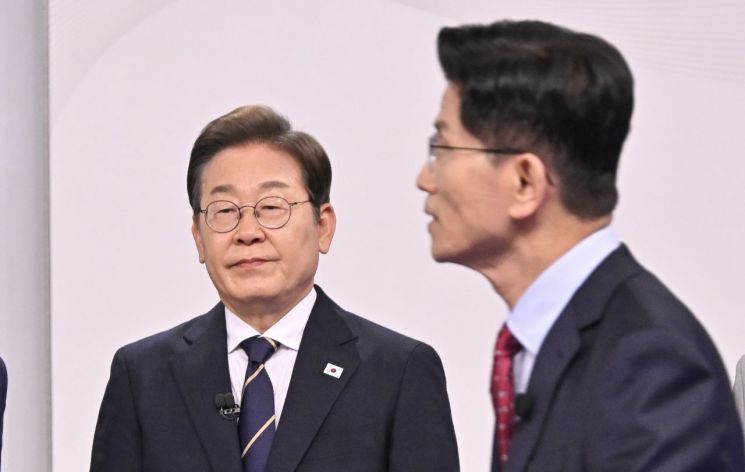 Kim Moonsoo of the People Power Party (right) and Lee Jaemyung, the presidential candidate of the Democratic Party, are attending the first round of the 21st presidential election candidates' debate held at the SBS Prism Center studio in Sangam-dong, Mapo-gu, Seoul, on the 18th, waiting for it to begin. Photo by Yonhap News
The key points of Lee's constitutional amendment proposal include: a four-year presidential term with the possibility of consecutive re-election, a runoff system for presidential elections, a system for the National Assembly to recommend the Prime Minister, reduction of the President's right to request reconsideration, transferring the Board of Audit and Inspection to the National Assembly, and the establishment of a new constitutional body involving the President, Prime Minister, and heads of local governments.
Until now, Lee had shown a passive stance on constitutional reform, emphasizing that "ending internal strife comes first," but he unexpectedly presented a constitutional amendment proposal. The significance is heightened by the fact that Lee, who leads in presidential polls and heads a party with a majority in the National Assembly, has brought up constitutional reform.
However, there are concerns that Lee's proposal could result in a "monarchical National Assembly." Critics argue that if the National Assembly is given the power to recommend the Prime Minister and approve appointments of the heads of the prosecution, police, and the Korea Communications Commission, it could undermine the balance of the separation of powers.
Given that the Democratic Party has secured a stable majority in both the 21st and 22nd National Assemblies, it remains to be seen whether the People Power Party will agree to Lee's vision. Lee's proposal does not include measures to check the National Assembly, such as abolishing parliamentary immunity from arrest or introducing a recall system for lawmakers.
Shin Dongwook, chief spokesperson for the People Power Party, told reporters at the party headquarters in Yeouido, Seoul, on the morning of the 19th, "The core of constitutional reform is for both the President and the National Assembly to relinquish their privileges, but Lee's proposal seems to be about expanding the powers of both the President and the National Assembly." He also criticized Lee's suggestion of a consecutive re-election system rather than a non-consecutive system, calling it "an attempt at permanent power consolidation."
The key points of Kim Moonsoo's proposal include: a four-year presidential term with the possibility of serving two non-consecutive terms, abolition of presidential immunity from prosecution, abolition of parliamentary immunity from arrest and indemnity, and the introduction of a national legislative initiative and a recall system for lawmakers.
Notably, Kim proposed that, unlike Lee?who suggested that the next president serve a full five-year term and that the four-year consecutive re-election system begin with the following president?the next president's term should be shortened to three years so that the general and presidential elections can be held together in 2028. The difference between consecutive and non-consecutive terms lies in whether the president can serve terms consecutively. The non-consecutive system allows a president to run again after any interval, while the consecutive system requires the terms to be served back-to-back.
The practical issue with constitutional reform is ultimately its feasibility. Lee proposed forming a special committee in the National Assembly to hold a national referendum on constitutional reform as early as next year's local elections. However, since the establishment of new constitutional bodies has not even been discussed and there is growing public concern over an expanded National Assembly, it will be difficult to accelerate the process.
Political commentator Lee Jonghun stated, "Former President Moon Jaein directly submitted a constitutional amendment proposal, but Lee Jaemyung has passed the responsibility to the National Assembly, saying he will follow its decision without making a direct pledge himself. The likelihood of the People Power Party accepting Lee's proposal to strengthen the National Assembly's powers is low, and Lee is well aware of this, so it is hard to see his proposal as a sincere offer."
© The Asia Business Daily(www.asiae.co.kr). All rights reserved.

















