Production Halted at Gwangju Plant... Over 50% of Plant 2 Destroyed
Nearby Facilities Operating at Full Capacity... Possibility of Relocation to Hampyeong Increases
Kumho Tire has faced disruptions in tire production due to the fire at its Gwangju factory. With the complete suspension of operations at the Gwangju plant, which accounts for 20% of the company’s total output, the previously stated annual sales target of 5 trillion won has also become uncertain. As was the case two years ago with the Hankook Tire Daejeon factory fire, the focus is shifting more toward concentrating production at nearby plants or constructing new facilities, rather than rebuilding the damaged factory.
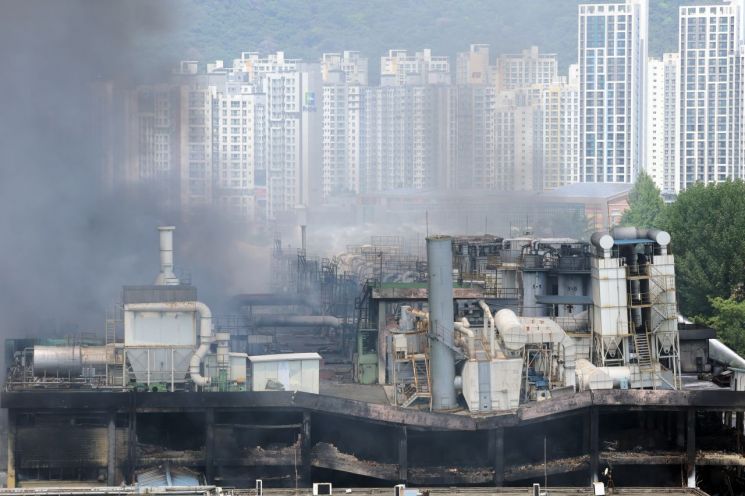 On the 18th, the second day since the Kumho Tire Gwangju factory fire, the urban area around Sochon-dong, Gwangsan-gu, Gwangju is covered in black smoke. Photo by Yonhap News
On the 19th, Kumho Tire announced that it had halted tire production at its Gwangju factory. The reason for the suspension was the fire that broke out two days earlier, and the date for resuming production has not yet been determined.
The fire occurred in Plant 2 (the western section), which is the compounding facility within the Gwangju factory, and it is estimated that 50?60% of Plant 2 was destroyed. Jung Iltaek, CEO of Kumho Tire, stated at the scene the previous day, "We will identify the exact cause and establish measures to prevent recurrence."
The fire at the Gwangju factory, a major production base, is also expected to impact Kumho Tire’s supply chain. Achieving the annual sales target of 5 trillion won has also become difficult. Last year, the Gwangju factory produced 12 million tires, which is about 20% of the company’s total annual production volume of 61.39 million tires. Among the company’s eight domestic and overseas factories, it is the third-largest in terms of output, following the Vietnam and Gokseong plants. In particular, the Gwangju factory specializes in high-inch and high-performance tires, which are highly profitable, so the losses could be greater than initially expected.
Kumho Tire is considering alternative production at nearby facilities, such as the Gokseong plant in South Jeolla Province. However, the utilization rate at these facilities is already as high as 99%, making this difficult. The situation is similar at the company’s overseas plants.
As a result, the possibility of relocating to a new factory is also being discussed. Rebuilding would essentially mean installing production facilities from scratch, which would incur significant costs. Hankook Tire, which experienced a factory fire at its Daejeon plant two years ago, has also not yet decided whether to rebuild. The Daejeon factory, which was destroyed by fire, was demolished about six months after the incident, but the site remains vacant.
Kumho Tire has been pursuing relocation of its factory since 2019 and, in the second half of last year, purchased 500,000 square meters of land in the Bitgreen National Industrial Complex in Hampyeong County. The remaining payment, excluding the 10% down payment already paid, is scheduled to be made in installments by October 2029. Although progress had been slow, it is expected that the recent fire will speed up consultations with local governments.
In response, Kumho Tire emphasized that resolving the aftermath of the incident is its top priority. A Kumho Tire official stated, "Whether or not to resume operations at the Gwangju factory will be decided after the fire is completely extinguished," adding, "The stability of the local community is our foremost priority."
Meanwhile, firefighting efforts are expected to be completed in the afternoon of the same day. The fire department finished the initial suppression at 2:50 p.m. the previous day and suspended nighttime operations due to safety concerns. Follow-up work resumed in the morning.
© The Asia Business Daily(www.asiae.co.kr). All rights reserved.

















