Development of Sensor Utilizing Bioimpedance Technology
Breastfeeding Volume Can Be Monitored via Smartphone
A wireless wearable sensor capable of measuring an infant's milk intake in real time during breastfeeding has been developed. By accurately determining the amount of breast milk consumed?something that has been difficult to measure?this device is expected to reduce anxiety and stress for mothers, help manage infant nutrition, and prove useful in managing newborns in neonatal intensive care units, where monitoring intake is essential.
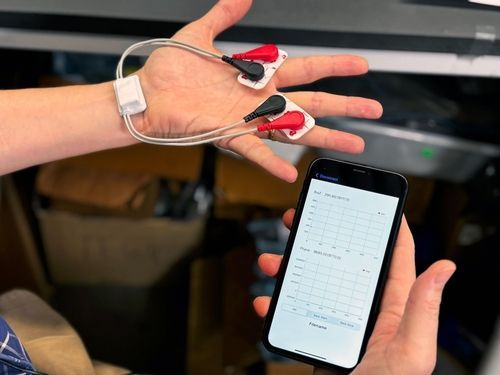 Wireless wearable sensor that can measure intake volume in real time during breastfeeding. Northwestern University
According to the scientific community on May 19, a joint research team from Korea and the United States?including Professor Kim Jihae of Ajou University, Professor Oh Seyong of Hanyang University, Professor Yoo Jaeyoung of Sungkyunkwan University, and Professor John Rogers of Northwestern University?published these findings in the international journal Nature Biomedical Engineering on May 14.
Breastfeeding has the disadvantage that it is difficult to determine exactly how much milk a baby is consuming. Currently, the only available methods are to compare the baby's weight before and after feeding or to express breast milk and measure it separately. Both require multiple steps and make it impossible to obtain precise, real-time measurements.
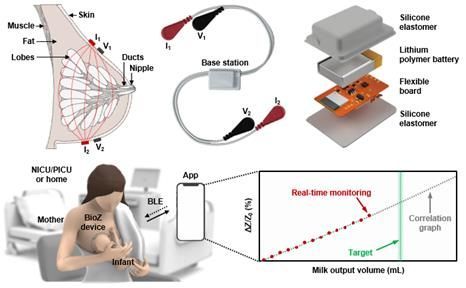 Wireless wearable sensor that can measure intake volume in real time during breastfeeding. Nature Biomedical Engineering
To address this, the research team developed a sensor utilizing bioimpedance technology, which is commonly used for body composition analysis. The device works by attaching two small pads above and below the breast, passing a tiny electric current through them, and detecting voltage changes that correspond to decreases in the amount of milk within the breast. By using anatomical data to simulate breast structure on a computer, quantify physiological changes during feeding, and analyze how sensor placement affects measurements, the team was able to optimize the device. As a result, they developed a sensor that allows for personalized calibration with just a single adjustment using a breast pump, and enables mothers to check feeding volume directly on their smartphones.
The sensor was tested for up to 17 weeks on 12 breastfeeding mothers, both in neonatal intensive care units and at home. The results showed that the amount of milk detected by the sensor closely matched the amount expressed with a breast pump. The team also verified that results were consistent when using the method of comparing the baby's weight before and after breastfeeding. Professor Kim stated, "When we asked about discomfort from wearing the electrodes or device during the trial, not a single participant reported any discomfort."
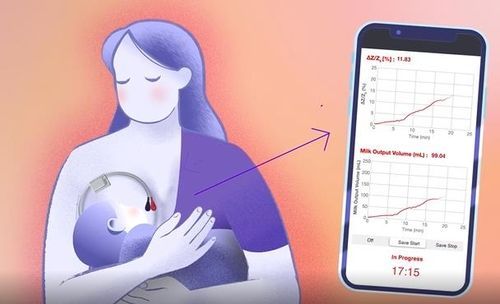 Wireless wearable sensor that can measure intake volume in real time during breastfeeding. Northwestern University
This study is the first case in which a technology for quantitatively measuring breast milk intake has been clinically verified and published in an academic journal. The research team has filed for related technology patents and expects that the device can eventually be integrated into nursing bras and similar products. Additionally, they plan to further optimize the device to provide information on changes in a mother's milk production, milk quality, and fat content.
Professor Kim said, "This newly developed sensor will be an important turning point by alleviating inconvenience and reducing uncertainty about feeding volume, providing reliable information to both mothers and medical professionals. We are currently discussing collaboration with breast pump companies." She added, "Uncertainty in breastfeeding causes anxiety and feelings of guilt for many mothers, and in some cases, leads to giving up breastfeeding altogether. By reducing maternal stress and providing clinical support for infant feeding, this technology can contribute to healthier babies, healthier mothers, and a healthier society."
© The Asia Business Daily(www.asiae.co.kr). All rights reserved.



















