U.S. Researchers Investigate Whether Wrinkles from Prolonged Water Exposure
Always Appear in the Same Pattern
"Consistent Wrinkle Patterns... Potential Forensic Applications"
A study has found that the wrinkles that form on fingers after prolonged exposure to water consistently exhibit the same pattern each time. On May 14 (local time), the American science media outlet Live Science reported that a research team led by Associate Professor Guy German of Binghamton University's Department of Biomedical Engineering published these findings in the international journal "Journal of the Mechanical Behavior of Biomedical Materials."
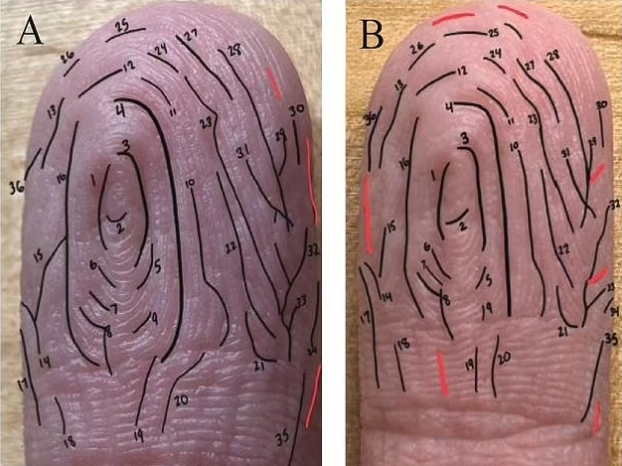 The appearance of wrinkled fingers depending on the time exposed to water. Binghamton University research team
Most people have experienced their fingertips becoming wrinkled and swollen after spending a long time in water. In the past, this phenomenon was considered to be a simple skin reaction caused by water absorption. However, previous studies have revealed that this phenomenon actually results from the autonomic nervous system. When water enters the fingers through the sweat pores due to osmosis, nerve fibers send information about the low salt concentration to the brain, and the autonomic nervous system responds by constricting blood vessels. This causes the volume of the fingers to decrease as the blood vessels contract.
Associate Professor German, who led this study, said he was asked by a student whether the wrinkles always form in the same pattern. He had previously assumed that the pattern would be consistent each time because the blood vessels that form the wrinkles do not move inside the finger, but he decided to test this hypothesis directly in response to the student's question. While previous research had investigated why fingers wrinkle, there had been little attention paid to the specific patterns of wrinkle formation.

The research team had three participants submerge their hands in water for 30 minutes and photographed the wrinkling of their fingertips. After 24 hours, they repeated the process under the same conditions and compared the photographs. The wrinkles of the participants appeared in the same pattern each time.
The research team stated, "This is the first study to definitively demonstrate that the wrinkle patterns that occur when a person's hands are submerged in water for an extended period are repeated and consistent across different time points," adding, "It shows that there is a meaningful relationship in the direction in which wrinkles form and that the wrinkle patterns remain consistent over time."
Professor German said, "It's as if biometric information and fingerprints are embedded in the brain," and expressed hope that this could be used in future forensic investigations. However, he noted that the study only included three participants, so further research involving a larger group is needed.
In addition, the reason why the shape of the fingers evolved to change after prolonged exposure to water has not yet been determined. While several studies have provided evidence that wrinkled fingers can improve the ability to grip objects in wet environments, other research has reported conflicting results, finding that wrinkled fingers do not enhance grip strength or tactile sensitivity.
© The Asia Business Daily(www.asiae.co.kr). All rights reserved.


















